Field notes
How to Launch a SaaS Product: A 30-Day Plan (With Template)
How to launch a SaaS product in 30 days: positioning, supporters, a launch kit, launching in waves, and October 2026 data on 11 launch platforms (what it took to place, and whether links were really followed), plus the first 90 days.
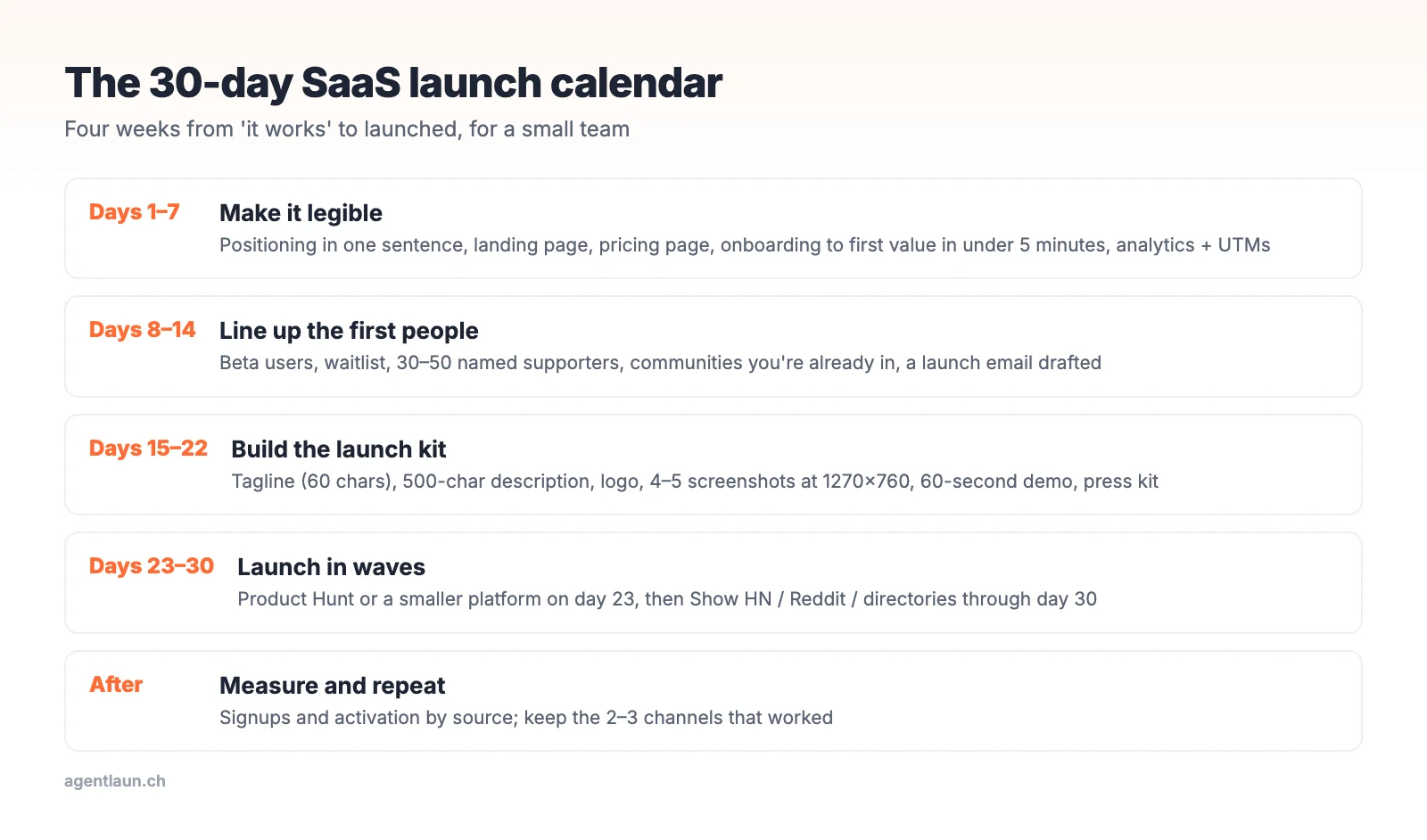
To launch a SaaS product, spend about 30 days on four things in order: make the product legible (one-sentence positioning, a landing page, onboarding that reaches value in under five minutes), line up 30–50 named people who want it, build a launch kit (tagline, screenshots, demo, descriptions), and then launch in waves: one main launch day, followed by communities and directories over the next week. Measure activated users by source, not upvotes or visits.
Below is a day-by-day calendar, a launch plan template you can copy, how to pick launch platforms, and what our catalog of 394 launch platforms and directories says about costs.
Before you start: soft launch or hard launch?
- Soft launch: open access quietly to a small group (waitlist, beta users), fix what breaks, and collect testimonials. Do this if onboarding or billing is untested.
- Hard launch: a public, dated launch across platforms. Do this once 10 people can reach value without your help.
Most small teams should soft-launch for 2–4 weeks, then hard-launch with proof. The calendar below assumes the soft launch is done or the product is already in users' hands.
Is it ready to launch? A five-question gate
Answer these honestly before you set a date. If any answer is no, fix it first, because launch traffic is one-shot.
- Can a stranger reach first value in under five minutes, without talking to you? Watch three people try.
- Does the homepage say who it's for and what it does, in one sentence? Ask someone outside your industry to repeat it back.
- Do signup, billing and cancellation work? Test each with a real card.
- Do you know where signups come from? Source tracking working on the signup form.
- Have at least 10 people used it for real? Their feedback and quotes are your launch proof.
The full version is our launch readiness scorecard.
Days 1–7: make it legible
Strangers decide in seconds. Before any launch:
- One-sentence positioning: "[Product] helps [who] [do what] without [pain]." Test it on five people outside your industry.
- Landing page: the headline says the outcome, the screenshot shows the product doing it, and the main call to action matches your signup.
- Pricing page: live and correct. Launch traffic checks pricing early.
- Onboarding: a new user reaches first value in under five minutes without a call. This is the most important item on the list. See why launch traffic doesn't convert.
- Analytics: signups and activation tracked by source, with UTM links ready for every channel.
Positioning: before and after
Most launch pages describe the category. The ones that convert describe the job:
| Before | After |
|---|---|
| AI-powered productivity platform for modern teams | Turn meeting notes into Jira tickets automatically |
| Next-gen analytics for SaaS | See which marketing channel your paying customers came from |
| The all-in-one scheduling solution | Fill cancelled clinic appointments automatically |
The real #1-of-the-day taglines on Product Hunt in September 2026 read the same way: "Search, organize and export every AI chat in one place", "Bring any AI agent into Slack, Teams & Discord". Concrete object, concrete outcome (tagline guide).
Pricing for launch
- Have a free way in: a free plan, a free trial, or a usable demo. Launch visitors won't book a call.
- Show prices publicly. Directories and review sites ask for pricing, and buyers filter on it.
- Keep the launch offer separate from list price so you can end it cleanly.
Days 8–14: line up your first people
A launch spreads through people who already care:
- Beta users and everyone on your waitlist
- Communities you're already part of (Slack, Discord, subreddits, alumni groups)
- 30–50 named supporters, each asked personally for feedback on launch day (not upvotes)
- A launch email sequence drafted
Where your first 30–50 people come from
| Source | How to ask |
|---|---|
| Beta users and waitlist | A personal email two weeks before, then on launch morning |
| People who've complained about the problem publicly | A reply or DM pointing to what you built, with no ask attached |
| Communities you're already active in | A build-story post on launch day, where self-promotion is allowed |
| Founders you've helped | A direct message asking for honest feedback |
| Your own network | Personal messages, not a blast |
Ask for feedback and comments, never upvotes. Product Hunt forbids asking for upvotes, and comments are what the top launches have more of: a median of 32 for the daily top five against 8 for everyone else.
Days 15–22: build the launch kit
One set of assets, reused everywhere:
| Asset | Spec |
|---|---|
| Tagline | ≤ 60 characters (how to write one) |
| Descriptions | 160, 500 and 1,000+ characters (guide) |
| Logo | Square PNG and SVG, 512 px |
| Screenshots | 1270 × 760 for launch galleries (Product Hunt specs) |
| Demo video | 60–90 seconds (structure) |
| Press kit | Boilerplate, bios, logos (checklist) |
Days 23–30: launch in waves
Pick one main launch day, then keep going for a week:
- Day 23, main launch: Product Hunt if you have 30+ supporters, otherwise a smaller platform like Uneed or TinyLaunch, where small audiences place well.
- Days 24–26, communities: a Show HN if it's technical and tryable, and an honest build story on Reddit.
- Days 24–30, directories and review sites: 15–30 listings, tracked in one sheet.
Launch platforms compared, with October 2026 numbers
We checked the main launch platforms in October 2026: what they cost, what it took to place, and whether the link to your site was followed on live listings.
| Platform | Cost | What it took to place | Link we saw on live listings |
|---|---|---|---|
| Product Hunt | Free | #5 of the day: median 191 upvotes; #10: about 110 | ugc |
| Uneed | Free (up to 5-month wait) or $14.99 / $29.99 | Daily podium: 77–112 | Followed on all 15 checked |
| Fazier | Free with badge, or $29 / $49 / $99 | 3rd of the day: 34–36 | Followed on all 35 recent listings |
| TinyLaunch | Free or $39 | 3rd of the week: 34 | Top 3 or Premium; older free launches nofollow |
| PeerPush | Free (queued) or $39 | Single and double digits | Followed, free and paid |
| Microlaunch | Free or $39 | Product of the Day: 8 upvotes | Followed |
| StartupBase | Free (badge, 4–5 weeks) or $39 | Daily leaders: 15–19 | Mostly nofollow unless Premium |
| Launch Llama | Free (~4 weeks) or $39 | Weekly top 5: 11–14 | nofollow until ~20 upvotes |
| DevHunt | Free or $19 | Weekly winner: 30 | Paid launches only |
| Peerlist | Free | Weekly, profile-based | nofollow ugc |
| Show HN | Free | Breakouts had 32–384 points | Followed at ~20+ points |
The pattern: Product Hunt has the audience, the small boards have the winnable rankings and most of the followed links, and a $30–$50 paid launch on one or two of them buys a date you control.
Product Hunt by the numbers
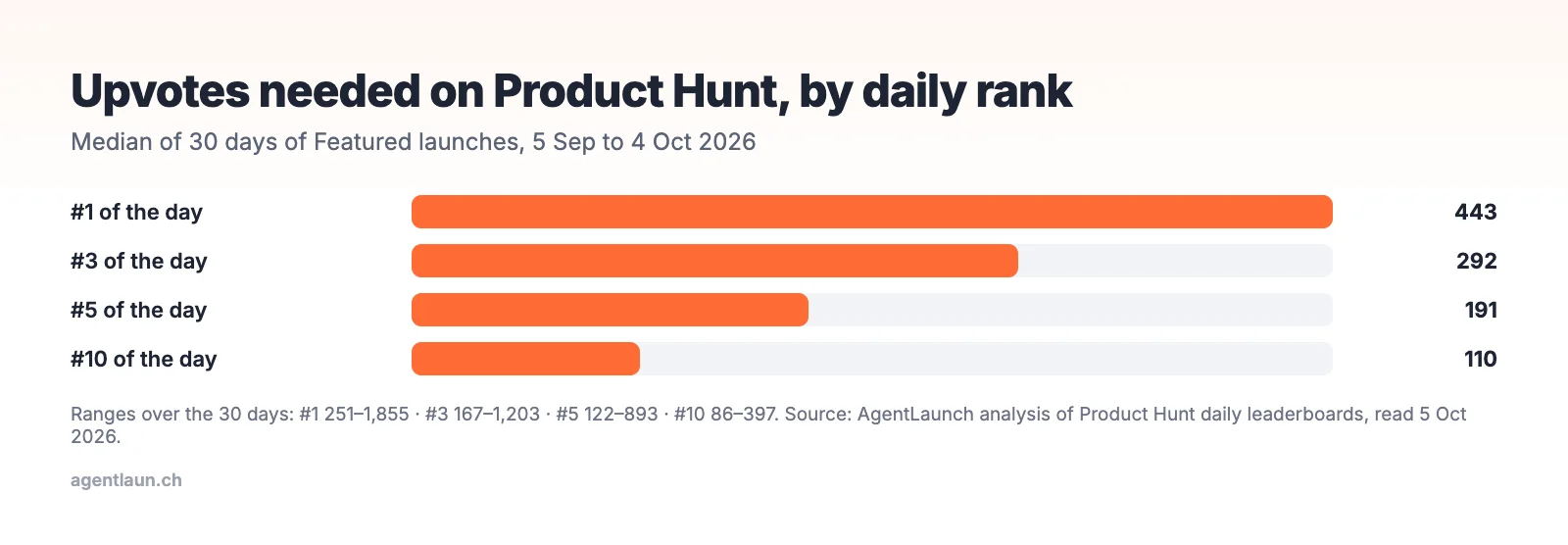
Over 30 days of Featured launches (5 September to 4 October 2026, 459 launches): #1 of the day needed a median of 443 upvotes, #5 a median of 191. The top five had a median of 32 comments, everyone else 8. Weekends needed fewer votes (#5 at about 142–150) and featured fewer products (12–13 vs 16–17). More in launching on Product Hunt without an audience.
Copy this launch plan
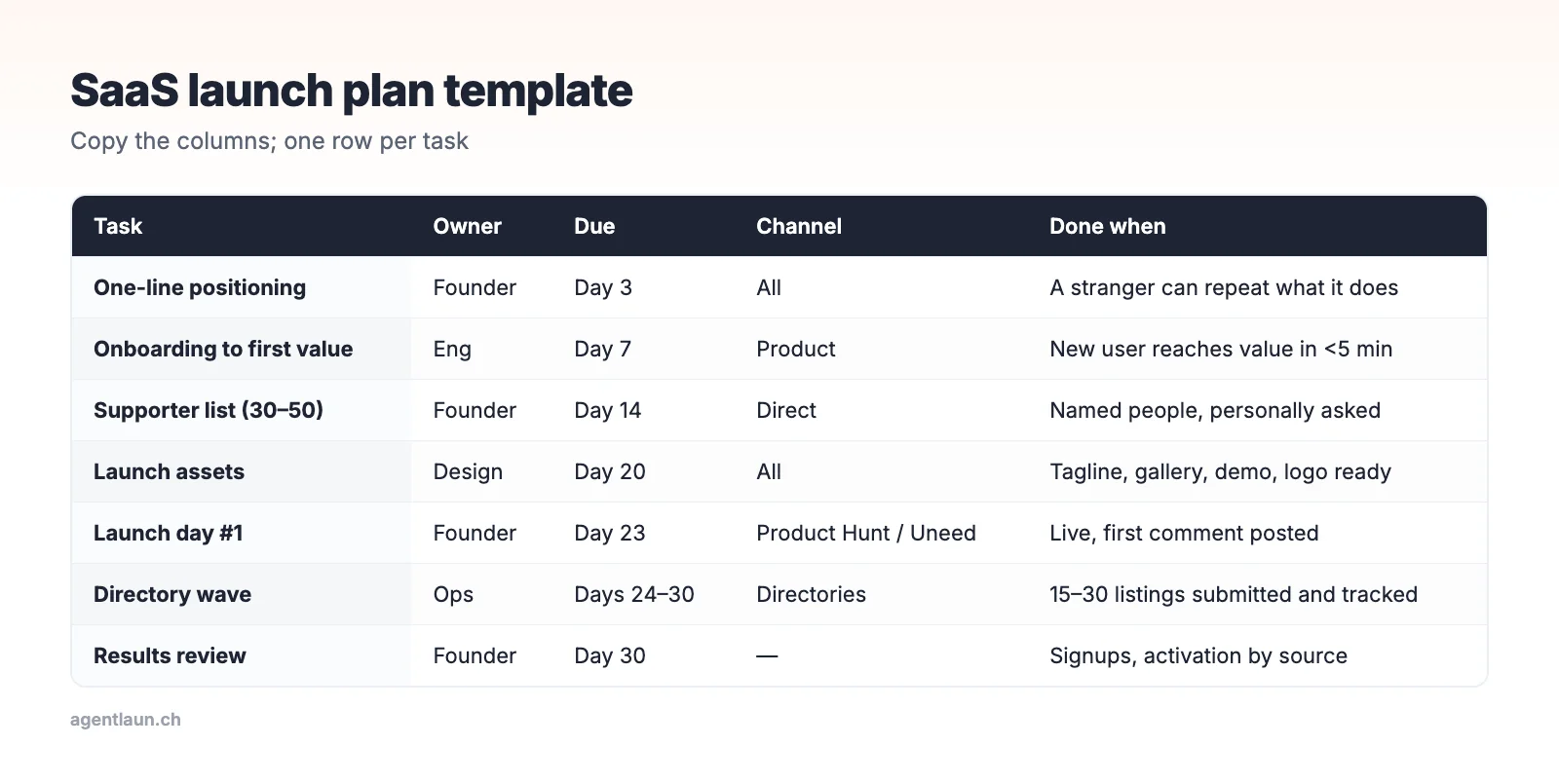
The "done when" column is the useful one. It turns "landing page" into "a stranger can repeat what it does".
What launching costs
From our catalog of 394 active launch platforms and directories (October 2026):
- 26% are completely free, and 59% have a free route with paid upgrades
- 30% of free routes require a badge or backlink on your site
- The median one-time paid listing is $24.50, and the middle half fall between $10 and $49
A full launch can cost $0 if you have time, or a few hundred dollars to buy dates and guaranteed links on the best platforms. See SaaS launch budget for three worked budgets.
Directories: how many, and which
You don't need hundreds. 15–30 well-chosen listings in the first month is plenty. Our catalog of 394 active directories breaks down like this:
| Type | Directories | Median DR | Median visits/month | Best for |
|---|---|---|---|---|
| AI tools directories | 131 | 41 | ~5,700 | AI products only |
| Launch platforms and maker communities | 120 | 50 | ~3,700 | Launch week, followed links |
| SaaS and startup directories | 50 | 43 | ~2,500 | Steady long-tail listings |
| Software review sites | 31 | 70 | ~84,000 | B2B buyers (guide) |
| Developer tools | 15 | 50 | ~43,000 | Dev tools |
| Alternatives sites | 12 | 50 | ~19,000 | "[Competitor] alternative" searches |
| Startup databases | 9 | 65 | ~139,000 | Investors and press |
| MCP and agent registries | 8 | 69 | ~214,000 | MCP servers and agent tools |
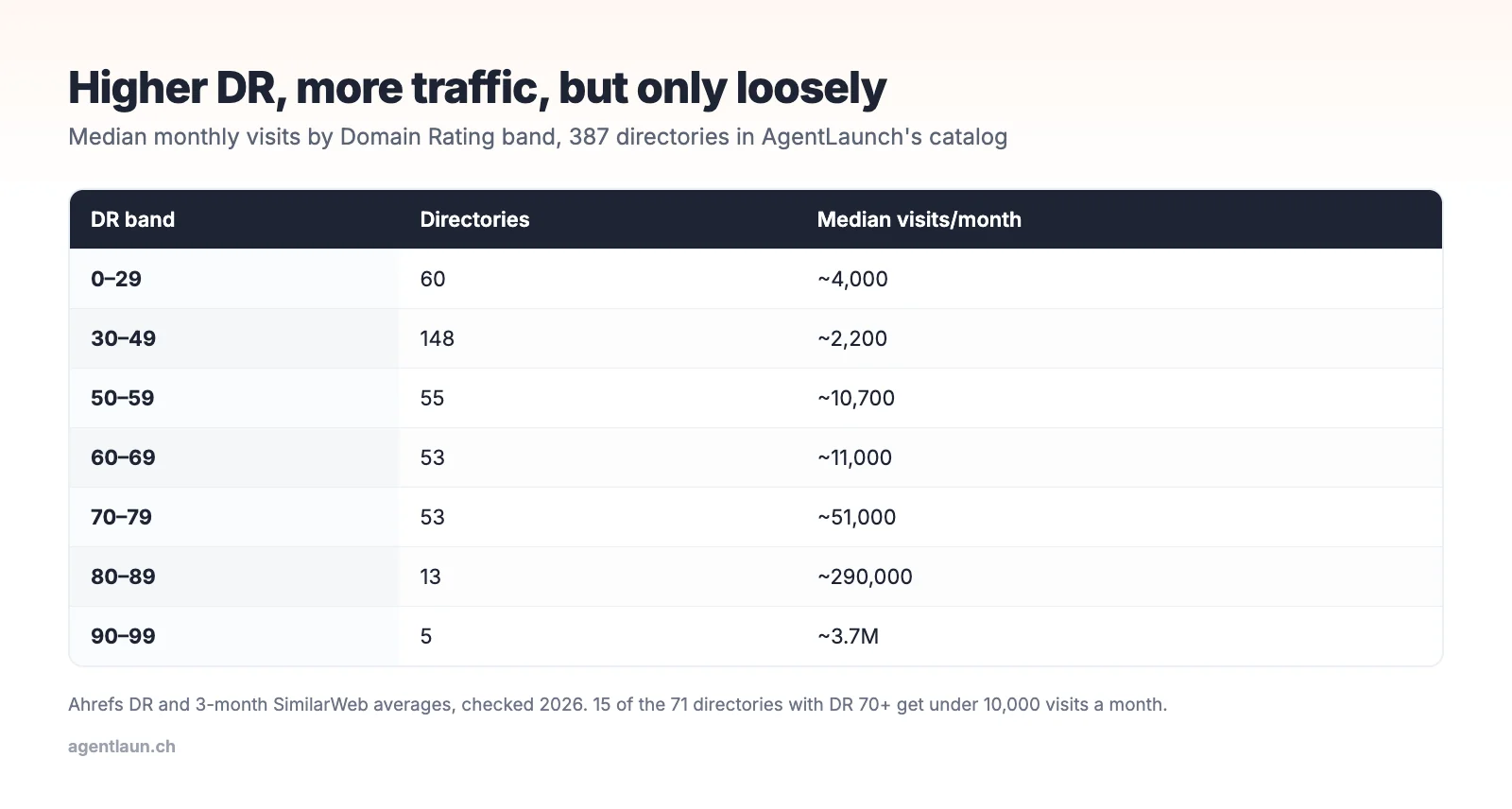
Pick by audience first, then traffic, then link type. Check each before paying (six checks), and keep one tracker (template).
Your launch offer
A reason to act today helps launch traffic convert:
- A time-limited discount (for example 30–50% off the first year for launch-week signups). Nine of the 108 directory forms we've parsed have a field for a discount code, and Product Hunt visitors look for one in the first comment.
- An extended free trial for launch traffic only.
- A lifetime deal for the first 100 customers, if your margins can carry it.
Whatever you choose, state the end date and honour it.
Launch day, hour by hour
| Time (Pacific) | What to do |
|---|---|
| 12:01 AM | Go live on your main platform. Post the first comment |
| 12:30–2:00 AM | Email and message supporters in Europe and Asia |
| 6:00–7:00 AM | Email the US list; post in your communities |
| All day | Reply to every comment within minutes; fix bugs live and say so |
| Midday | Post one update in the thread: a fix, or an answer to the most common question |
| Evening | Thank people; share the best comment on social |
| Next morning | Write personally to every new signup |
The first 90 days after launch
| When | Focus |
|---|---|
| Days 1–7 | Replies, onboarding fixes, personal emails to signups |
| Days 8–30 | Directory wave, review requests, a results post |
| Days 31–60 | Keep the 2–3 channels that produced activated users; one SEO page a month |
| Days 61–90 | Re-check links and listings; plan a second launch on smaller platforms; Product Hunt relaunch only after six months and a significant update (rules) |
SEO from listings takes time. New links have to be crawled before they count, and some launch platforms only keep the link followed for top finishers, so expect any Domain Rating change to show over weeks, not days (why DR lags).
What to measure after day 30
| Metric | Why it matters |
|---|---|
| Activated users by source | The real launch outcome |
| Signup → activation rate | Onboarding quality |
| Paid conversions within 30 days | Revenue impact |
| Feedback themes | What to build next |
| Listings live and link type | Long-term discovery and SEO |
Keep the two or three channels that produced activated users and drop the rest. Then read what to do after a launch.
Which launch platform for your main day?
| If you have… | Main launch | Why |
|---|---|---|
| 100+ engaged supporters, broad audience | Product Hunt | Biggest audience; you can compete for the daily top 5 |
| 20–50 supporters | Uneed or TinyLaunch | Smaller fields; third place took 34–77 upvotes when we checked |
| A developer tool | Show HN + DevHunt | Technical audience; DevHunt's week was won with 30 votes |
| No audience yet | Two small platforms, then Product Hunt in a month | Builds proof and supporters first (plan) |
| A B2B product with sales-led buyers | Review sites + LinkedIn + a launch platform for the links | Buyers check G2 and Capterra, not launch boards (review sites) |
An example plan for a two-person SaaS
To make the calendar concrete, here's how it might look for a scheduling tool for clinics with 15 beta users and two founders (illustrative):
- Week 1: rewrite the homepage around one outcome ("Fill cancelled appointments automatically"), add a sample clinic so new users see a filled calendar in under a minute, and set up source tracking.
- Week 2: ask all 15 beta users and 30 clinic owners from an industry group to look at the launch and comment honestly. Draft three launch emails.
- Week 3: record a 75-second demo, make five 1270 × 760 screenshots, write taglines at 60 and 160 characters.
- Week 4: launch on Uneed with Skip the line ($29.99, to pick a Tuesday), then TinyLaunch the following Monday, then 20 directories including the two healthcare-software review sites its buyers use.
Expect the launch platforms to bring most of the visits and links, and the niche directories and review sites to bring fewer visits but more buyers. Judge each by activated clinics, not clicks.
Mistakes that waste a launch
- Launching with onboarding that needs a call
- Spending launch day asking for upvotes instead of answering questions
- Treating launch day as the finish line rather than the start of the directory and community work
- Judging success by rank instead of activated users
Related
- Product launch checklist and launch readiness scorecard
- How to market a SaaS product for the months after launch
- AgentLaunch handles the directory wave: your AI agent in Claude Code, Codex or Cursor picks which of 300+ directories fit your product and fills the forms
FAQ
How long does it take to launch a SaaS product? About 30 days of preparation once the product works: a week each for positioning, supporters, assets and the launch itself.
Where should I launch a SaaS product? One main launch platform (Product Hunt or a smaller one like Uneed or TinyLaunch), then relevant communities, directories and review sites over the following week.
How much does a SaaS launch cost? It can be free. In our catalog, the median paid directory listing is $24.50 one-time, and most platforms have a free route.
What's the best day to launch a SaaS on Product Hunt? It depends on your goal. Weekdays bring more visitors; weekends need fewer upvotes for the top five (in our 30-day data, #5 needed about 142–150 on weekends vs 171–227 on weekdays).
How many directories should I submit a new SaaS to? 15–30 well-chosen ones in the first month. Pick by audience fit, then traffic, then whether the link is followed on live listings.
Do I need a hunter to launch on Product Hunt? No. Product Hunt encourages makers to post their own products and says there's no discernible advantage to a third-party hunter.