Field notes
How to Launch on TinyLaunch: Free vs Premium, Weekly Voting and the Backlink
TinyLaunch runs free weekly launches, but only the top 3 keep the dofollow link. Premium is $39 and guarantees it. The form limits, the weekly cycle, what we found on 15 live listings, and when to pay.
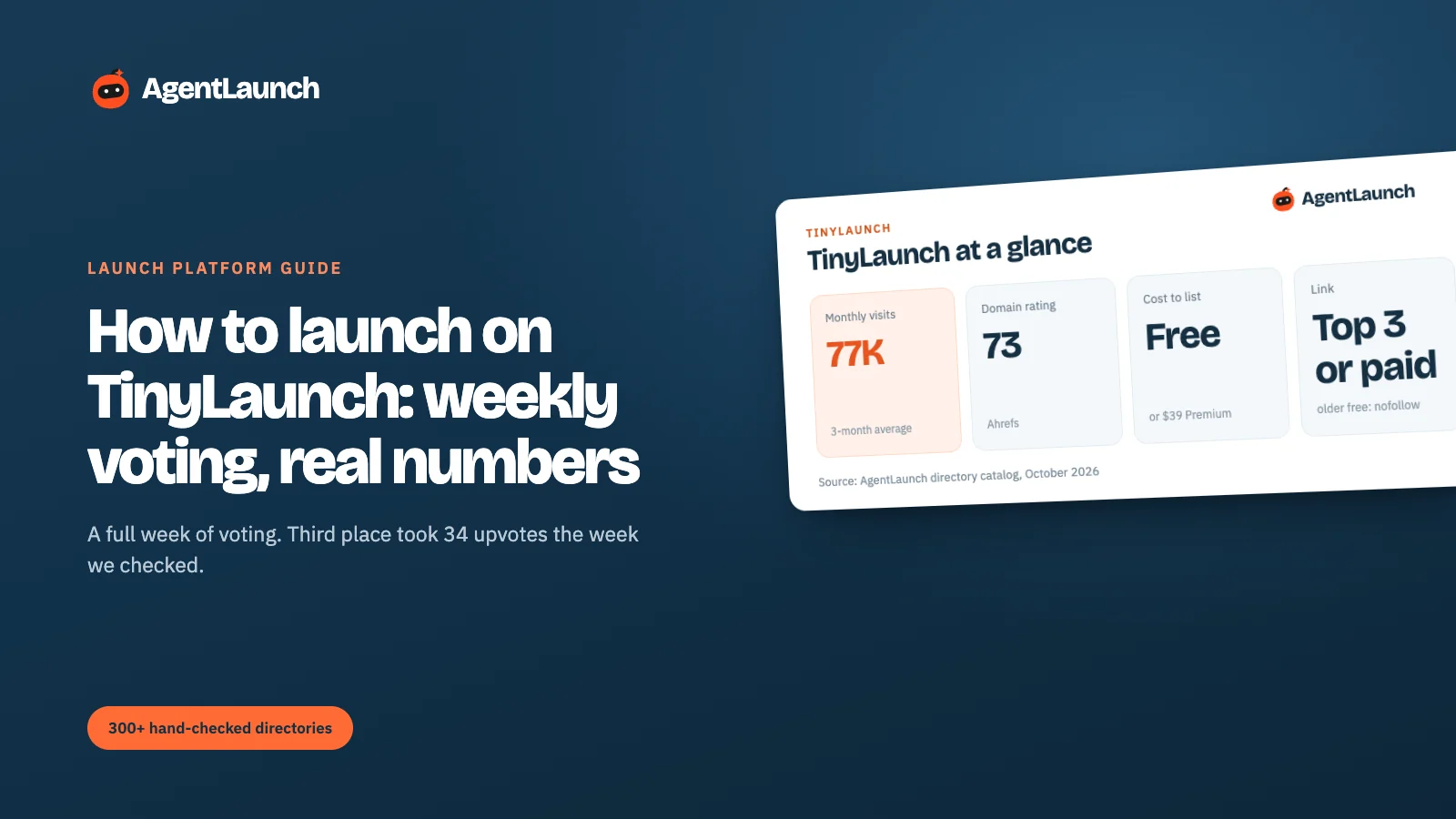
TinyLaunch is free, and it runs weekly launches rather than daily ones: a new batch goes live every Monday, and products collect upvotes for the whole week. The catch with the free Standard launch is that the badge and the dofollow backlink only go to the week's top 3. A Premium launch ($39) skips the queue and guarantees the backlink whatever your ranking.
Weekly launches make TinyLaunch one of the easier places for a solo founder to place well. At the end of the week we checked, third place had 34 upvotes. Here's how the submission works, what it takes to reach the top 3, and when $39 is worth paying, as of October 2026.
TinyLaunch at a glance
| TinyLaunch | |
|---|---|
| Submit | tinylaunch.com/submit (sign in first; the form lives at Dashboard → Startups → New) |
| Launch cycle | Weekly. A new launch period starts each Monday |
| Free option | Standard launch: homepage for several days, standard queue |
| Paid option | Premium launch $39 per launch: skips the queue, guaranteed backlink |
| Backlink | Free launches: only the weekly top 3. Premium: guaranteed |
| What we saw | 9 recent launches followed; 6 older launches nofollow (15 checked) |
| Run by | Chris, who also answers support and does the paid testing and feedback |
| Domain Rating | 73 (our Ahrefs check; TinyLaunch advertises "72+ DR") |
| Traffic | ~77,000 visits/month (3-month average, SimilarWeb) |
| Account | Required. Email sign-in with a verification link, then a short maker profile |
| Form limits | Name 30 characters, tagline 60 characters, logo required, up to 3 images |
| Time to submit | About 10 minutes including account setup |
What TinyLaunch is
TinyLaunch is a weekly launch platform for indie makers. Founders quoted on its pricing page credit Chris for support and for the paid product testing. Instead of a daily race, every product launched in a week competes on one leaderboard from Monday to Sunday. The format suits small teams: you have seven days to gather votes instead of 24 hours.
The crowd is mostly indie hackers launching developer tools, marketing tools, productivity apps and small AI products. One founder quoted on the pricing page finished #17 of 195 products in a week with no following, which gives you a sense of the field size.
TinyLaunch has grown a set of paid services around the launch: a directory submission service, weekly ad spots and a $9 "AI visibility audit" that checks whether ChatGPT-style assistants recommend your product. The launch itself is still free.
How TinyLaunch works
The weekly cycle
A new launch period opens every Monday at about 07:00 UTC (midnight Pacific). Products launched that week collect upvotes until the following Monday, when the winners are fixed and the next batch starts.
Ranking and the mid-feed slot
The homepage shows the week's leaderboard. Premium launches are "frequently showcased between 3rd and 4th place", which is the most-seen spot below the podium. The same position is also sold as a $15/week ad, so you'll often see a paid product sitting there.
Badges and the backlink
The top three each week get a winner badge and the "high authority backlink". Everyone else on the free plan gets a listing without that guarantee. Premium launches get the backlink whatever their position.
The two launch plans
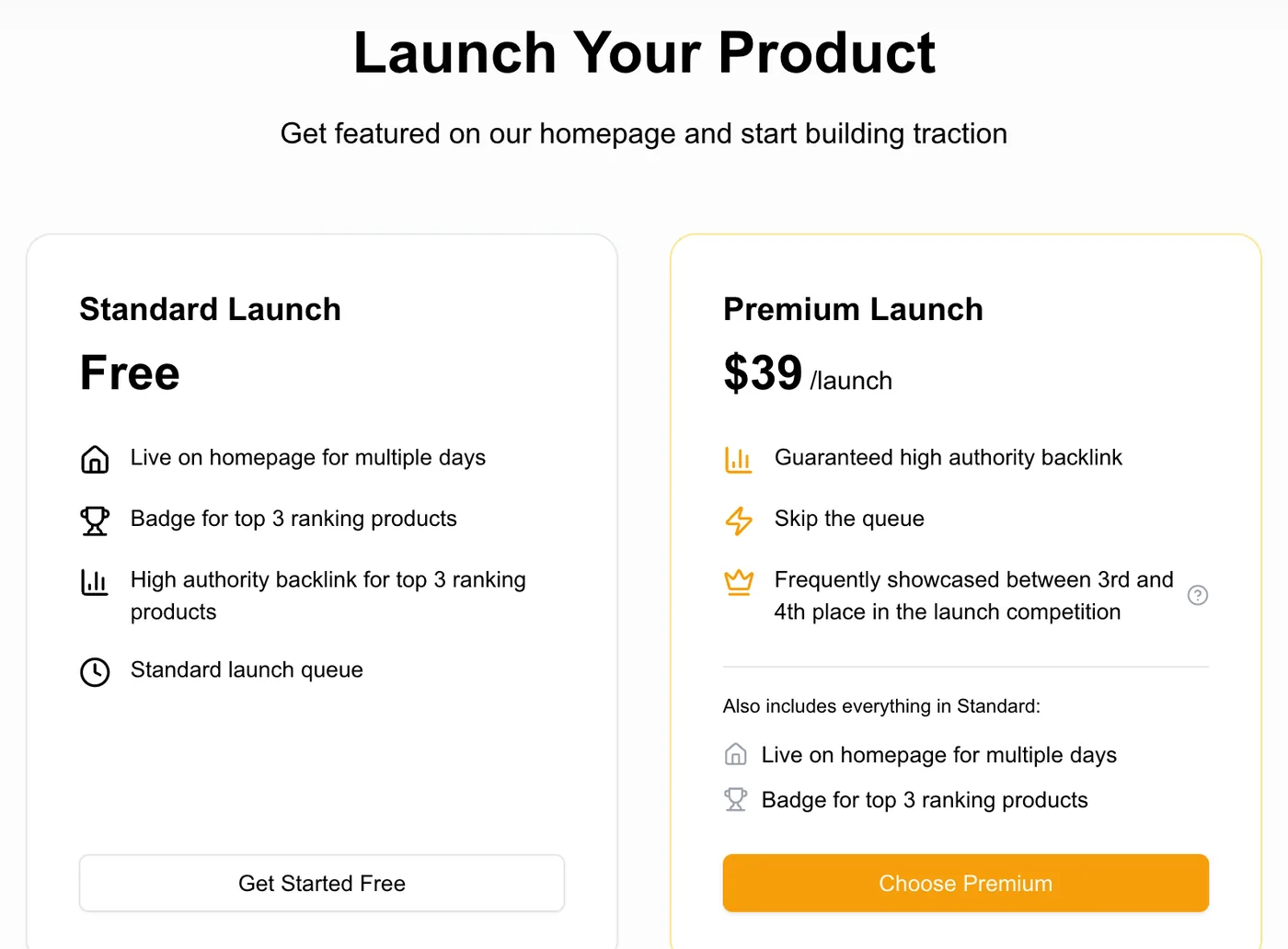
Standard launch (free). Your product sits on the homepage for multiple days, in the standard launch queue. If it finishes in the top 3 for its week, you get a winner badge and a high-authority backlink.
Premium launch ($39 per launch). Skips the queue, guarantees the backlink however you rank, and is "frequently showcased between 3rd and 4th place", so it gets a visible slot just below the podium during the week.
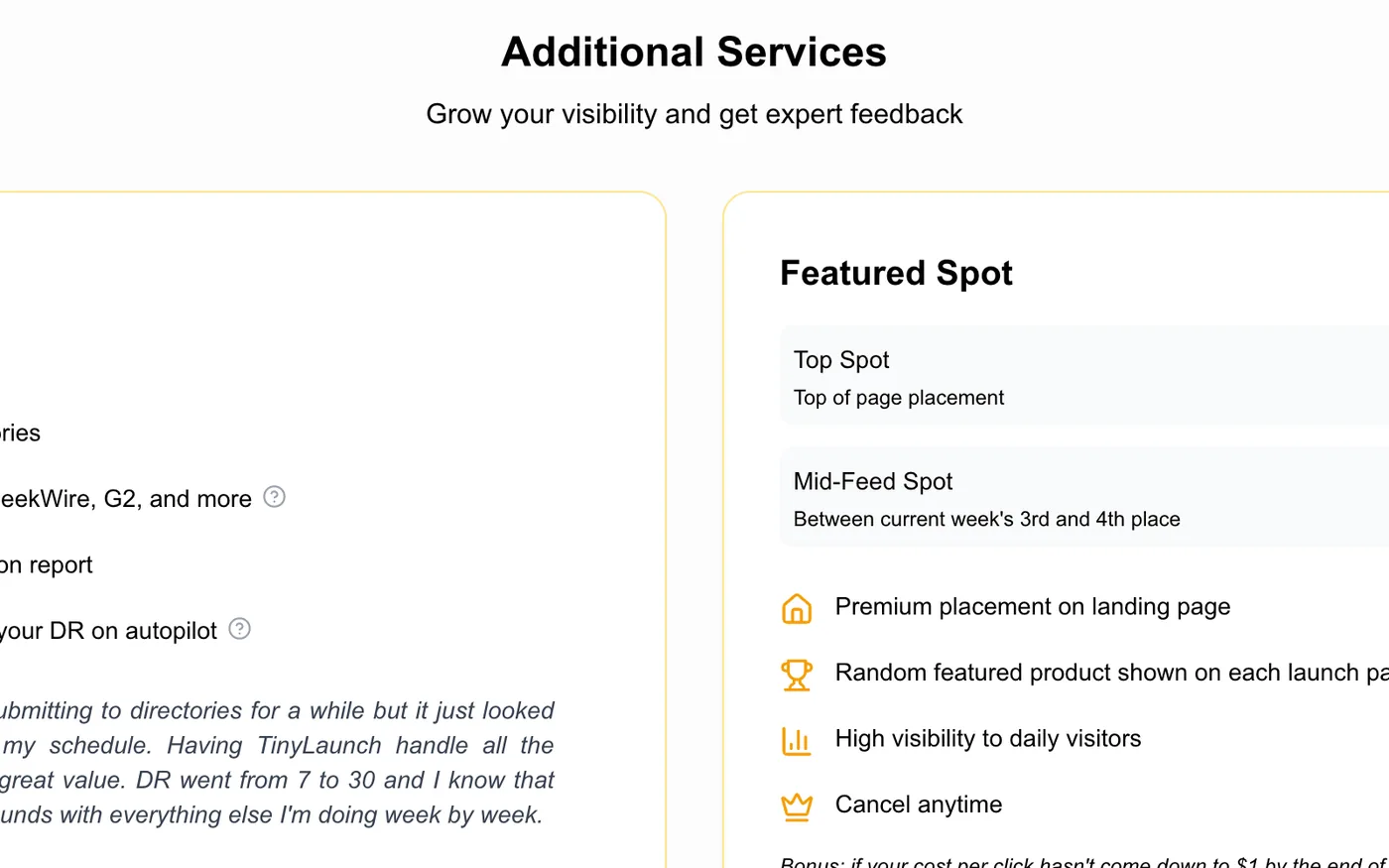
TinyLaunch also sells separate add-ons: a $279 service that submits you to 110 directories, featured placements at $30 a week (top of page) or $15 a week (between 3rd and 4th place), and a $9 "AI visibility audit". They're unrelated to the launch itself.
Step 1: sign in and set up a maker profile
Click Submit Product. TinyLaunch asks you to sign in and emails a verification link. Click it and you land in a dashboard. Before you can create a startup, it asks for a short Maker Profile (your name and a handle). That profile is shown next to your product in the launch list ("by Max · @its_xlab"), so use the name people know you by on X or LinkedIn.
The dashboard also tracks your analytics, upvotes, domain rating, streaks and badges, which is useful after launch.
Step 2: create the startup
From Startups → New, fill in "Create New Startup". These are the fields we saw:
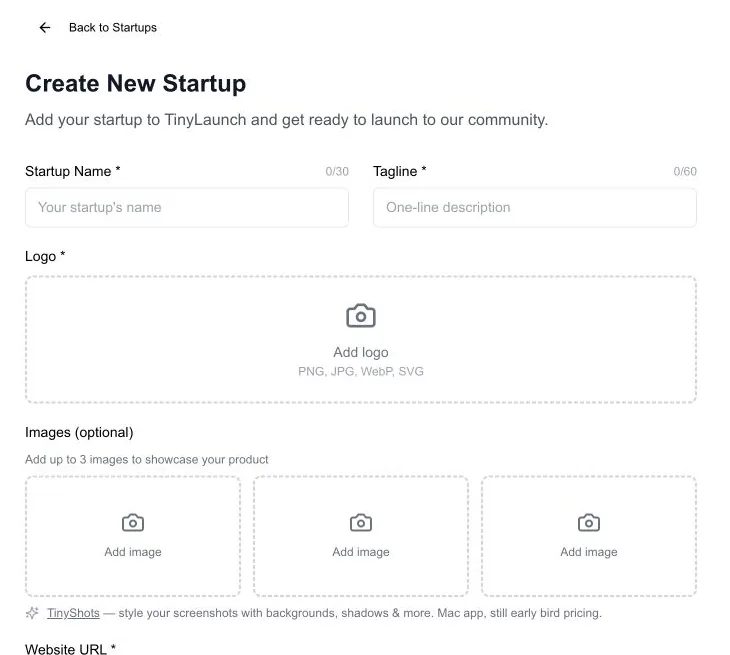
- Startup Name* (max 30 characters).
- Tagline* (max 60 characters). This is the one line shown in every list, so make it count. The top three in our capture used "The AI-powered Git platform for modern software teams", "Turn Reddit users into customers" and "The database that feels like a notebook". Notice how short the last two are.
- Logo* in PNG, JPG, WebP or SVG. You can't save the startup without one.
- Images (optional, up to 3). Use real product screenshots. The first one does most of the work on your product page.
- Website URL*, followed by the rest of the product details further down the form.
Creating the startup saves it as a draft in your dashboard. Launching is a separate step, which is where you choose Standard or Premium.
For writing the tagline and description, our guide to writing a SaaS directory description has a structure that fits a 60-character limit.
Step 3: launch, and what the week looks like
The homepage "Launching Now" section shows the current week's podium and a countdown to the next launch period. When we captured it early on Monday 5 October (UTC), the countdown pointed to about 07:00 UTC, which is midnight Pacific time.
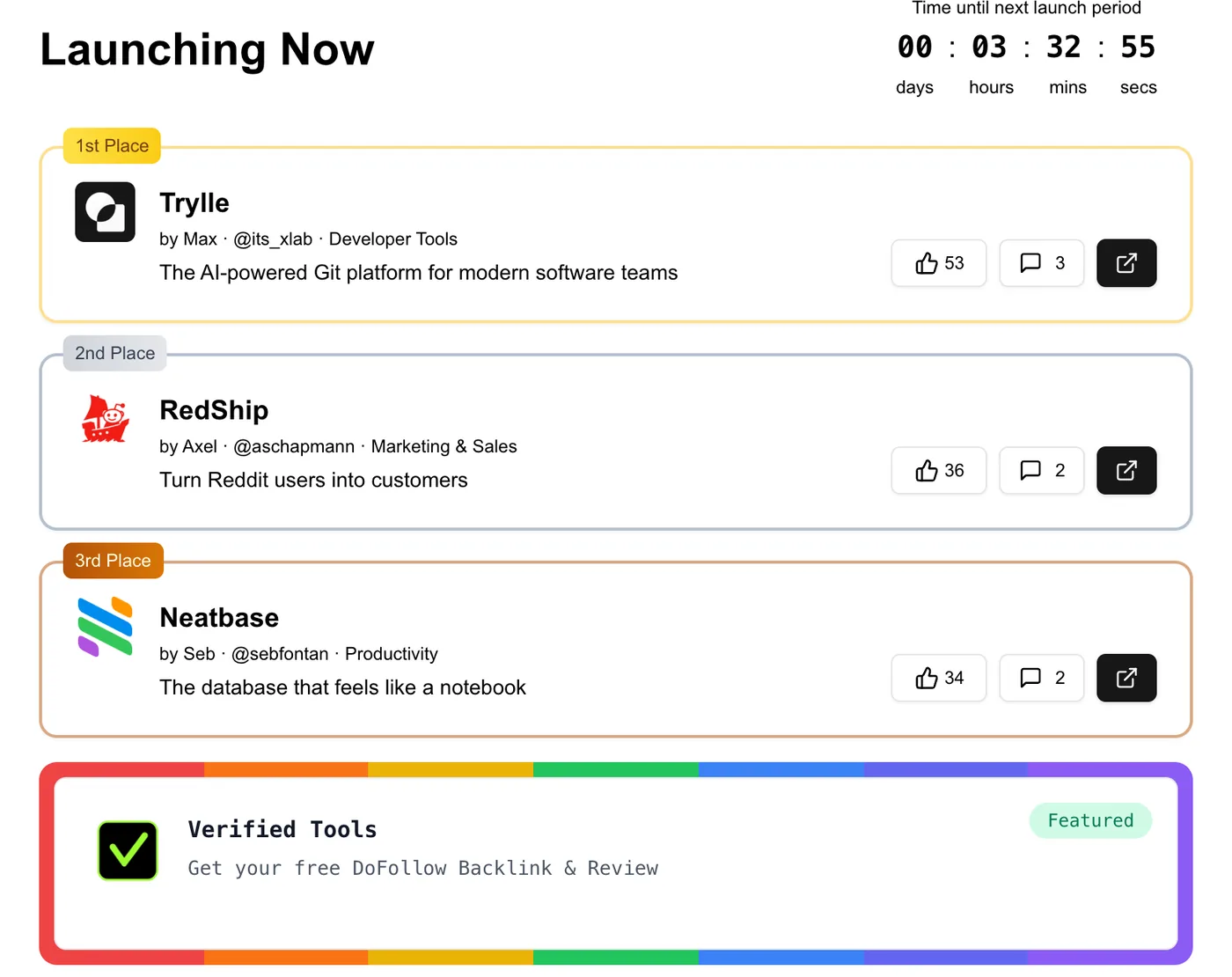
That capture shows end-of-week numbers: 53 upvotes for first place, 36 for second and 34 for third. Products are tagged with a category ("Developer Tools", "Marketing & Sales", "Productivity"), and each card links straight to the product site.
Because the window is a full week, you don't need everyone to show up in a 24-hour burst, as you would on Product Hunt. A realistic plan for the free top 3:
- Monday: launch, then send the TinyLaunch link to 10–15 existing users and friends who'd use the product.
- Tuesday to Wednesday: post a short build story on X or LinkedIn tagging @TinyLaunch. TinyLaunch's audience is mostly indie makers, so "what I built and why" lands better than a feature list.
- Thursday to Sunday: reply to every comment and post a second update mid-week. Steady votes through the week beat one spike.
One founder quoted on TinyLaunch's pricing page reached #17 of 195 products in a week with zero existing following. Without any audience of your own, expect a mid-table finish. With 30–40 real supporters, the podium is realistic.
What we found on 15 live listings
We opened 15 launch pages linked from TinyLaunch's homepage on 5 October 2026 and inspected the main product link ("Open product page").
| Launch IDs | Listings | Main link |
|---|---|---|
| 22328 to 24041 (recent weeks) | 9 | Followed (rel="noopener") |
| 12591 to 21286 (older weeks) | 6 | nofollow noopener |
The split lines up with TinyLaunch's rules: products from recent weeks were still followed, and older free launches that didn't place had been switched to nofollow. In other words, a free launch outside the top 3 should expect its link to lose value once its week is over. Premium and podium finishes keep it.
Check your own link a week after launch: open your listing, inspect the product link, and look for nofollow in rel.
Is Premium worth $39?
- Pay for Premium if the backlink is the main goal and you can't count on 35-plus upvotes. You get a guaranteed dofollow link from a 73-DR domain, skip the queue, and a visible slot just below the podium all week.
- Stay on Standard if you have an engaged audience and are happy to compete. Winning the week also earns a badge, which is worth more than a paid slot as social proof on your landing page.
For the backlink alone, $39 is reasonable. Our view is that TinyLaunch's weekly format gives free launches a better shot than most daily platforms, so try Standard first if you're launching on several platforms in the same month.
Pros and cons
Pros
- A full week to collect votes, not 24 hours.
- Reachable podium: 34 to 53 votes took the top three in the week we captured.
- A $39 one-time Premium with a guaranteed link from a 73 DR domain.
- A useful maker dashboard: analytics, upvotes, DR and badges.
Cons
- Free launches keep the followed link only if they place top 3.
- Strict field limits (30-character name, 60-character tagline).
- The mid-feed slot is shared with paid ads.
- Lots of paid add-ons around the free launch.
Common mistakes on TinyLaunch
- Writing a tagline over 60 characters. The form cuts you off. Write it to fit before you start.
- Front-loading every vote on Monday. A steady stream through the week keeps you visible, and late-week momentum matters.
- Forgetting the maker profile. Your handle shows next to the product. A blank or odd handle looks like a throwaway account.
- Launching in the same week as a big Product Hunt push. Your supporters can only be asked so many times.
- Not adding the winner badge. If you place, it's free, legitimate social proof.
TinyLaunch vs similar launch boards
Figures from AgentLaunch's catalog checks (DR via Ahrefs, visits as a 3-month SimilarWeb average).
| Directory | DR | Visits/month | Format | Paid option | Guaranteed link |
|---|---|---|---|---|---|
| TinyLaunch | 73 | ~77,000 | Weekly | $39 Premium | Premium or top 3 |
| Uneed | 76 | ~173,000 | Daily | $14.99 / $29.99 | Skip the line |
| Fazier | 83 | ~87,000 | Daily | $29 / $49 / $99 | Premium and Super |
| MicroLaunch | 64 | ~93,000 | Monthly | Premium launch | See guide |
| PeerPush | 75 | ~55,000 | Daily | Paid plans | See guide |
| Launch Llama | 72 | ~9,500 | Weekly | $39 / $99 a month | No, upvote-gated |
After launch
- Tag your submitted URL (
?utm_source=tinylaunch&utm_medium=launch) so signups show up separately in analytics. See how to measure directory referral traffic. - If you placed, add the winner badge to your site. It's legitimate social proof.
- Check the link on your product page with your browser's inspector, and look for
nofolloworugcin therelattribute. Track your Domain Rating with our free DR checker.
Where TinyLaunch fits
Because TinyLaunch runs all week, it pairs well with daily boards on separate days. For the full comparison, see sites like Product Hunt. If you're working through dozens of these, AgentLaunch stores each directory's form limits and link type, and your AI agent in Claude Code, Codex or Cursor fills the forms, handing sign-in codes and payments back to you.
FAQ
Is TinyLaunch free? Yes. Standard launches are free. Premium launches cost $39 and guarantee the backlink.
Does TinyLaunch give a dofollow backlink?
Yes, to the weekly top 3 on the free plan, and to every Premium launch. Older free launches we checked that didn't place had nofollow links.
How long does a TinyLaunch launch last? A full week. A new launch period starts every Monday, and your product stays on the homepage for multiple days.
How many upvotes do you need to win on TinyLaunch? In the week we captured, first place had 53 upvotes and third had 34. Weeks vary, but 35–55 upvotes is the range to aim for.
What are TinyLaunch's character limits? Startup name: 30 characters. Tagline: 60 characters.
When does TinyLaunch reset? Every Monday at about 07:00 UTC, which is midnight Pacific.
Is TinyLaunch worth it? The free launch is worth doing if you can rally 35 or more supporters over a week. Premium at $39 is worth it if you mainly want the link.