Field notes
How to launch on Product Hunt: a practical checklist for 2026
What to prepare, when to launch, what to do on the day, and how to turn one Product Hunt day into a two-week launch across other platforms.
Launching on Product Hunt is free and takes about an hour of setup. Launching well takes a couple of weeks of preparation and a day where you do nothing else. Here's a practical checklist.
1. Decide if and when to launch
Before choosing Product Hunt as a channel, run through the software product launch checklist to assign owners and check the product, support and recovery paths.
- Launch when people can use the product. A waitlist launch gets a fraction of the interest. If you're not there yet, start on BetaList.
- Pick a day you can give entirely to it. You'll be answering comments from morning until late night.
- Weekdays get more traffic and more competition. Weekends are quieter on both counts. A small product can do better on a quieter day.
- Product Hunt's day starts at 12:01 a.m. Pacific time. Launches go live then and run for 24 hours.
Not sure it's worth it at all? Read is Product Hunt worth it in 2026.
2. Prepare your launch page
Prepare the Product Hunt image gallery as a sequence that explains the product clearly on small screens.
The Product Hunt tagline guide shows how to fit the product’s job and distinction into the current field limit.
Product Hunt asks for:
- Name and tagline. The tagline is short (60 characters). Say what it does: "Turn meeting notes into tasks", not "Work, reimagined".
- Description. A few sentences: the problem, who it's for, what's different.
- Thumbnail. A square image or GIF that reads at small sizes.
- Gallery. Screenshots or short videos showing the product doing its job. Product Hunt recommends 1270 × 760 px.
- Links, topics and pricing. Pick topics your users browse.
- Maker comment. A short, personal note: why you built it, who it's for, and an honest ask for feedback.
Schedule the launch in advance from Product Hunt's launch page, so it goes live at 12:01 a.m. PT without you staying up.
3. Line up your people, without begging for votes
Draft a useful maker first comment that explains the problem, what you built and the feedback you want.
If you do not have an existing launch audience, use the no-audience Product Hunt plan to prepare honest outreach and a learning goal.
- Tell your users, newsletter and communities that you're launching and where to find it.
- Don't ask for upvotes. Product Hunt discourages it and can penalize launches that do. Ask people to check it out and leave honest feedback instead.
- Prepare replies to the obvious questions: pricing, privacy, how you differ from the main competitor.
Share the launch for discussion, not votes
Product Hunt allows you to share a direct link with people who may care about the product. The useful request is an invitation to look at it, try it, ask a question, or leave feedback. It is not a request for a guaranteed upvote. Product Hunt’s sharing guidance specifically warns against mass messages asking for upvotes, incentives, and coordinated voting.
Use a short, specific note: explain what the product does, who it is for, and what kind of feedback would help. Send it to people for whom the problem is relevant, through channels where you already have a relationship. Do not buy votes, create accounts for supporters, run a voting ring, or offer a discount or gift in exchange for an upvote. Product Hunt says people should vote because they find a product useful or interesting; its vote-manipulation guidance says pressure or incentives can cause a launch to drop in rank or leave the homepage.
A simple test is whether the message still makes sense if the reader never votes. If it does not, rewrite it around discovery and feedback. Measure replies, product questions, trials and useful conversations alongside any ranking change. Those signals tell you more about whether the launch reached the right people, and they do not turn your audience into a coordinated engagement campaign.
If you use a launch service, verify what it does
Some launch services help with positioning, assets or scheduling. Others sell the promise of votes, a ranking or homepage placement. Treat the second kind as a serious warning sign. Product Hunt’s removal guidance lists manipulation, incentivized upvotes, incomplete launches, suspicious profiles and duplicate products among reasons a post may be removed. Its sharing guidance also rules out mass messages asking people to upvote, rewards for votes and coordinated voting.
Before you pay anyone, ask for a written answer to these questions:
- Are they providing research, copy and creative assets, or will they post the product too?
- Which account owns the post, and will you keep control of the personal Product Hunt account and recovery methods?
- Will they ever request your password, one-time code or a supporter’s login? Do not hand over credentials or let a vendor create accounts for an engagement campaign.
- What is included in the fee: a draft, a scheduled post, a public URL, comment support, or a report? What is explicitly excluded?
- Do they promise votes, a rank, featuring or traffic? A reputable provider can describe its work; it cannot guarantee Product Hunt’s editorial or ranking decisions.
- What happens if the product is not ready, the post needs correction, or Product Hunt rejects or removes it?
Product Hunt says personal accounts are required to post, and that makers can post their own products without a Hunter. Keep the final product facts, links, pricing, maker identity and publish decision under the maker’s review. A service can reduce preparation work, but the public submission should remain accurate, transparent and based on genuine interest.
If the sales pitch is mainly “we will get you votes,” “we guarantee the top spot,” or “we use a private voting network,” stop and walk away. The risk is not only wasted money: artificial activity can damage the post and the account. Pay for a clearly defined preparation or support deliverable, and record the public URL and the work that was delivered.
4. On launch day
- Post your maker comment as soon as you're live.
- Reply to every comment, quickly and specifically. It's the single most useful thing you can do on the day.
- Share the launch on your own channels, once in the morning and once later on.
- Watch your signup flow. A launch is a stress test. Fix what breaks.
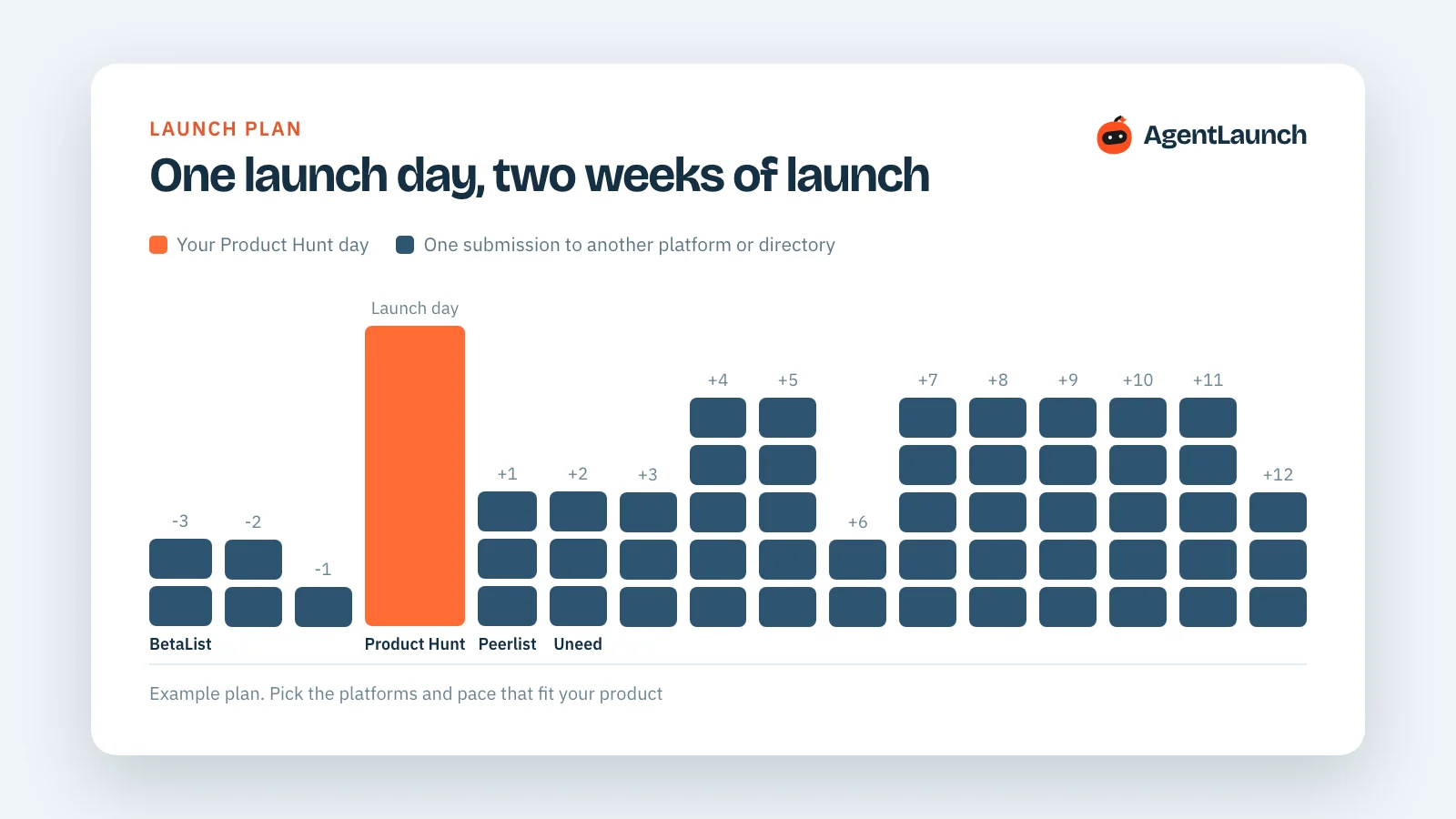
5. Turn one day into a two-week launch
A later Product Hunt relaunch is a separate eligibility decision; significant changes and current platform rules matter more than wanting another launch-day spike.
Use the first-week Product Hunt follow-up plan to turn questions, product friction and visitor behavior into next actions.
A Product Hunt day brings a spike, then quiet. Spread the rest of your launch around it:
- Before: BetaList and a couple of smaller launch platforms.
- The same week: the other big launch platforms like Peerlist and Uneed, on different days. See sites like Product Hunt, ranked by traffic.
- The next two weeks: SaaS, AI and startup directories that fit your product, spread over the fortnight. See best startup directories.
Where AgentLaunch fits
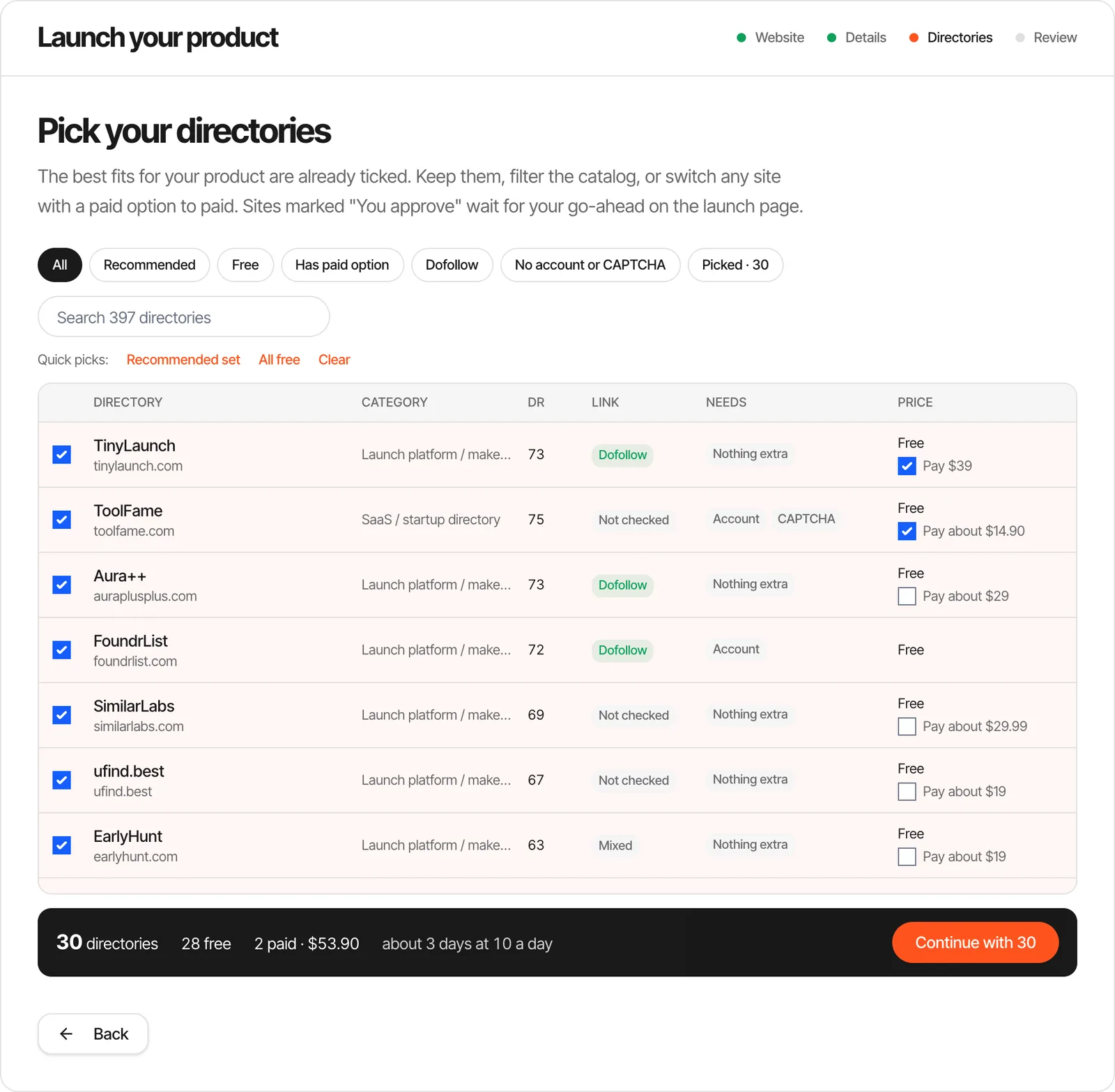
Your Product Hunt day is yours to run. AgentLaunch handles the other two weeks. It's a directory-submission kit you open in Claude Code, Codex or Cursor: your agent picks the launch platforms and directories that fit your product, writes copy for each one and fills the forms in a real browser. On major platforms like Product Hunt, it fills the details and leaves the final launch to you.
Frequently asked questions
How do I submit my product to Product Hunt?
Create a Product Hunt account, open the launch page, fill in your name, tagline, description, thumbnail, gallery and links, then schedule or launch.
When should I launch on Product Hunt?
When people can use the product, on a day you can dedicate to it. Launches start at 12:01 a.m. Pacific time.
Can I launch on Product Hunt for free?
Yes. Launching is free. Product Hunt also sells promotion placements, priced on request.
Do I need a hunter to launch on Product Hunt?
No. Makers can launch their own products.
Related guides
- Is Product Hunt worth it in 2026?
- Sites like Product Hunt, ranked by real traffic
- Is BetaList worth it? Cost and wait times
- Automated directory submission tools compared
See all 119 launch platforms in the AgentLaunch catalog, or get the $149 Self-Host License.