Field notes
Why SaaS Launch Traffic Doesn't Convert (and How to Fix It)
Why SaaS launch traffic doesn't convert: who launch visitors actually are (mostly makers, not buyers), how to find where they drop, fixes by symptom, time to value, and a seven-day fix plan.
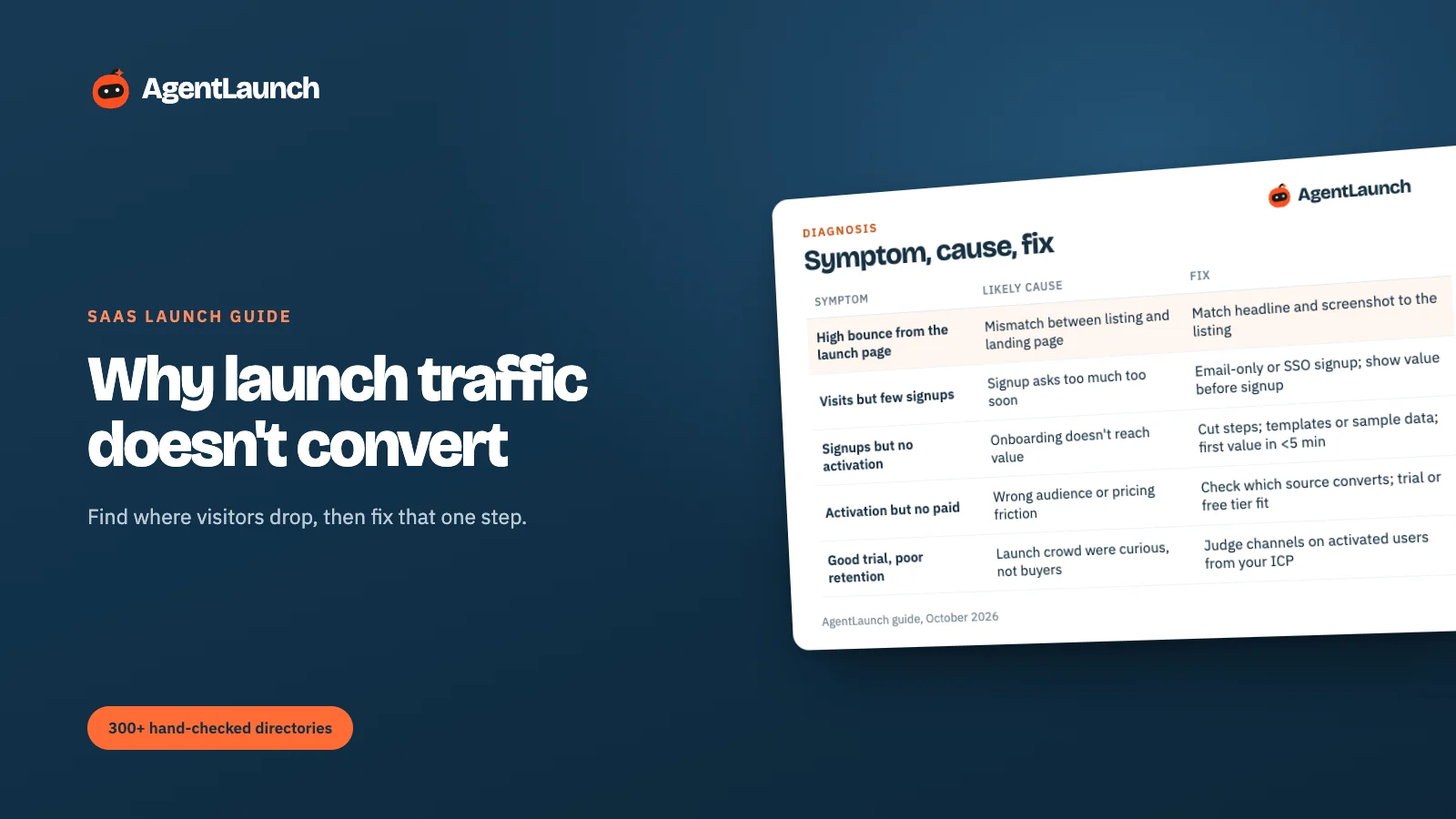
SaaS launch traffic often doesn't convert because launch visitors are curious, not committed, and the product makes them work too hard before they see value. The usual culprits, in order: the landing page doesn't match the listing they clicked, sign-up asks too much too soon, and onboarding doesn't reach first value in under five minutes. Sometimes the traffic simply isn't your buyer. Find the step where people drop, fix that one step, and judge launch channels by activated users from your target customer, not visits.
Here's how to diagnose it step by step, and what to fix at each stage.
Who your launch traffic is
Launch platforms send a specific crowd, and it's mostly not your buyers:
- Makers and founders browsing for ideas. On Product Hunt, 64% of top-five launches over 30 days in September–October 2026 were tagged Artificial Intelligence and 37% Developer Tools. The audience is people who build these things.
- Other launchers. On small launch boards, many visitors are founders checking the competition on their own launch day.
- Curious clickers from newsletters. They click on a headline and leave if the first screen doesn't explain itself.
That's why launch traffic often shows high visits, low signups and lower activation. It isn't a broken funnel so much as the wrong visitors for a sales funnel. Expect conversion from launch platforms to be a fraction of what you get from search or referrals, and judge each source on its own numbers.
| Source | Typical visitor | What converts them |
|---|---|---|
| Product Hunt, launch boards | Makers, early adopters | A tryable product with no signup wall, a clear "start here" |
| Directories | People comparing tools in a category | Pricing on the page, comparison against the tool they know |
| Review sites | Buyers building a shortlist | Reviews, security info, a demo or trial |
| Hacker News | Developers | Docs, a repo, honest technical detail |
| Reddit threads | People with the problem | A direct answer, then your product as one option |
Step 1: find where people drop
Set up a simple funnel by source (UTM or referrer):
| Step | Healthy sign | Where to look |
|---|---|---|
| Visit → engaged (scroll, click) | Most visitors don't bounce in under 10 s | Analytics engagement by source |
| Engaged → sign-up | Sign-up rate comparable to your other channels | Sign-up events by utm_source |
| Sign-up → activated | A clear share reach the "aha" action | Product events: first report, first integration… |
| Activated → paid | Converts within the trial window | Billing data by first-touch source |
If you haven't tagged launch links, start now (UTM setup).
Fix by symptom
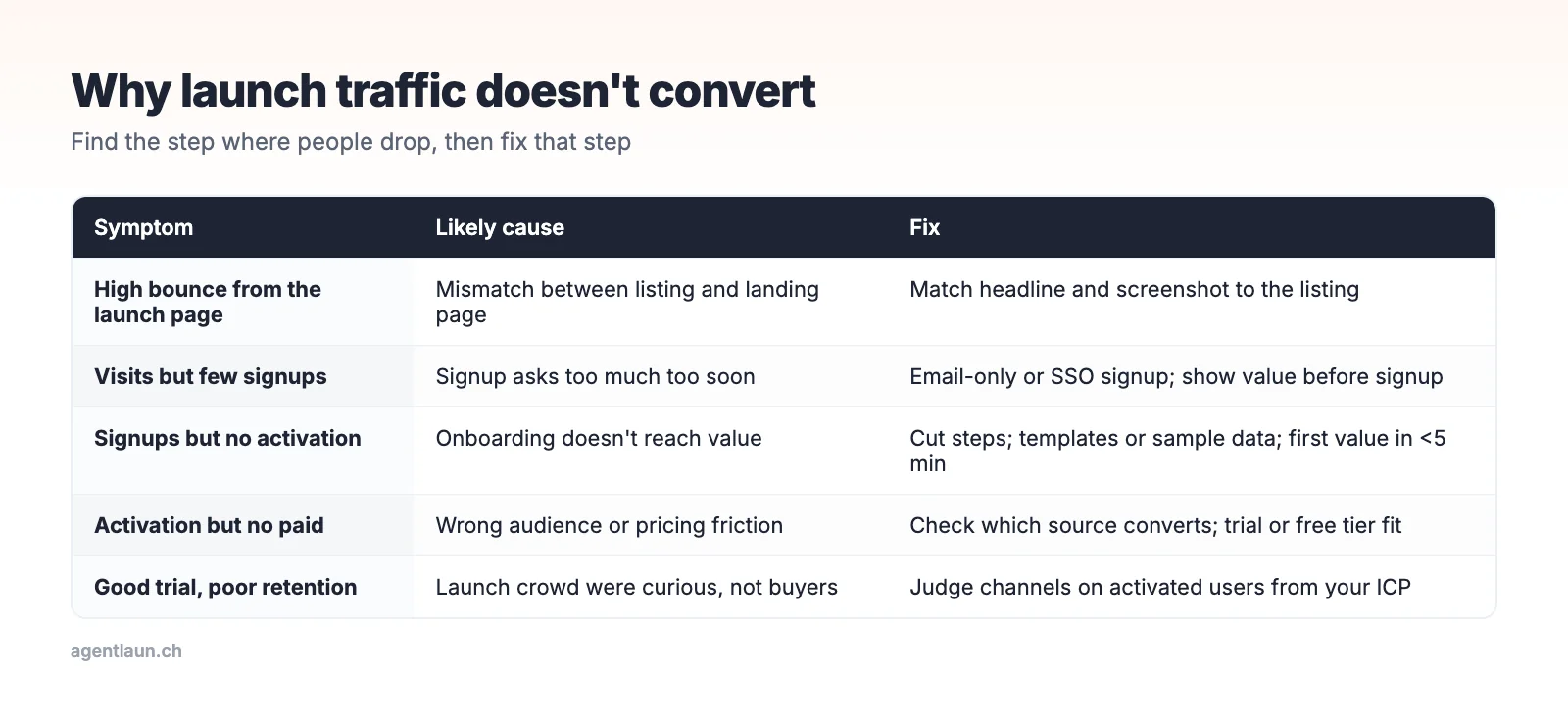
High bounce: the page doesn't match the promise. Someone clicked a tagline on a launch platform and landed on a page with a different headline and no product screenshot. Match the listing: same words, same screenshot, above the fold.
Visits but few sign-ups: too much friction.
- Email-only or Google/GitHub sign-up
- No credit card for trials, unless that's deliberate
- Show the product (a demo, sample output, an interactive preview) before asking for an account
Sign-ups but no activation: onboarding doesn't reach value. This is the most common and most expensive problem.
- Time a new user from sign-up to first value. Over five minutes is too slow for launch traffic.
- Pre-fill with templates or sample data
- Cut optional setup steps and defer them
- Send a personal email within an hour of sign-up (templates)
Activation but no paid: wrong audience or pricing friction. Launch platforms skew towards founders and early adopters who love trying things and rarely buy. Compare activation-to-paid by source. If one platform's users never pay, it's an audience mismatch, not a product failure.
Good trial, poor retention. The launch crowd liked the novelty. Judge retention on users from your ideal customer profile only.
Is it the traffic or the product?
Look at conversion by source. If organic search and referrals convert well but launch traffic doesn't, the product is fine and the launch audience isn't your buyer. Keep the launch for links, feedback and social proof, and put acquisition effort elsewhere. If nothing converts, fix onboarding first.
Before the next launch
Run the readiness scorecard. Time to value under five minutes is the item that most improves launch conversion.
The biggest lever: time to value
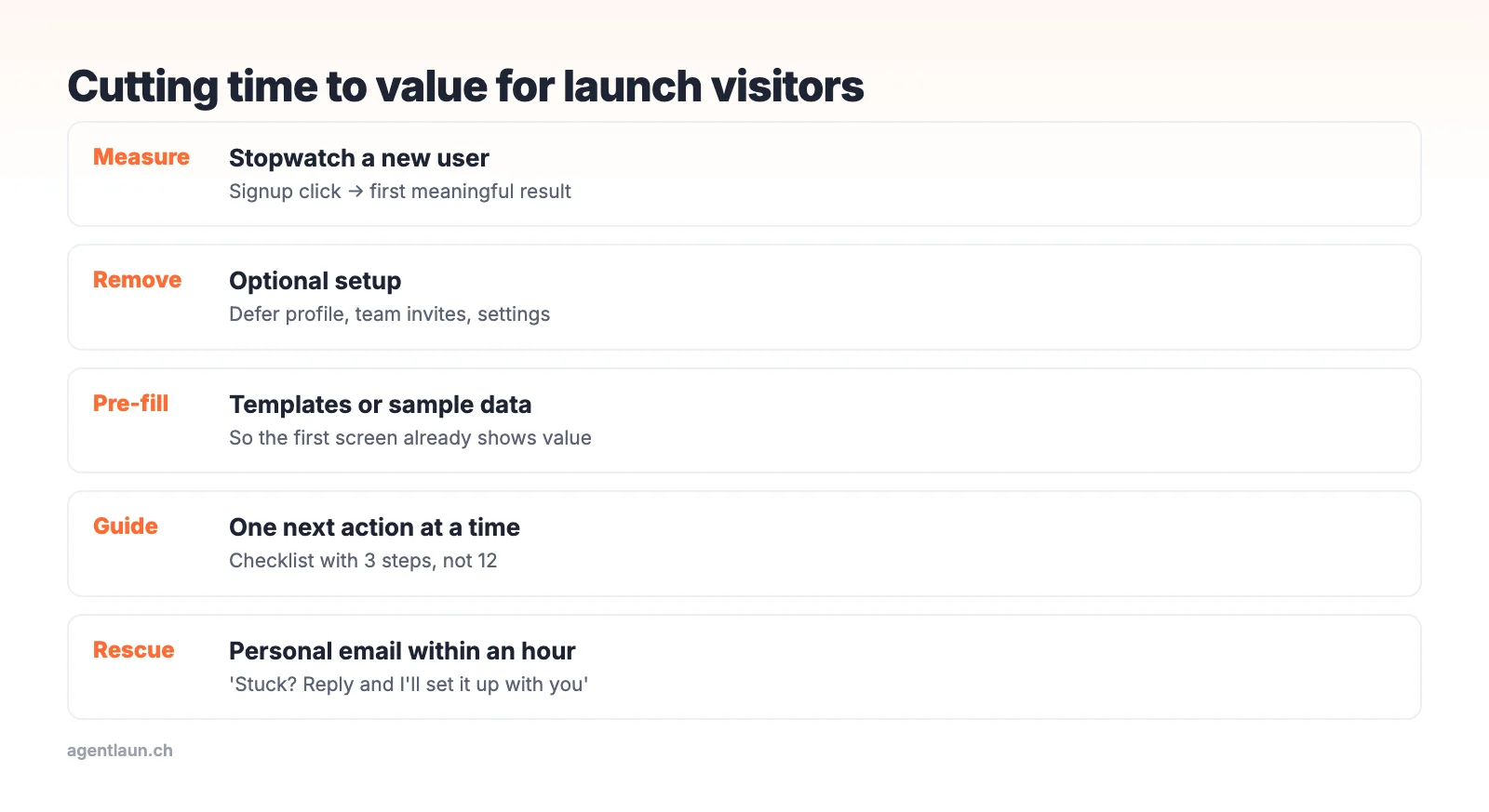
If you only fix one thing, fix this. Launch visitors give you a few minutes at most. Every optional step before the first meaningful result (profile setup, inviting teammates, connecting three integrations) is a place where curious visitors leave. Defer those steps until after the user has seen value.
A worked example
A reporting tool launched on two platforms in the same week:
| Source | Visits | Sign-ups | Activated |
|---|---|---|---|
| Launch platform A | 900 | 60 | 6 |
| Directory B | 120 | 14 | 7 |
(Illustrative.) Platform A looks like the winner on visits. But only 10% of its sign-ups activated, against 50% from Directory B. The fix wasn't more launch traffic. It was onboarding: the team added a sample report so new users saw a finished result in under a minute, and activation from the next launch roughly doubled. Directory B's audience (agency owners) also turned out to be the real buyer, so that's where the team put its listing effort.
Fix it in seven days
- Day 1: pull signups and activations by source for launch week. Separate launch-platform traffic using the
refparameters they add (how). - Day 2: watch five session recordings from launch traffic. Note where they stop.
- Day 3: cut one step from signup (drop a field, add Google sign-in, or allow trying without an account).
- Day 4: make the first screen after signup do one useful thing with sample data.
- Day 5: email every launch signup who didn't activate, personally, asking what stopped them.
- Day 6: rewrite the hero to say who it's for and the job it does, in the words commenters used.
- Day 7: compare activation for new signups against launch week. Keep what moved it.
Related
- What to do after a Product Hunt launch
- How to market a SaaS product
- Demo video structure: show value before sign-up
FAQ
Why doesn't my Product Hunt traffic convert? Launch visitors are curious, many are founders rather than buyers, and slow onboarding loses them. Fix time to value and judge the channel by activated users.
What is a good conversion rate for launch traffic? It varies widely. Compare against your other channels, and look at activation by source rather than one blended rate.
How do I improve SaaS onboarding for launch traffic? Get to first value in under five minutes with templates or sample data, and defer optional setup.
Why do Product Hunt visitors not sign up? Many are makers and founders browsing, not buyers. Over 30 days, 64% of Product Hunt's top-five launches were AI products and 37% developer tools, which says a lot about who browses. A tryable product without a signup wall converts them best.
What's a normal conversion rate for launch traffic? Lower than search or referral traffic, because most visitors aren't in the market. Compare each source against itself over time rather than against a benchmark.