Field notes
How to Launch on Product Hunt Without an Audience
How to launch on Product Hunt with no audience: four weeks of groundwork, 30–50 real supporters, launch-day routine, and 30 days of leaderboard data on what each rank takes (#5 needed a median of 191 upvotes; weekends need fewer).
You can launch on Product Hunt without an audience, but you need to borrow one first. Spend 3–4 weeks being active on Product Hunt itself, collect 30–50 people who want the product, schedule the launch up to a month ahead so people can follow it, and on launch day ask for feedback and comments, never upvotes (Product Hunt doesn't allow asking for upvotes). Then stay in the thread for the full 24 hours.
Realistically, a no-audience launch rarely wins Product of the Day. It can still bring your first 50–200 users and real feedback, and the smaller launch platforms reward small audiences far more. Here's the plan.
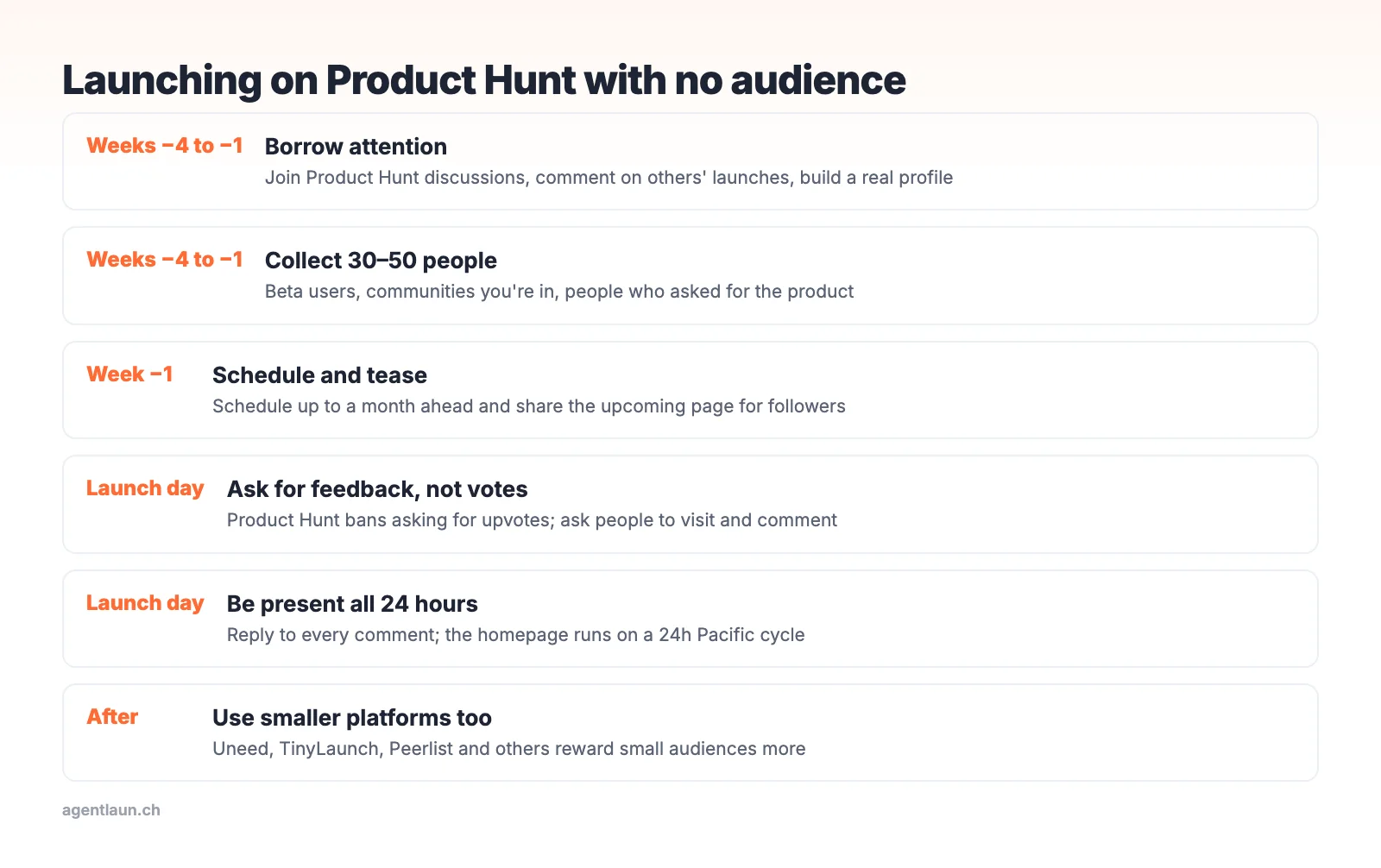
Four weeks before: become a member
- Make a real personal profile. Product Hunt prohibits company accounts, so launch from your own.
- Comment on other launches in your category with useful feedback. Makers notice, and many will visit your launch when it's your turn.
- Join Product Hunt's forums and answer questions in your area.
This isn't gaming anything. It's how people on Product Hunt get to know you.
Find your first 30–50 people
You don't have an audience, but you have people:
- Beta users and anyone who's emailed you about the product
- Communities you're already in (Slack and Discord groups, subreddits, alumni networks)
- People who've publicly complained about the problem you solve (search X, Reddit and forums)
- Founders you've helped, who'll happily return the favour with genuine feedback
Ask each one personally: "I'm launching on Product Hunt on [date]. Would you check it out and leave honest feedback?"
One to four weeks before: schedule and tease
Product Hunt lets you schedule a launch up to a month in advance and recommends using that time to tease it and collect followers. Share the upcoming page with your 30–50 people so they can follow it. Followers get notified at launch.
Prepare the assets: a 60-character tagline, at least two 1270 × 760 gallery images and a first comment.
Launch day
- Launch at 12:01 AM Pacific unless you have a reason not to. The homepage runs on a 24-hour Pacific cycle, so this gives you the full day.
- Send personal messages, not blasts: "We're live. I'd love your honest take in the comments." No upvote requests: it's against Product Hunt's rules, and it shows in the comments when people do it.
- Reply to every comment within minutes, all day. Active threads get noticed.
- Post in your communities with the story, not a vote ask.
What to expect
With 30–50 engaged supporters, a typical no-audience launch lands mid-pack on the day, below the ~110 upvotes the #10 product usually gets (see the numbers below). That still means a few hundred visitors from Product Hunt's homepage and daily email, honest feedback, and a page that ranks for your product's name. The "Visit website" link Product Hunt gives you carries rel="ugc" and an automatic ?ref=producthunt tag, so it's an audience channel more than an SEO link.
What it takes to place
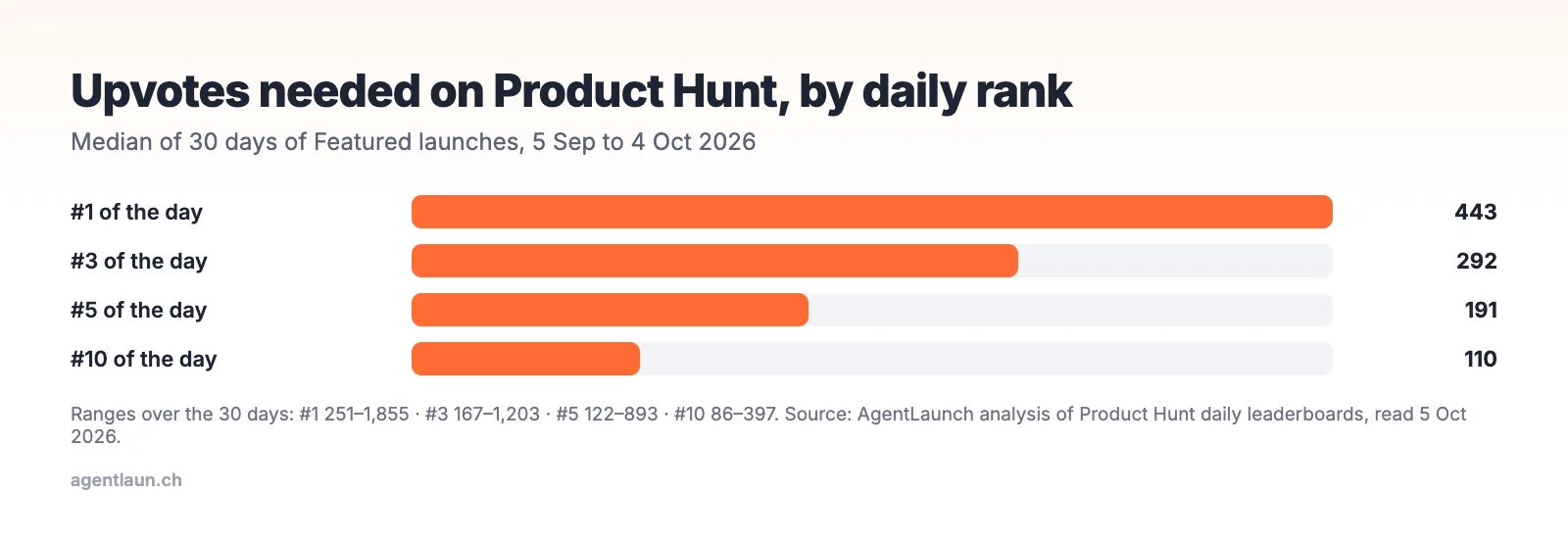
We read 30 days of Product Hunt's daily leaderboards (5 September to 4 October 2026, 459 Featured launches) to put numbers on "mid-pack":
| Daily rank | Median upvotes | Lowest | Highest |
|---|---|---|---|
| #1 | 443 | 251 | 1,855 |
| #3 | 292 | 167 | 1,203 |
| #5 | 191 | 122 | 893 |
| #10 | 110 | 86 | 397 |
With 30–50 supporters you won't win the day, but the bottom of the top 10 (around 90 to 110 upvotes) is within reach if your supporters bring a few of their own and the homepage picks you up.
Comments matter as much as votes. The top five each day had a median of 32 comments. Everyone else had 8. A launch where 30 people leave real, specific comments looks very different from one with 150 silent upvotes.
Launch on a weekend if you're small
The same data shows weekends are easier:
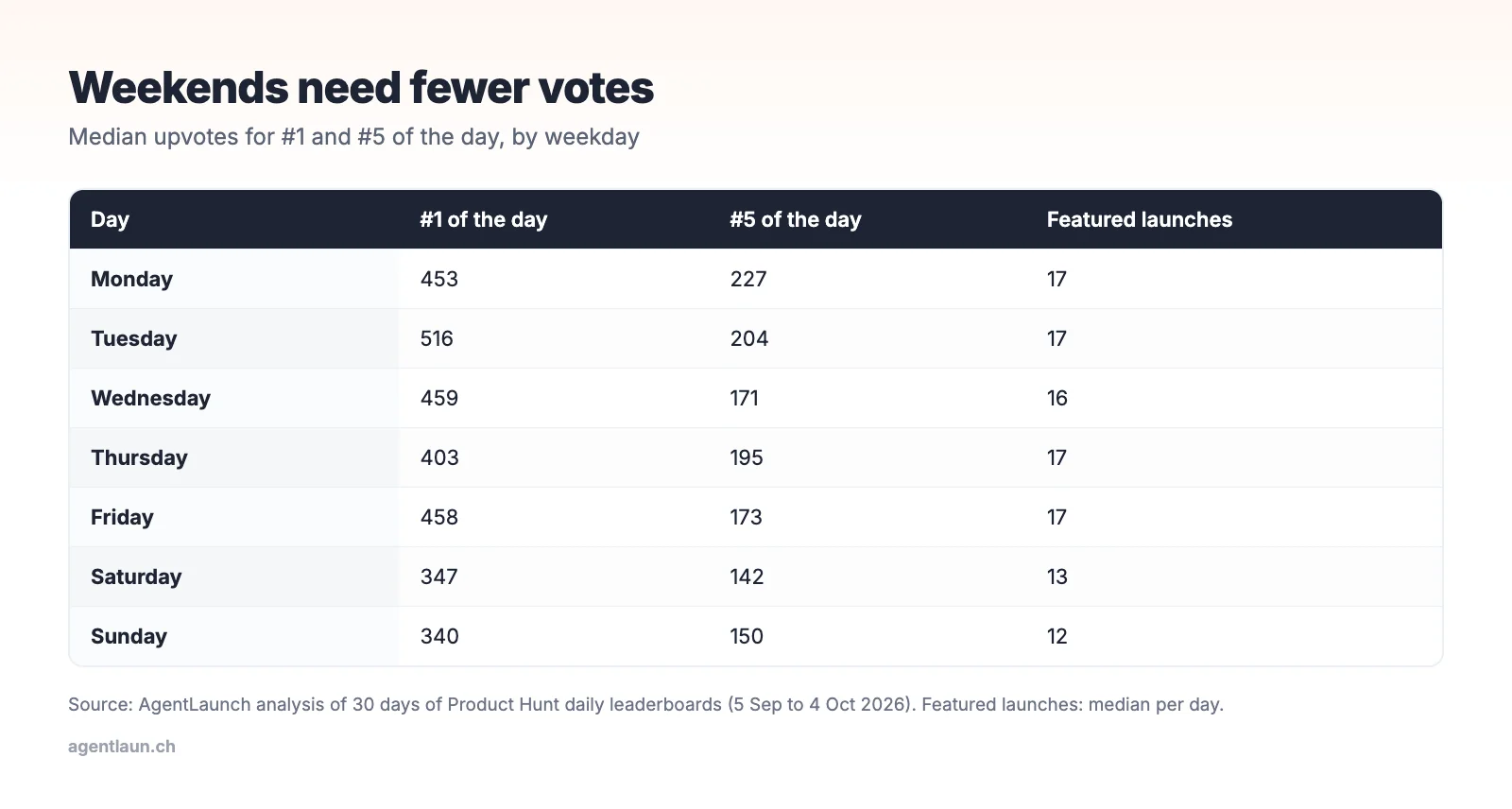
On Saturdays and Sundays, #5 needed a median of 142 and 150 upvotes, against 171 to 227 on weekdays, and only 12–13 products were featured instead of 16–17. Fewer visitors come on weekends, but if your goal is a top-five badge and a calmer thread, a weekend launch is the smart bet with a small audience.
Featured vs All
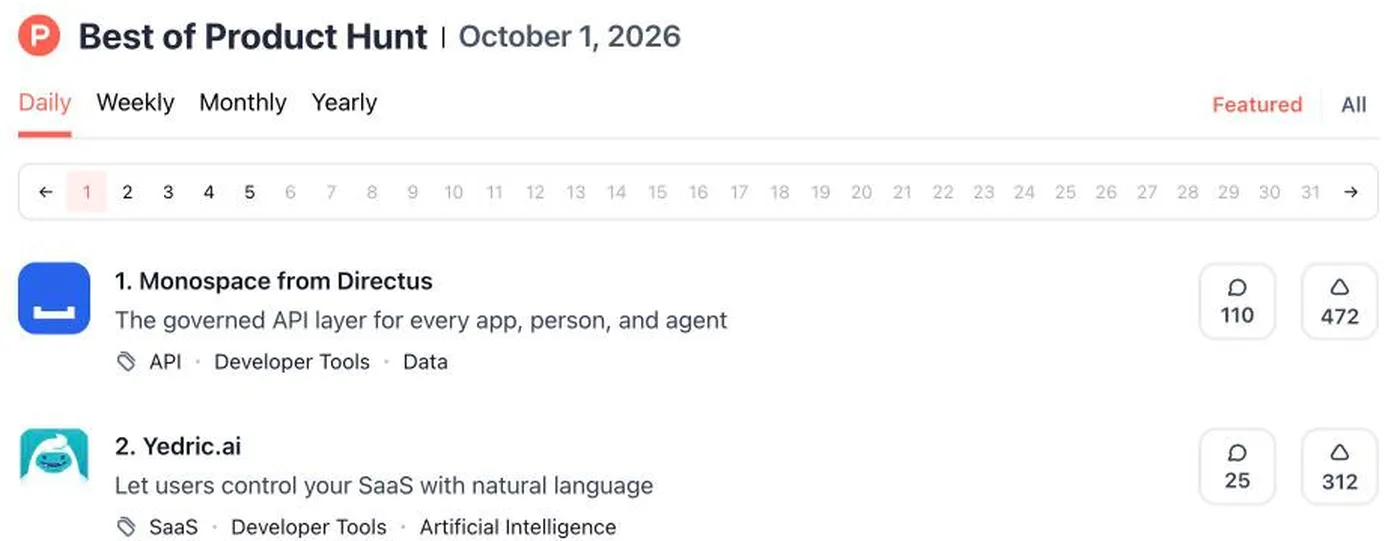
Product Hunt's homepage shows Featured launches by default. Everything else is only under All. Featured status isn't guaranteed, and Product Hunt doesn't publish its criteria. What helps: a clear tagline, a real product that people can try, a maker profile with history, and early comments that show genuine interest.
Where small audiences win
Some launch platforms favour small audiences more than Product Hunt does:
| Platform | Why it suits a small audience |
|---|---|
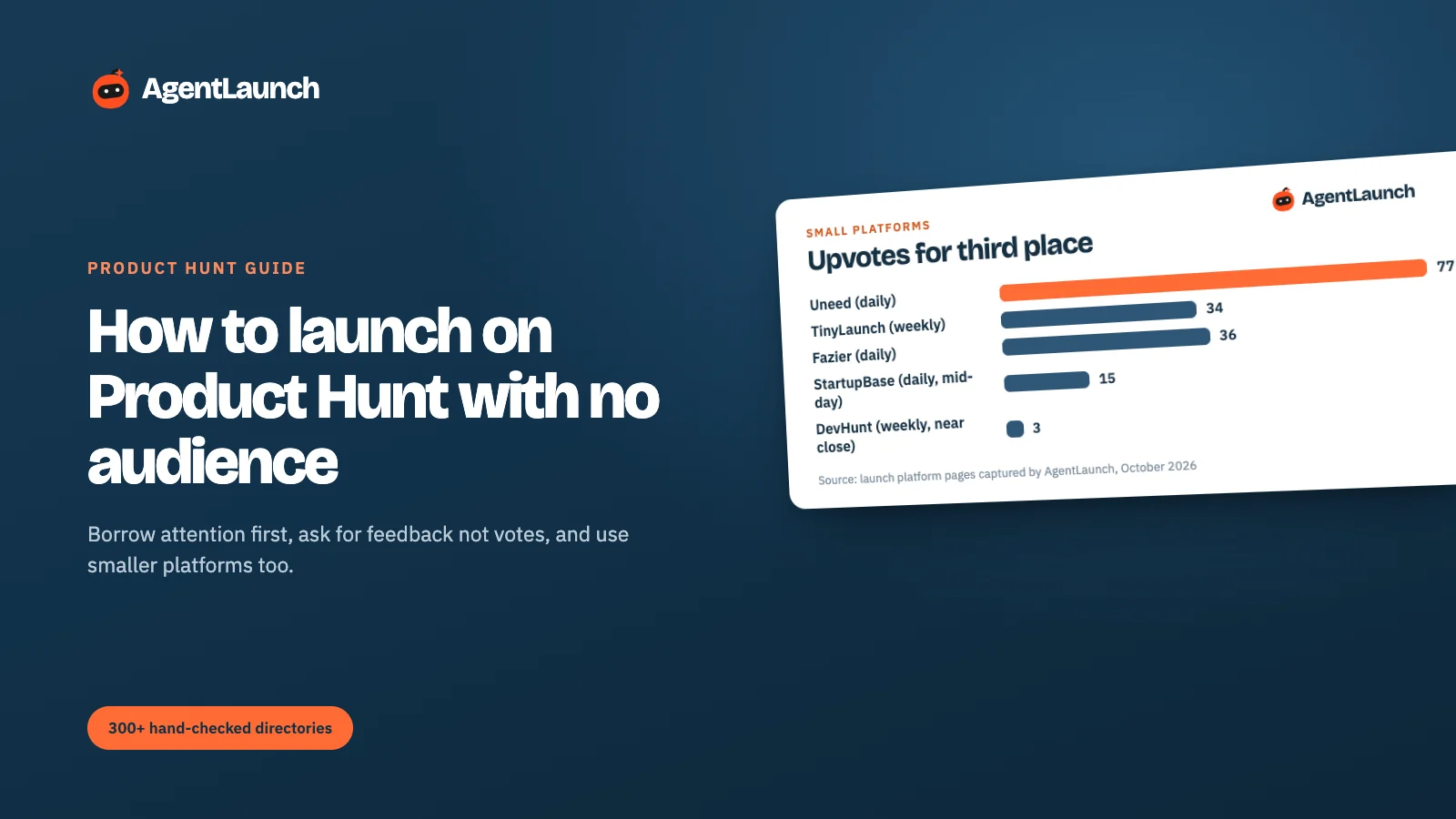
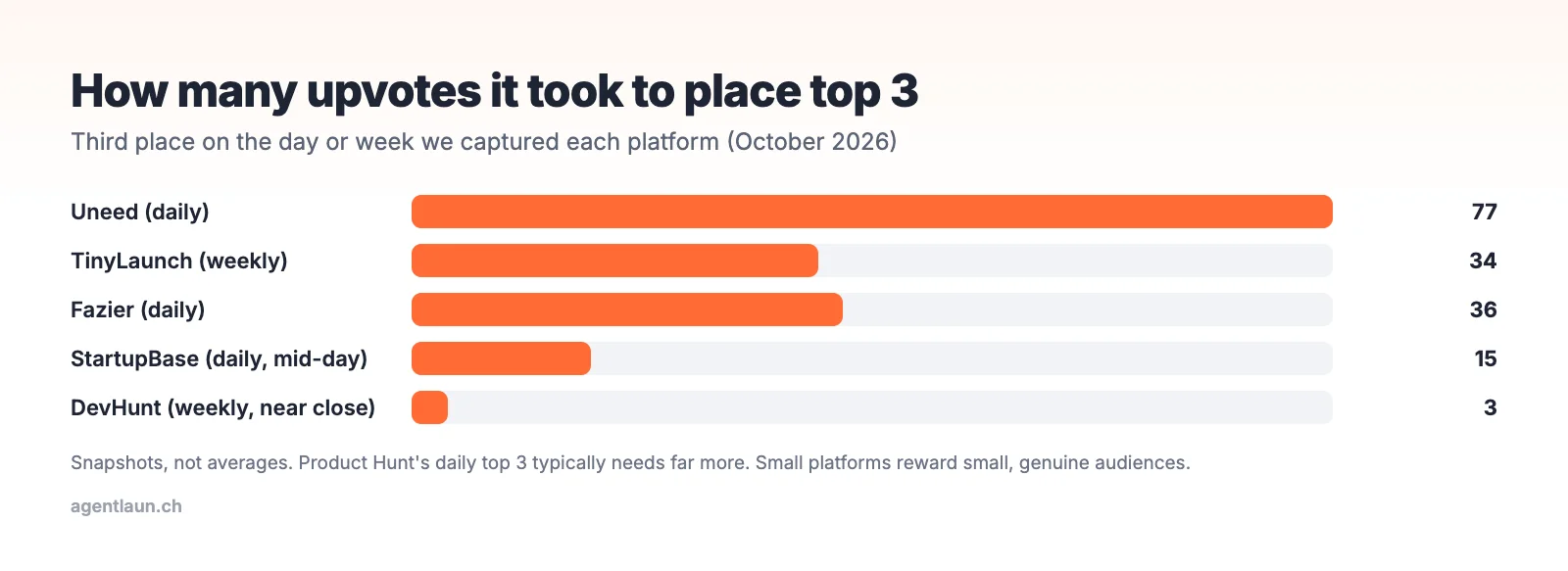
| TinyLaunch | Weekly voting. Third place took 34 upvotes in the week we checked |
| Uneed | Daily, with 10–20 upvotes deciding the dofollow link on the free line |
| Microlaunch | 30-day launches scored on reviews, not a single-day race |
| Peerlist | Week-long launches inside a builder network |
| DevHunt | Dev tools. 30 votes won the week we looked |
A common sequence: launch on two or three of these first, collect users and testimonials, then do Product Hunt with a bigger base. See sites like Product Hunt.
How many upvotes small platforms need
Messages you can copy
Personal messages work because they're personal. Edit these, don't paste them.
Two weeks before (to someone who's used the product or asked about it):
Hey [name], I'm launching [product] on Product Hunt on [date]. You were one of the first people to try it, so your take would mean a lot. Here's the upcoming page if you want a reminder: [link]. No pressure at all.
On launch morning:
We're live on Product Hunt: [link]. If you have five minutes, I'd love an honest comment, especially on [specific question, e.g. "whether the setup was clear"].
In a community you're part of (where allowed):
I've been building [product] for [time] to fix [problem]. It's on Product Hunt today, and I'm in the comments all day answering questions. The thing I'm least sure about is [honest doubt]. Would love to hear what you think.
None of these mention upvotes. Each asks for something specific, which gets you real comments.
Launch day, hour by hour (Pacific time)
| Time | What to do |
|---|---|
| 12:01 AM | Launch goes live. Post your first comment immediately |
| 12:05–1:00 AM | Message supporters in time zones where it's morning (Europe, India, Asia) |
| 6:00–8:00 AM | Message US supporters; post in your communities |
| 8:00 AM–12:00 PM | Reply to every comment within minutes; thank people by name |
| Midday | Post a short update in your thread: a fix you shipped, or an answer to a common question |
| Afternoon | Second wave: anyone who hasn't seen it yet, with a different specific question |
| Evening | Keep replying; share the day's best comment on X or LinkedIn |
| Next day | Thank everyone; follow up with each new signup personally |
If you're not featured
It happens to good launches. If your product doesn't show under Featured by mid-morning:
- Keep going anyway. People you message can still find it, and comments still count.
- Don't ask Product Hunt staff to feature you on social media. Make sure the page is complete and accurate, and contact support only if something is broken.
- Treat it as a feedback day. Collect every objection, fix what you can, and use the comments for your landing page.
- Move to the smaller platforms the following week, where the same supporters count for much more.
Mistakes that sink small launches
- Asking for upvotes. It's against Product Hunt's rules, and the "voted because asked" pattern shows.
- Launching from a brand-new account. Spend the four weeks first.
- Going quiet after 9 AM. The thread needs you all day.
- Launching a waitlist. People have to be able to try it.
- Picking the busiest day. Tuesdays needed the most upvotes for #1 in our data.
- A vague tagline. Winners averaged 49 characters of plain description. See tagline examples.
A realistic timeline
| When | What |
|---|---|
| Weeks −6 to −4 | Comment helpfully on 2–3 Product Hunt launches a week; join the forums |
| Week −4 | Launch on TinyLaunch or Uneed to collect first users and testimonials |
| Week −3 | Message 30–50 people personally; schedule the Product Hunt launch |
| Week −1 | Share the upcoming page; finalise gallery, tagline and first comment |
| Launch day | 12:01 AM Pacific; personal messages asking for feedback; reply all day |
| Week +1 | Results post; directories and smaller platforms (after launch) |
Related
- How to launch on Product Hunt and is Product Hunt worth it?
- What to do after a Product Hunt launch
- AgentLaunch's catalog, which helps you plan the smaller launches and directories around Product Hunt
FAQ
Can you launch on Product Hunt with no followers? Yes. Build engagement on Product Hunt for a few weeks, line up 30–50 genuine supporters, and ask for feedback rather than upvotes.
Do I need a hunter on Product Hunt? No. Product Hunt encourages makers to hunt their own products and says there's no discernible advantage to a third-party hunter.
What time should I launch on Product Hunt? 12:01 AM Pacific, unless you're coordinating with news or a specific audience.
How many upvotes do you need to be top 5 on Product Hunt? Over 30 days in September and October 2026, #5 of the day needed a median of 191 upvotes, and as few as 122. Weekends needed fewer (about 142–150).
What's the best day to launch on Product Hunt with a small audience? A weekend. In our data, Saturday and Sunday needed the fewest upvotes for the top five, and fewer products were featured.