Field notes
Launch Readiness Checklist: A Go/No-Go Scorecard
A product launch readiness checklist as a go/no-go scorecard: ten areas scored 0–2, the four that must pass, common zeros and their fastest fixes, what launching with a zero costs, and a copyable scorecard.
A launch readiness checklist is a go/no-go scorecard: rate ten areas from 0 (not ready) to 2 (ready), and launch only if you score 16 or more with no zeros in the first four: core flow, time to value, billing and support. Those four are the ones that turn a launch-day spike into lost users and refund requests if they fail. The other six (positioning, landing page, measurement, assets, supporters and a rollback plan) make the launch work better, but won't break it.
Use it a week before launch, again two days before, and be honest.
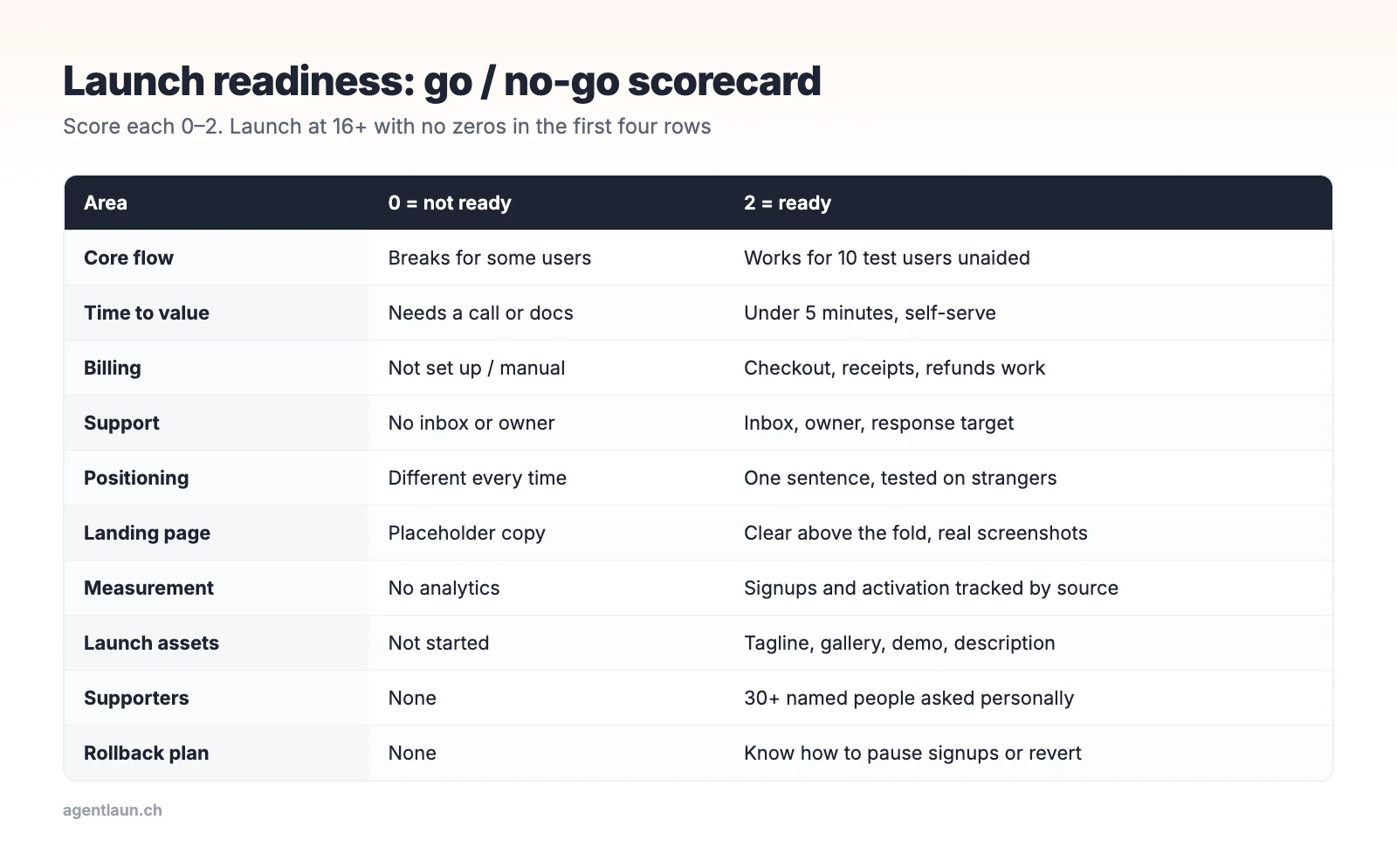
The four must-pass areas
1. Core flow. Ten people who've never seen the product complete the main job without help. Not your co-founder, not a friend who's watched demos: actual strangers. If 3 of 10 get stuck, it's a 0.
2. Time to value. A new user reaches a meaningful result in under five minutes, self-serve. Time it with a stopwatch from the signup click. Templates, sample data and skipping optional setup are the usual fixes.
3. Billing. Checkout works in the currencies you'll see, receipts send, and you know how to refund. Launch traffic includes people who buy fast and ask for refunds fast.
4. Support. A named person owns the inbox in launch week, with a response target (for example 4 hours). Launch-day questions answered quickly become your best testimonials.
The six make-it-better areas
| Area | 2 = ready means |
|---|---|
| Positioning | One sentence, tested on five outsiders |
| Landing page | Outcome headline, real screenshot, one call to action |
| Measurement | Signups and activation tracked by source with UTMs |
| Launch assets | Tagline, gallery, demo and descriptions ready (checklist) |
| Supporters | 30+ named people asked personally |
| Rollback plan | You know how to pause signups, disable a broken feature, or revert a deploy |
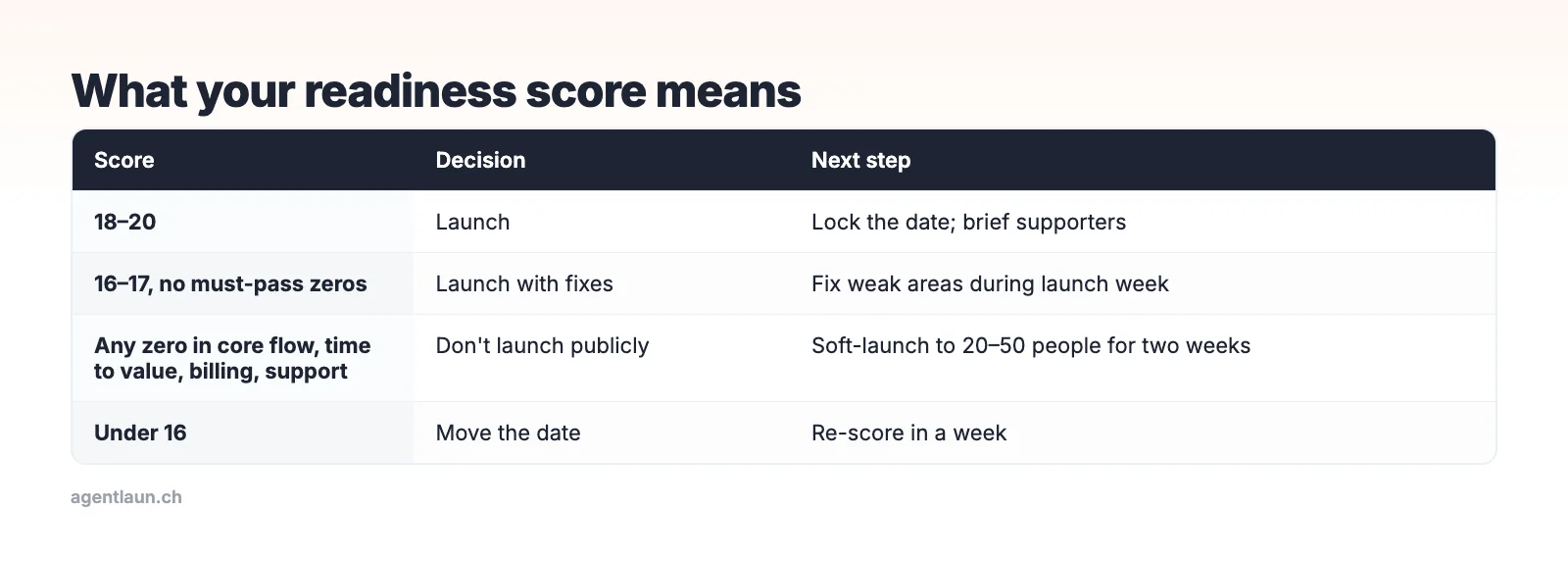
How to read the score
| Score | Decision |
|---|---|
| 18–20 | Launch |
| 16–17, no must-pass zeros | Launch, and fix the weak areas during launch week |
| Any must-pass zero | Don't launch publicly. Soft-launch to a small group and fix it |
| Under 16 | Move the date. Launch platforms will still be there next week |
Moving a launch date costs nothing on most platforms. Product Hunt lets you reschedule, and smaller platforms like Uneed and TinyLaunch run every day or every week. Burning your one Product Hunt launch for the next six months on a broken onboarding does cost something (relaunch rules).
A soft launch fixes most zeros
If you score zeros, open access to 20–50 people from your waitlist or beta testers for two weeks. Watch where they get stuck, fix it, then re-score.
From score to decision
A worked example
A team scores itself five days before launch:
| Area | Score | Note |
|---|---|---|
| Core flow | 2 | 10/10 testers completed it |
| Time to value | 1 | 8 minutes; templates not finished |
| Billing | 2 | Stripe tested, refunds tested |
| Support | 2 | Shared inbox, 4-hour target |
| Positioning | 2 | Tested on 6 outsiders |
| Landing page | 1 | Hero screenshot is outdated |
| Measurement | 2 | UTMs and sign-up events live |
| Launch assets | 2 | All ready |
| Supporters | 1 | 18 asked so far |
| Rollback plan | 1 | Can pause sign-ups, no revert plan |
| Total | 16 | No must-pass zeros |
Decision: launch, and fix during the week: finish templates (time to value is the biggest risk), update the screenshot, ask 15 more supporters, and write down the revert steps. If time to value had been a 0 (say, 25 minutes with a required call), the right call would be a two-week soft launch.
Common zeros and the fastest fixes
| Area scored 0 | What it usually looks like | Fastest fix |
|---|---|---|
| Core flow | 3+ of 10 testers get stuck at the same step | Remove or pre-fill that step; add one line of guidance |
| Time to value | 15+ minutes, or a call needed | Sample data, templates, skip optional setup |
| Billing | Checkout untested in a currency you'll see; no refund process | Run a real purchase and refund yourself |
| Support | Nobody owns the inbox; replies take days | Name an owner and a response target for launch week |
| Positioning | Outsiders describe the product wrongly | Rewrite the one-liner around the job, not the category |
| Measurement | Signups not tied to a source | Capture utm_source, ref and referrer at signup |
| Supporters | Fewer than 10 people asked | Message beta users and people who've asked about the problem |
| Rollback | No way to pause signups | Add a feature flag or maintenance switch |
What launching with a zero costs
Launch traffic arrives once. If the core flow or time to value fails, most of that traffic leaves before seeing what the product does, and the comments fill up with "couldn't get it to work". On Product Hunt, where a thread is public for good and the top five launches have a median of 32 comments, that first impression sticks. A two-week soft launch is cheaper than a failed public one.
The scorecard, ready to copy
| Area | 0 = not ready | 1 = partly | 2 = ready | Score |
|---|---|---|---|---|
| Core flow (must pass) | 3+ of 10 stuck | 1–2 stuck | 10 of 10 complete | |
| Time to value (must pass) | 15+ min or a call | 5–15 min | Under 5 min | |
| Billing (must pass) | Untested | Purchase tested | Purchase and refund tested | |
| Support (must pass) | No owner | Owner, no target | Owner and target | |
| Positioning | Untested | Tested on 1–2 people | Tested on 5 outsiders | |
| Landing page | Generic | Partly updated | Outcome headline, real screenshot | |
| Measurement | None | Signups only | Signups and activation by source | |
| Launch assets | Missing | Some ready | All ready | |
| Supporters | Under 10 | 10–29 | 30+ asked | |
| Rollback plan | None | Can pause signups | Can pause and revert |
Launch at 16 or more with no zeros in the four must-pass areas.
Who should score it
Not just the founder. Ask one person who wasn't involved in building the product to score the first four areas by trying it. Builders consistently underestimate time to value.
Related
- How to launch a SaaS product: the 30-day plan this scorecard fits into
- Product launch checklist: the task list
- Why launch traffic doesn't convert
FAQ
What is a launch readiness checklist? A go/no-go scorecard that checks whether the product, billing, support and messaging are ready before a public launch.
When should I run a launch readiness review? About a week before launch, and again two days before.
Should I delay my launch if I'm not ready? Yes, if core flow, time to value, billing or support score zero. Soft-launch to a small group instead.
What score do I need to launch? 16 out of 20, with no zeros in core flow, time to value, billing or support.
What if I score under 16? Do a two-week soft launch with a small group, fix the zeros and ones, and rescore.