Field notes
How to Market a SaaS Product: Channels, a 90-Day Strategy and What to Measure
How to market a SaaS product: pick one or two channels by buyer and price, work them for 90 days, and measure activated users. Channels compared on speed, cost and compounding, October 2026 benchmarks, and marketing for AI search.
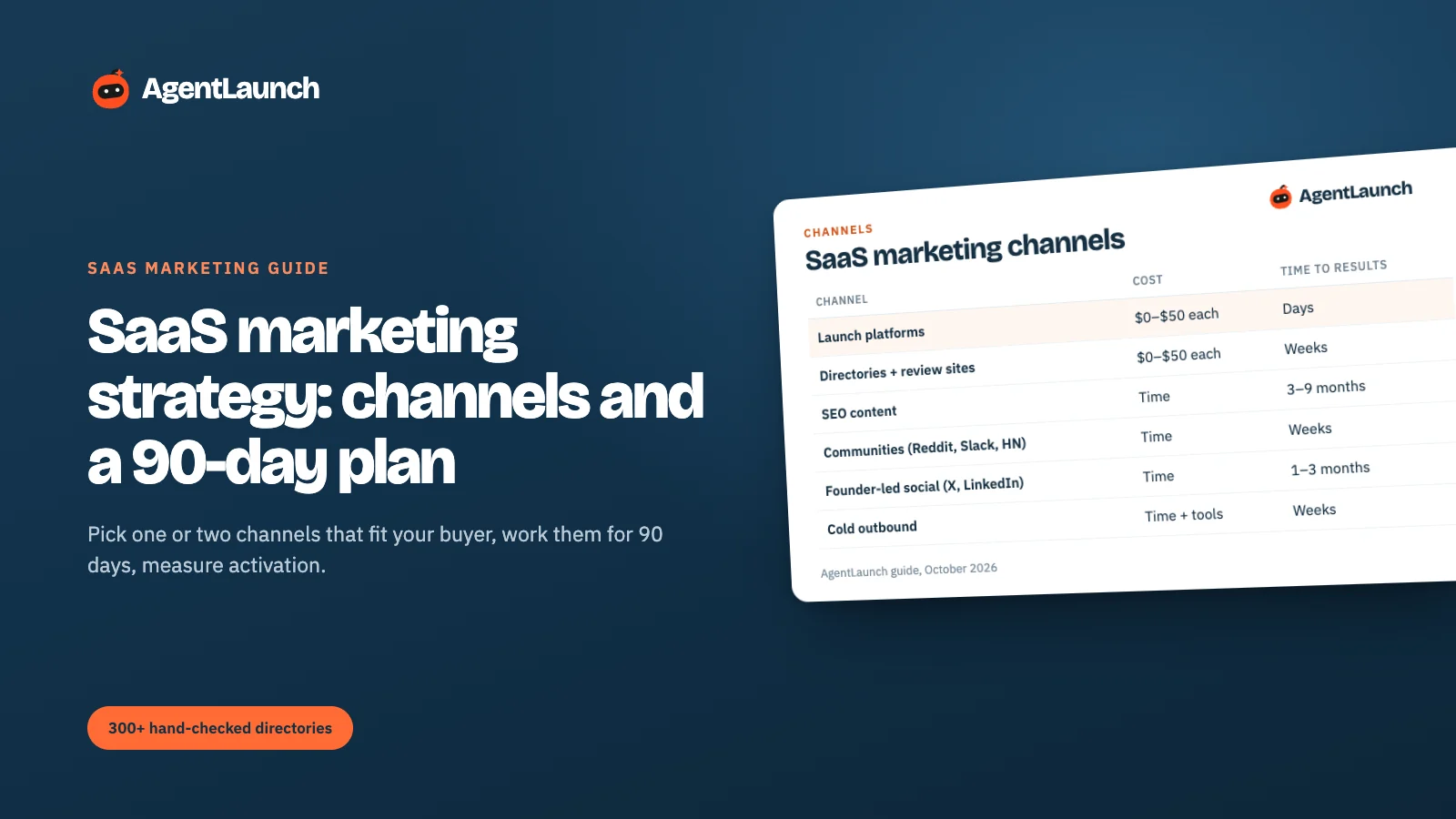
To market a SaaS product, pick one or two channels that match your buyer and price point, and work them consistently for 90 days before judging them. For most early SaaS that means a mix of launch platforms and directories (fast, cheap, good for first users and backlinks), founder-led content and communities (slower, builds trust), and SEO pages for buyer-intent searches (slowest, but compounding). Paid ads come later, once you know what a customer is worth. Measure every channel by activated users and revenue, not traffic.
Below is a channel comparison, a simple way to choose, a 90-day SaaS marketing strategy, and what to measure.
Choose channels by buyer and price
| Your SaaS | Start with | Add later |
|---|---|---|
| Self-serve, under $50/month, broad audience | Launch platforms, directories, SEO, communities | Paid search once the funnel converts |
| Self-serve, developer audience | Show HN, DevHunt, GitHub, docs SEO, Reddit | Integrations, sponsorships |
| Sales-assisted B2B, $200+/month | Founder outbound to a tight ICP, review sites (G2, Capterra), LinkedIn | SEO for comparison terms, partnerships |
| Micro SaaS / solo founder | Launch platforms, directories, one community, "alternative to X" SEO pages | Marketplaces of tools your users already use |
The rule: channel fit beats channel quality. Cold outbound doesn't work for a $9/month tool, and Product Hunt rarely closes an enterprise deal.
A 90-day SaaS marketing strategy
Days 1–30: get discovered
- Launch on one main platform and 2–3 smaller ones (how to launch a SaaS)
- Submit to 20–40 relevant directories and review sites, tracked in one sheet (tracker)
- Claim G2, Capterra and TrustRadius profiles if you're B2B (review sites)
Days 31–60: build trust
- Publish one useful post a week: a teardown, data, a build story with real numbers
- Answer questions where your buyers already ask (subreddits, Slack groups, forums) (Reddit guide)
- Collect your first 10 reviews (plan)
Days 61–90: compound
- Write 4–6 SEO pages for specific buyer searches: "[problem] software", "[competitor] alternative", "how to [job] in [tool]"
- List in integration marketplaces for tools your users already pay for
- Double down on whichever channel produced activated users
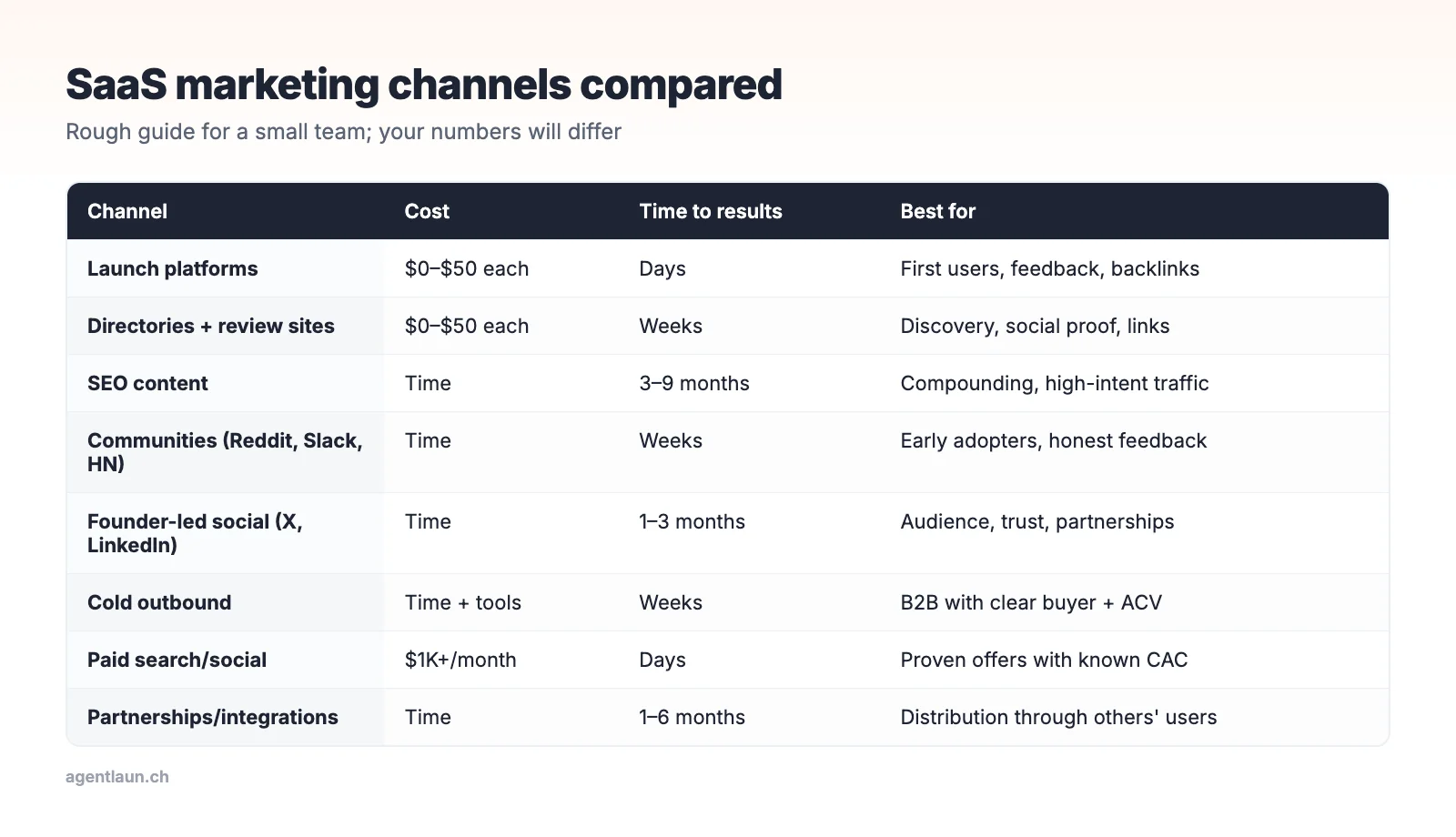
Channels compared
| Channel | Time to first result | Cash cost | Compounds? | Best for |
|---|---|---|---|---|
| Launch platforms | Days | $0–$50 each | A little (listings, links) | First users, proof, followed links |
| Directories | Days to weeks | Mostly free; median paid ~$25 | Yes, slowly | Discovery, long-tail traffic |
| Review sites | Weeks (needs reviews) | Free profiles; paid tiers expensive | Yes | B2B trust |
| Communities and Reddit | Weeks | Free | Yes, if threads rank | Early users, feedback |
| SEO content | 3–9 months | Your time or a writer | Strongly | Buyer-intent searches |
| Partnerships and integrations | 1–3 months | Time | Yes | Products with a platform to plug into |
| Paid ads | Days | $ per click | No | Products with known unit economics |
| Outbound | Weeks | Time, tools | No | High-ACV B2B |
What we measured in October 2026
Some numbers from researching this blog, to calibrate expectations:
- Product Hunt: over 30 days, #5 of the day needed a median of 191 upvotes and #10 about 110. The top five had a median of 32 comments (no-audience plan).
- Small launch boards: Launch Llama's weekly top five had 11–14 votes; DevHunt's weekly winner had 30; TinyLaunch's third place had 34 (micro SaaS plan).
- Directories: the median directory in our catalog of 394 gets only a few thousand visits a month, and DR is a weak guide to traffic (quality checks).
- Reddit in Google: a Reddit thread was the #1 Google result for seven of 11 founder questions we checked.
- Links: on nearly 500 live listings, promised dofollow links were often conditional or missing. Check before you pay.
Marketing for AI search
More buyers now ask ChatGPT, Claude, Perplexity or Google's AI features for recommendations. You can't buy your way into those answers, but you can be present where they draw information from:
- Clear product pages that state what the product does, for whom, pricing and alternatives in plain text.
- Review sites and directories with complete, accurate profiles.
- Comparison pages on your own site that are honest about trade-offs.
- Community threads where real users mention you.
- An
llms.txtfile summarising your product for AI crawlers. Some directories (Launch Llama, for example) publish one, and it costs you an hour.
What to measure
| Metric | Why |
|---|---|
| Activated users by channel | The real output of marketing |
| Visitor → signup → activation by channel | Shows whether it's a traffic or an onboarding problem |
| Cost per activated user (time or money) | Compare channels fairly |
| Revenue by first-touch channel | Which channel brings payers |
UTM-tag everything (how to). Judge after 90 days, not 9.
Common mistakes
- Doing six channels badly instead of two well
- Optimising for traffic: launch traffic often doesn't convert (why)
- Paid ads before the funnel converts: it only makes losses bigger
- No positioning: if you can't say who it's for in one sentence, no channel will work
How to split your time
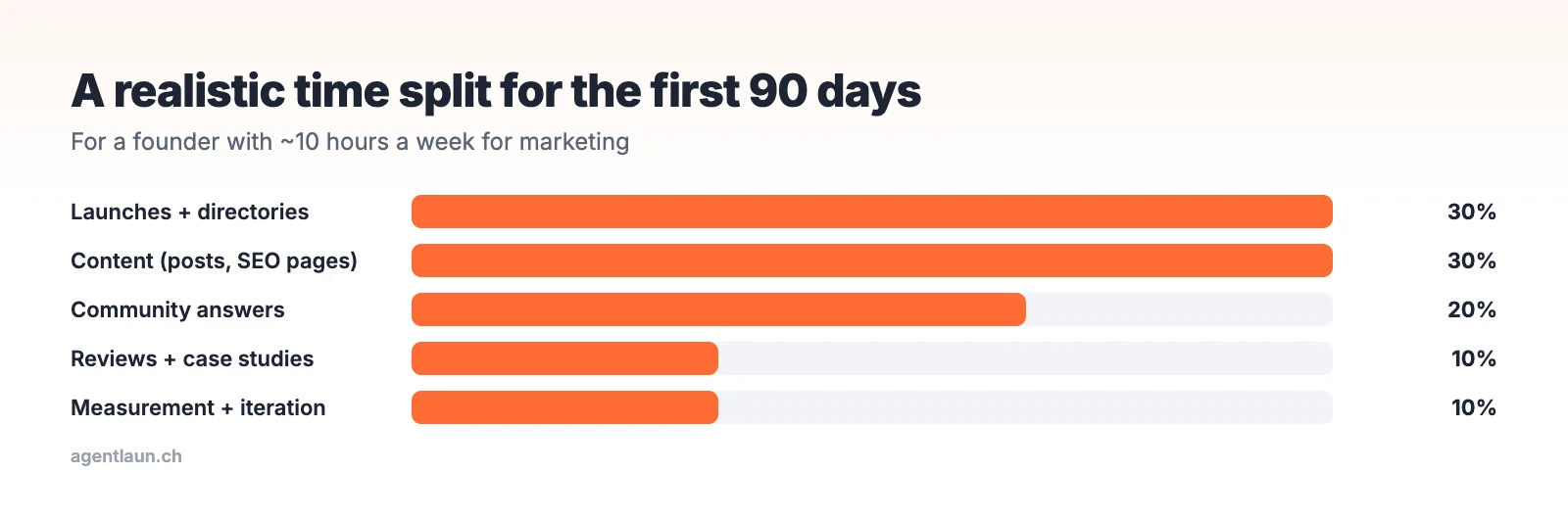
Most founders have far less marketing time than they plan for. With about ten hours a week, a split like the one above keeps every early channel alive without spreading thin. After 30 days, look at activated users by source and move time from the weakest channel to the strongest. After 90 days you should be spending most of your time on one or two channels.
An example: a $29/month SaaS for freelancers
An illustrative 12-week plan for an invoicing tool for freelance designers, with 12 paying users:
- Weeks 1–2: launches on Uneed and TinyLaunch, then 25 directories, including design-tool and freelancer-focused ones.
- Weeks 3–8: one post a week on what freelancers get wrong about invoicing (with numbers from anonymised usage), and five answers a week in two freelancer subreddits and a Slack community.
- Weeks 9–12: four SEO pages: "invoice template for designers", "how to charge a late fee", "[big invoicing tool] alternative for freelancers" and "how to invoice international clients".
- What to expect: directories usually send steady low volume, Reddit sends spikes, and SEO pages take months to bring sign-ups. Plan for SEO to matter from months 4–9, not week 2.
Positioning comes first
No channel fixes unclear positioning. Before spending time on any of the above, make sure you can finish this sentence in a way strangers understand: "[Product] helps [specific who] [do specific what] without [specific pain]." If five people outside your industry can repeat it back, channels have something to amplify.
Related
- B2B SaaS marketing strategy: by stage, for sales-assisted products
- How to promote a micro SaaS: the solo-founder version
- AgentLaunch handles the directory and launch-platform part of the plan, with your AI agent in Claude Code, Codex or Cursor picking relevant sites from 300+ and filling the forms
FAQ
What is the best marketing strategy for a SaaS product? Pick one or two channels that fit your buyer and price point (usually launch platforms, directories, communities and SEO early on) and work them for 90 days, measuring activated users.
How do I market a SaaS with no budget? Launch platforms, free directory listings, founder content, community answers and SEO pages all cost time, not money.
When should a SaaS start paid ads? When you know which visitors convert and what an activated customer is worth.
What's the fastest way to get first users for a SaaS? Launch platforms and personal outreach to people with the problem. Small launch boards need only 10–40 genuine supporters to place well.
How long does SaaS SEO take to work? Usually three to nine months for new pages on a young domain. Start in month one so it's working by month six.