Field notes
Product Launch Checklist for Software (15 Items, With What 'Done' Means)
A software product launch checklist with 'done when' criteria for product, message and launch, a specs cheat sheet for Product Hunt and directories, launch-day benchmarks from 30 days of leaderboards, and a printable version.
A product launch checklist covers three areas: the product (core flow works, onboarding reaches value in under five minutes, pricing and support are ready), the message (one-sentence positioning, a tagline under 60 characters, a tested landing page, demo and screenshots), and the launch itself (30–50 supporters asked, platform scheduled, directories prioritised, UTM links and follow-up emails ready). Below is the full checklist, what "done" means for each item, and the mistakes that sink software launches.
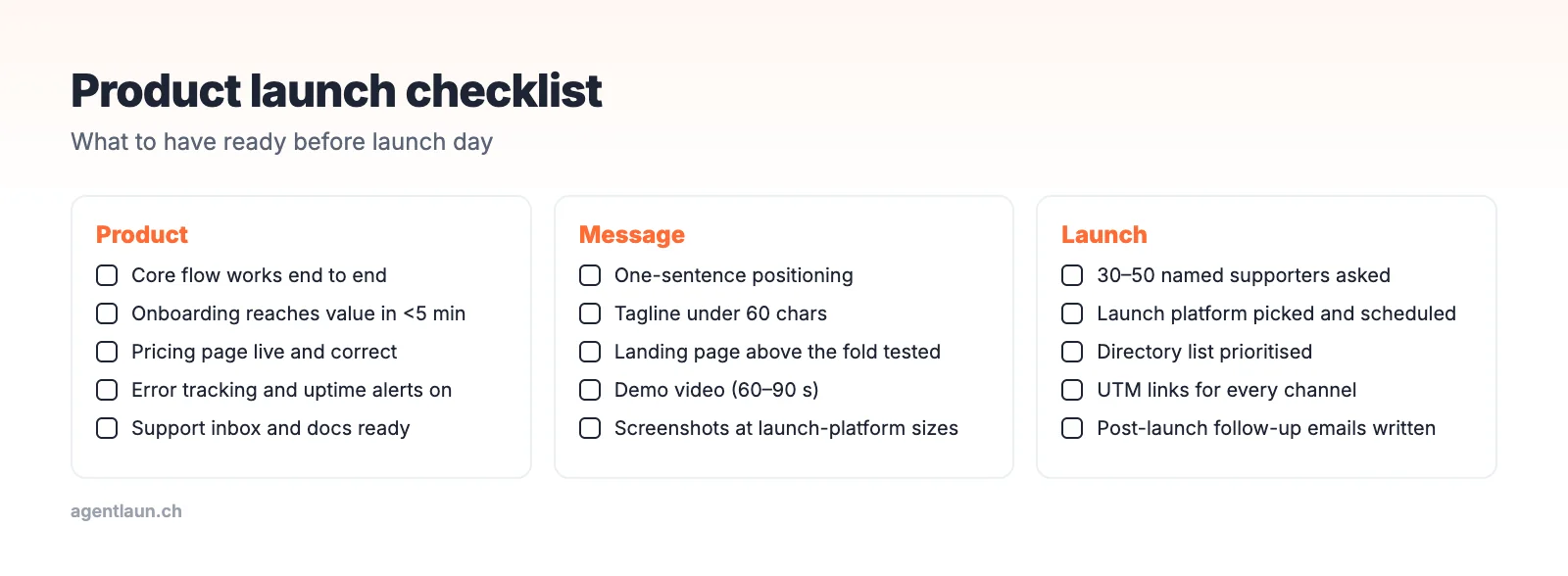
Product: does it work for a stranger?
| Item | Done when |
|---|---|
| Core flow works end to end | 10 people who've never seen it complete the main job unaided |
| Onboarding reaches value in < 5 min | Time a new user from signup to first result |
| Pricing page live and correct | Prices match checkout; trial and free tier terms are clear |
| Error tracking and uptime alerts | You'll know about a crash before a user tweets it |
| Support inbox and basic docs | A named owner and a response target for launch week |
Most common failure: onboarding. Launch traffic is curious, not committed, and if value takes 20 minutes, most visitors never see it.
Message: can people tell what it does?
| Item | Done when |
|---|---|
| One-sentence positioning | Five outsiders can repeat it back correctly |
| Tagline ≤ 60 characters | Says what it does and for whom, with no hype (how to) |
| Landing page above the fold | Headline = outcome, screenshot = product doing it |
| Demo video, 60–90 seconds | Outcome in the first 5 seconds (structure) |
| Screenshots at platform sizes | 1270 × 760 for launch galleries, 1600 × 900 for directories |
Launch: who will see it, and how will you know?
| Item | Done when |
|---|---|
| 30–50 named supporters asked | Personal messages sent, asking for feedback on launch day |
| Launch platform chosen and scheduled | Product Hunt (scheduling up to a month ahead) or a smaller platform |
| Directory list prioritised | 15–30 relevant directories, free routes first (checklist) |
| UTM links for every channel | One scheme, used everywhere, except Product Hunt, which rejects UTM links and adds ref=producthunt itself (how to) |
| Follow-up emails written | Day-of and day+2 emails to signups and supporters (templates) |
Specs cheat sheet
The limits that trip people up, confirmed on each platform in October 2026:
| Where | Limit |
|---|---|
| Product Hunt tagline / description | 60 / 500 characters |
| Product Hunt gallery | 2+ images, 1270 × 760 recommended, each under 3 MB |
| Product Hunt thumbnail | 240 × 240, GIF allowed |
| Product Hunt video | YouTube only, not private |
| Product Hunt URL field | No shortened or UTM links |
| Product Hunt scheduling | Up to one month ahead; launches go live at 12:01 AM Pacific |
| TinyLaunch name / tagline | 30 / 60 characters, logo required |
| Typical directory tagline | 160 characters (most common cap across 108 forms) |
| Typical directory description | Capped anywhere from 90 to 5,000; 10 of 22 at 500 or less |
| SourceForge business description | 1,000 characters |
What "good" looks like on launch day
Benchmarks from 30 days of Product Hunt's daily leaderboards (September–October 2026):
| Result | Median upvotes | What it means |
|---|---|---|
| #1 of the day | 443 | A big, prepared audience |
| #5 of the day | 191 | A strong launch |
| #10 of the day | 110 | A solid launch for a small team |
The top five averaged four times the comments of everyone else (a median of 32 vs 8). Plan for comments, not just votes.
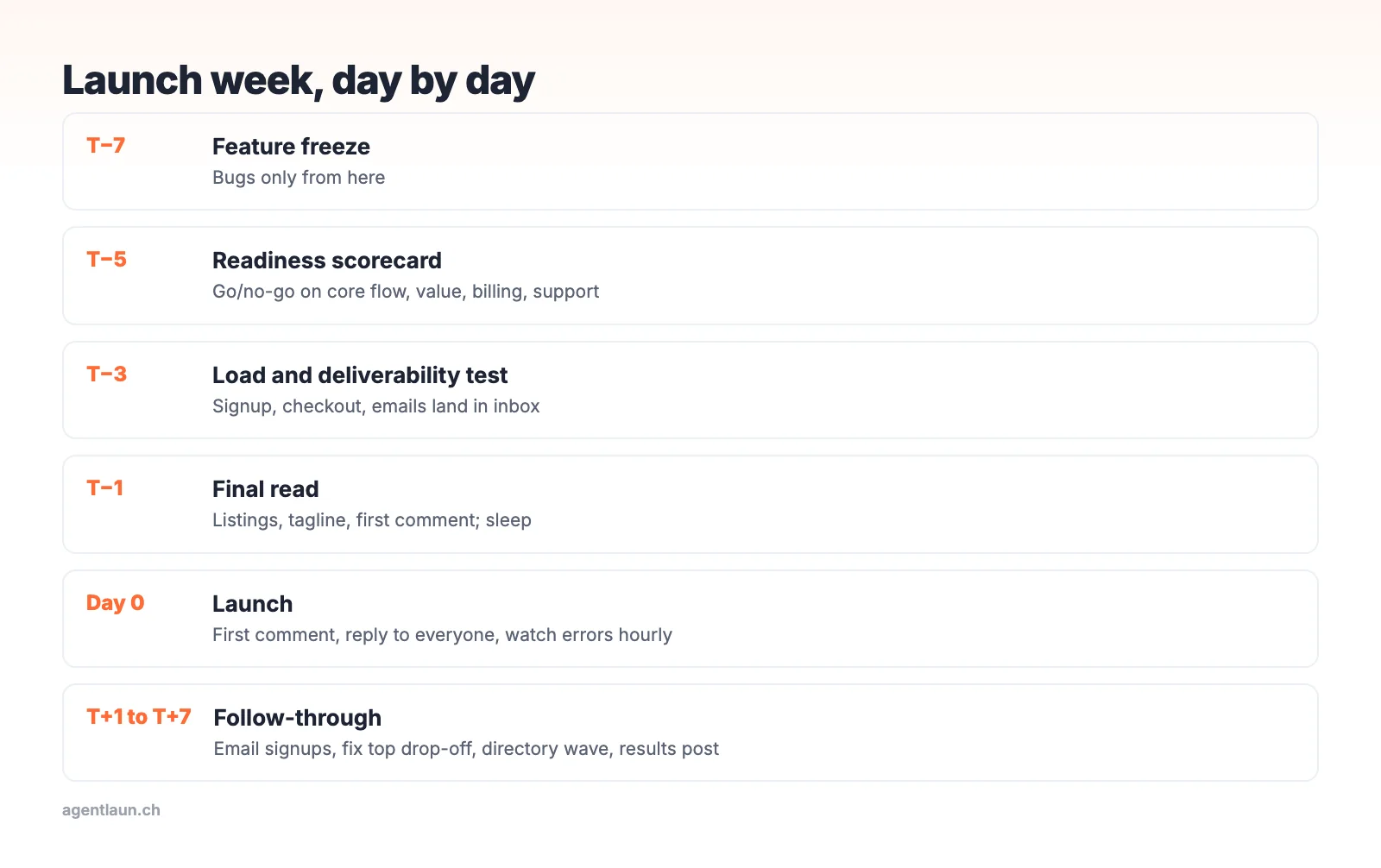
The week before
- T−7: freeze features. Only fix bugs from here.
- T−5: run the go/no-go scorecard.
- T−3: load-test signup and checkout. Check emails land in inboxes, not spam.
- T−1: final read of every listing, tagline and first comment. Sleep.
Launch day
- Post the first comment or Show HN comment right away
- Reply to every comment for the whole day
- Watch signups and errors hourly, and fix onboarding issues live
- Send personal thank-yous
The week after
- Email every new signup personally
- Fix the biggest drop-off in your funnel
- Submit to directories and smaller launch platforms while the story is fresh
- Publish a results post with real numbers
See what to do after a launch for the full 30-day follow-through.
The printable checklist
Product
- 10 strangers completed the core flow unaided
- First value in under five minutes, timed
- Pricing page matches checkout
- Error tracking and uptime alerts on
- Support inbox owned, with a response target
- Refund process tested
Message
- Positioning tested on five outsiders
- Tagline at 60 characters, plus 160 and 500-character descriptions
- Landing page: outcome headline, real screenshot, one call to action
- 60–90 second demo video, public or unlisted on YouTube
- 3–5 screenshots at 1270 × 760
- Press kit page live
Launch
- 30–50 named supporters asked personally
- Main platform chosen and launch scheduled
- First comment written, with one specific question
- 15–30 directories prioritised in a tracker
- Source tracking working (UTMs, plus
refparameters from platforms) - Launch-day and day+2 emails scheduled by time zone
- Launch offer and its end date decided
- Rollback plan written down
Mistakes that sink software launches
- Launching before onboarding works. You get one shot at launch-day visitors.
- Asking for upvotes. It's against Product Hunt's rules and Hacker News's, and it shows.
- One channel only. A single launch day is a spike. Directories, review sites and communities make it a curve.
- Measuring upvotes. Measure activated users by source.
- Copy-pasting one description everywhere. Each audience needs its own first sentence.
Launch week, day by day
For a software product specifically
Software launches have a few extra items most generic launch checklists miss:
| Item | Why |
|---|---|
| Rate limits and abuse controls | Launch traffic brings scripted sign-ups and free-tier abuse |
| Email deliverability (SPF, DKIM, DMARC) | Verification and welcome emails must land in inboxes |
| Status page | Somewhere to point users if something breaks |
| Changelog | Launch visitors check whether the product is actively developed |
| Security page | B2B buyers ask about data handling on day one |
| Feature flags | So you can switch off a broken feature without redeploying |
| Database backups verified | Before the busiest day of your product's life |
None of these take long, and all of them are painful to set up mid-launch.
Related
- How to launch a SaaS product: the 30-day calendar
- SaaS launch press kit and launch budget
- AgentLaunch works through the directory part of the checklist for you, with your AI agent in Claude Code, Codex or Cursor using your product page and filling the forms
FAQ
What should be on a product launch checklist? Product readiness (core flow, onboarding, pricing, support), messaging (positioning, tagline, landing page, demo) and distribution (supporters, platform, directories, UTMs, follow-up emails).
How far in advance should I prepare a launch? About four weeks once the product works. Freeze features a week before.
What's the most common launch mistake? Launching before a new user can reach value in under five minutes without help.
What should be on a software launch checklist? Three groups: product (it works for strangers, value in under five minutes, billing and support ready), message (positioning, tagline, landing page, demo, screenshots) and launch (supporters, platform, directories, tracking, follow-up emails).
How many upvotes is a good Product Hunt launch? In September–October 2026, #10 of the day needed a median of 110 upvotes and #5 a median of 191.