Field notes
How to Promote a Micro SaaS in 5 Hours a Week
How to promote a micro SaaS in about five hours a week: launch in waves on small platforms (with October 2026 vote counts for each), 15–30 directories, a weekly community rhythm, monthly SEO, and a first-month budget under $150.
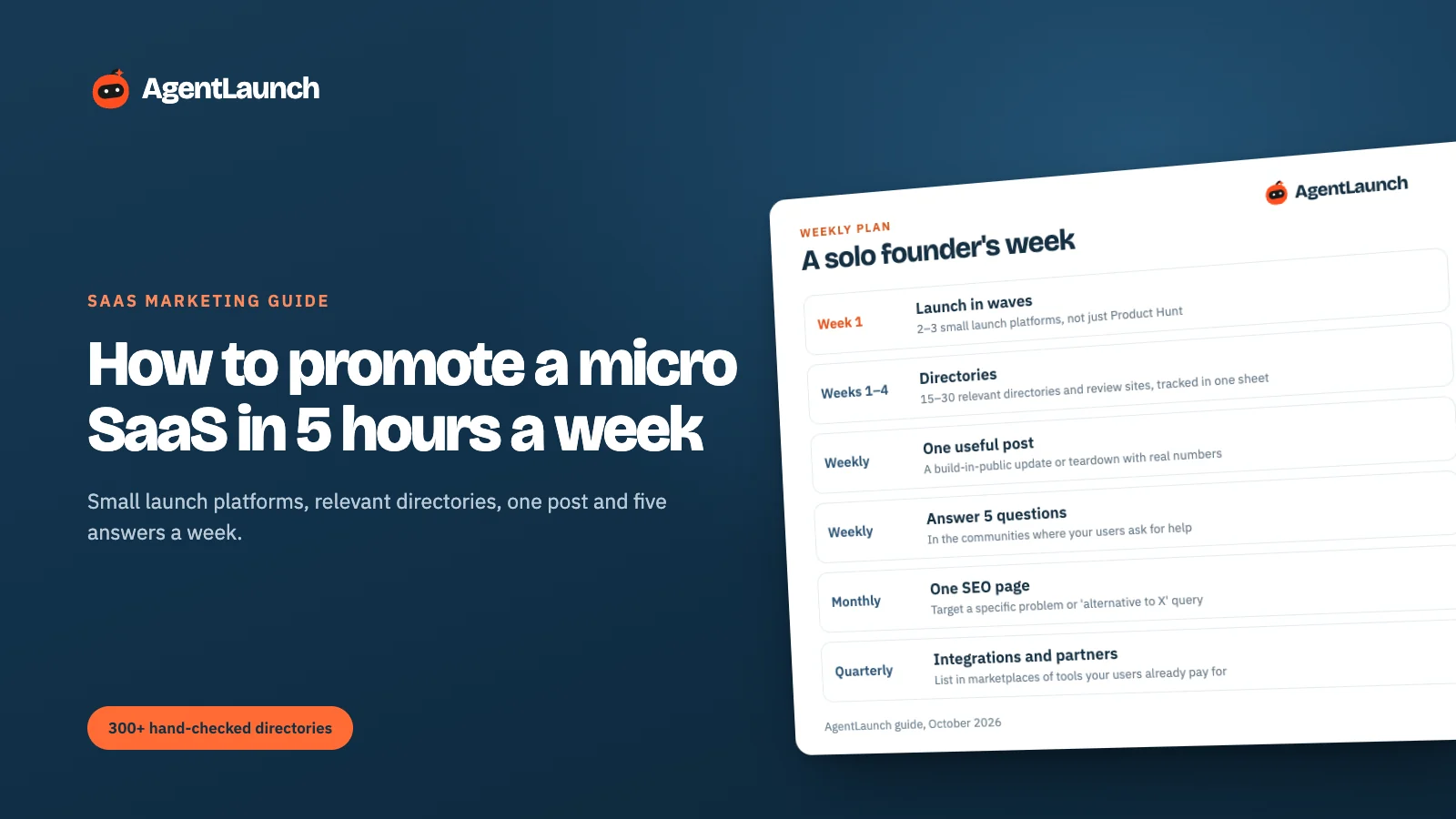
To promote a micro SaaS on a solo founder's schedule (about five hours a week), do three things: launch in waves on two or three small platforms, not just Product Hunt; list on 15–30 relevant directories in the first month; then keep a weekly rhythm of one useful post and five helpful answers in the communities where your users ask for help. Add one SEO page a month targeting a specific problem or "alternative to X" search. Skip paid ads until you know which channel converts.
Here's the plan, the platforms where small products do well, and how to measure without a growth team.
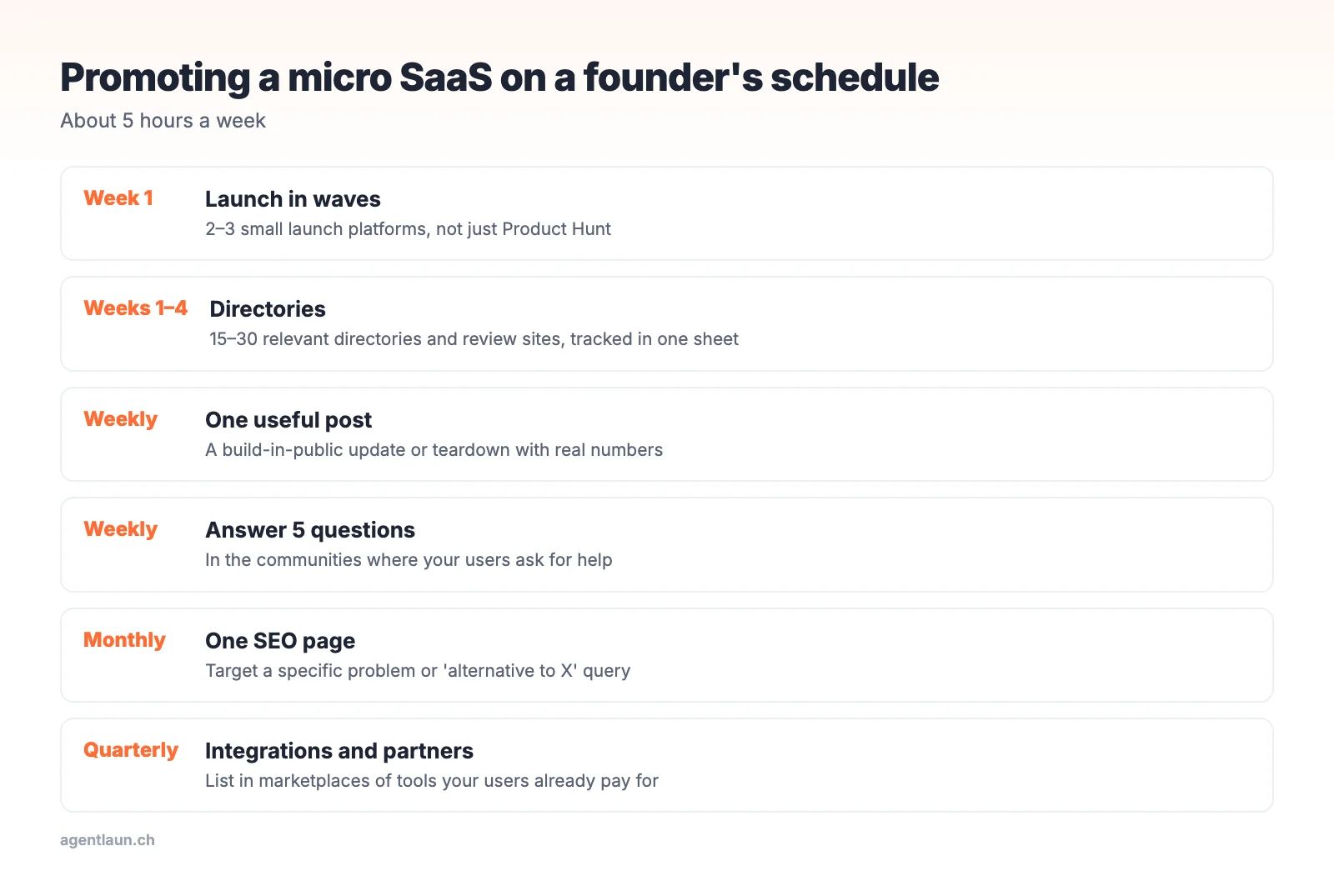
Month 1: launch in waves
Product Hunt rewards big audiences. Micro SaaS does better on platforms where a small group of supporters can place you:
| Platform | Why it suits micro SaaS |
|---|---|
| TinyLaunch | Weekly voting; 34 upvotes took third place in the week we checked |
| Uneed | Free queue or $14.99–$29.99; 20 upvotes unlocks the dofollow link |
| Microlaunch | 30-day launches scored on reviews |
| Peerlist | Week-long launches inside a builder network |
| Fazier | Free with a badge; $49 for a guaranteed link |
| DevHunt | Dev tools: $19 for a dofollow link |
Space them out over two to three weeks and reuse the same assets.
Month 1: directories
Submit to 15–30 directories that list products like yours. Prioritise by relevance and real traffic, not DR alone: in our catalog of 394 directories, 58% get under 10,000 visits a month (how to judge quality). Use one tracker and one description set.
Every week: one post, five answers
- One post: a build-in-public update, a teardown or a small data finding, on X, LinkedIn or your blog. Real numbers ("first $100 MRR", "what 40 trial users did") beat announcements.
- Five answers: in subreddits, Slack groups or forums where your users ask questions your product solves. Mention it only when relevant, and say you built it (Reddit rules).
Every month: one SEO page
Micro SaaS often wins long-tail search because big competitors ignore small queries:
- "[specific problem] tool": "convert Figma frames to app store screenshots"
- "[big competitor] alternative for [niche]"
- "how to [job] in [platform your users use]"
One useful page a month adds up to a meaningful traffic base in a year.
Every quarter: integrations and marketplaces
If your product plugs into Shopify, Notion, Slack, Figma or similar, list it in their marketplaces. Users of those tools are already looking for add-ons.
Measure without a growth team
- UTM-tag every link:
?utm_source=tinylaunch&utm_medium=launch(how to) - Each month, look at signups and paid conversions by source, keep the top two, and drop the rest
- Track total time spent per channel. For solo founders, time is the real cost.
What it takes to place on small platforms
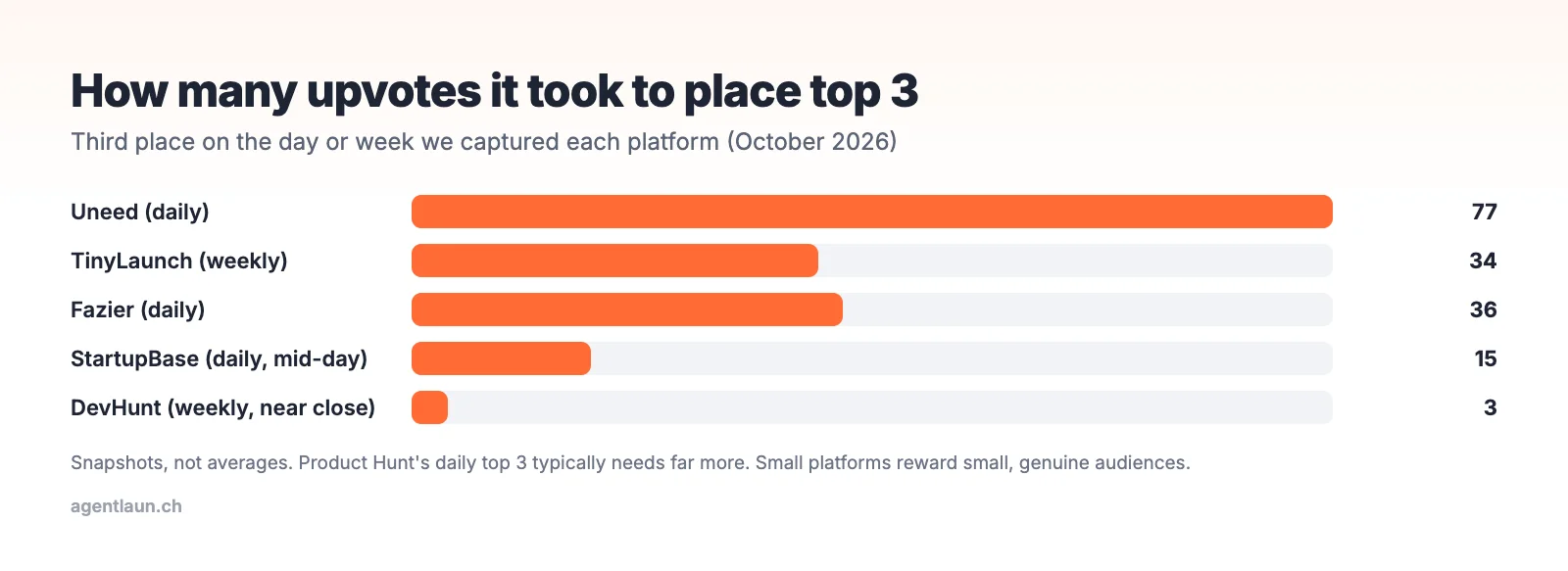
These numbers are why small platforms suit micro SaaS. On the days and weeks we captured them, third place took somewhere between a handful and about 80 upvotes. A micro SaaS with 20–40 real users and a few founder friends can realistically reach the podium on TinyLaunch, Fazier or DevHunt. On Product Hunt, the same audience usually lands mid-table.
How many votes it takes, platform by platform (October 2026)
We checked what small and big launch platforms required on the days we looked:
| Platform | What it took | Format | Followed link |
|---|---|---|---|
| Launch Llama | Weekly top 5 had 11–14 votes | Weekly | Weekly top 5 or ~20 upvotes |
| DevHunt | 30 votes won the week | Weekly, dev tools | $19 paid launch |
| Microlaunch | Product of the Day had 8 upvotes | Monthly round | Followed in our check |
| TinyLaunch | 3rd of the week had 34 | Weekly | Top 3 or $39 Premium |
| Fazier | 3rd of the day had 34–36 | Daily | Followed in our check |
| Uneed | Podium took 77–112 | Daily | Score rules / $29.99 |
| Product Hunt | #5 needed a median of 191, #10 about 110 | Daily | ugc |
For a micro SaaS with 20 to 40 genuine supporters, the weekly and monthly boards are where you can win something. Product Hunt is worth doing for the audience, not the ranking.
Pricing and positioning for micro SaaS
Promotion works better when the offer is simple:
- One plan, or two at most. Micro SaaS buyers decide in minutes.
- A free tier or trial that reaches value immediately, since most of your visitors come from listings and communities and are just curious.
- Niche positioning: "Invoicing for freelance designers" gets shared in designer communities. "Invoicing software" doesn't.
- An 'alternative to' angle: if you replace an expensive incumbent for a small segment, say so. That's both your SEO strategy and your community pitch.
A realistic first-month budget
You can do this for free, but a little money saves weeks:
| Item | Cost | Worth it? |
|---|---|---|
| Free launches (Uneed line, TinyLaunch, Microlaunch, PeerPush, Peerlist, Product Hunt) | $0 | Yes, all of them |
| One paid launch for a followed link and a date you control (Uneed $29.99, TinyLaunch $39, Fazier $49) | $30–$50 | Pick one |
| DevHunt paid launch (dev tools only) | $19 | Yes, if you're a dev tool |
| One paid AI directory (if you're an AI tool) | $47–$99 | Only the big ones |
| Domain and email for listings | ~$15 | Use a launch@ address so you can find every confirmation |
That's under $150 for a launch month with three or four followed links from DR 70+ sites and five or six audiences. See SaaS launch budget for bigger plans.
When to stop doing something
Every month, drop the channel that produced the fewest paying users for the time spent, unless it's under 60 days old. SEO is the exception: give it 4–6 months before judging. Solo founders rarely fail from too few channels. They fail from too many half-done ones.
Related
- How to market a SaaS product
- Product Hunt launch without an audience
- SaaS launch budget
- AgentLaunch automates the directory month for solo founders: it picks relevant directories and fills forms from your browser at a pace you set
FAQ
How do I promote a micro SaaS with no audience? Launch on small platforms where 20–40 supporters can place you, submit to relevant directories, and answer questions in your users' communities every week.
Is Product Hunt good for micro SaaS? It can be, but smaller platforms like TinyLaunch, Uneed and Microlaunch usually give a small audience better placement.
How much time does micro SaaS marketing take? About five focused hours a week is enough for steady growth once the first launch month is done.
Which launch platforms are easiest for a micro SaaS? Weekly and monthly boards. In October 2026, Launch Llama's weekly top five needed 11–14 votes, DevHunt's winner had 30, and Microlaunch's Product of the Day had 8.
How much does it cost to launch a micro SaaS? It can be free. With one or two paid launches for followed links and a chosen date, expect $50–$150 for the first month.