Field notes
How to Get Beta Testers for a SaaS Product (and Run the Beta)
Where to find beta testers for a SaaS product (people with the problem first, then early-adopter platforms like BetaList), the recruiting message, how to run the beta, how many testers you need, and mobile beta rules.
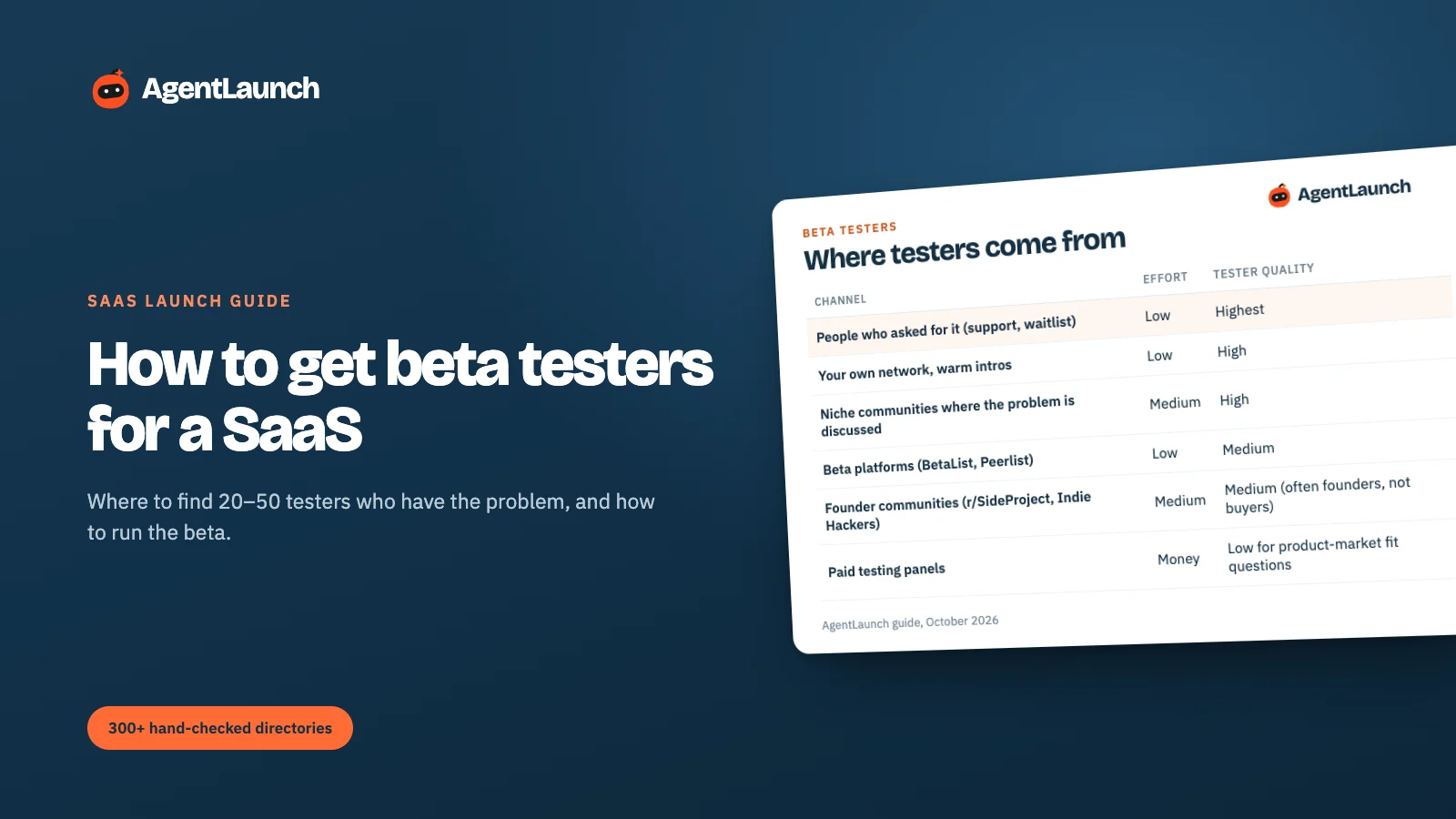
The best beta testers for a SaaS product are people who already have the problem and told you so: support conversations, waitlist sign-ups, and people complaining about the problem in communities. Start there, add warm intros from your own network, then use beta platforms like BetaList and Peerlist and founder communities for volume. Aim for 20–50 active testers, give them a clear task and a direct line to you, and ask for feedback within the first 48 hours.
Here's where to find them, how to recruit without sounding salesy, and how to run a beta that produces useful feedback.
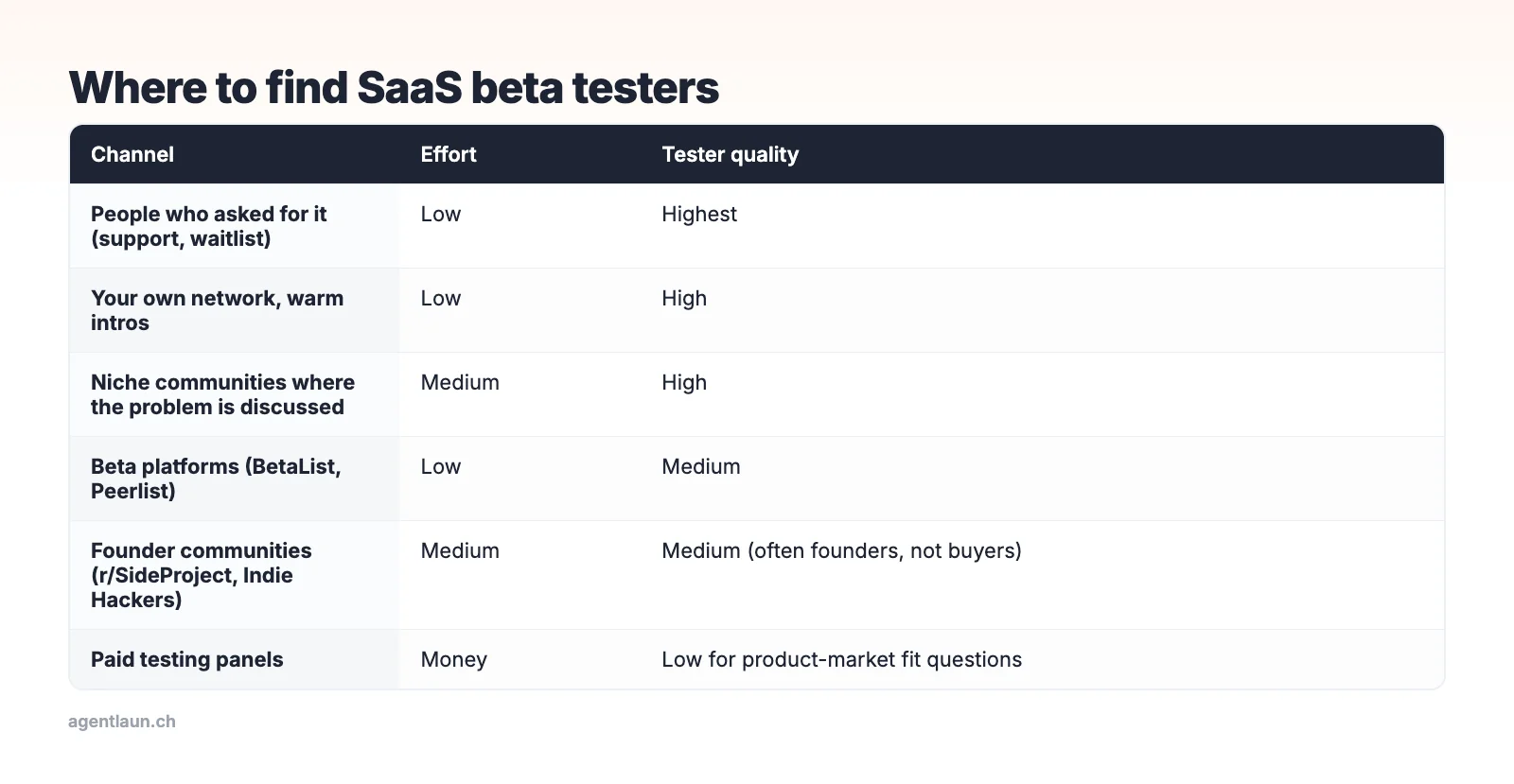
Where to find them
1. People who asked for it. Search your inbox, support tickets, DMs and waitlist for anyone who described the problem. They're the most motivated testers you'll get.
2. Your network, via warm intros. "Do you know anyone who [specific pain]?" works better than "want to try my app?"
3. Communities where the problem is discussed. Search Reddit, Slack groups, forums and X for people describing the pain. Reply helpfully. If it fits, say you're building something and ask whether they'd test it. Disclose that you're the founder (Reddit guide).
4. Beta platforms. BetaList features pre-launch startups to early adopters. Peerlist has a builder audience. Both bring volume, but testers are less targeted.
5. Founder communities. r/SideProject and Indie Hackers are generous with feedback, but they're often founders, not your buyers. Great for UX feedback, weak for pricing and positioning.
Platforms built for early adopters
A few sites exist specifically to connect pre-launch products with people who like trying them. From AgentLaunch's catalog (October 2026):
| Platform | DR | Visits/month | What you get | Notes |
|---|---|---|---|---|
| BetaList | 76 | ~259,000 | A pre-launch listing seen by early adopters | Free queue is slow; paid speeds it up |
| EarlyHunt | 63 | ~11,000 | A listing for early-stage products | Its own copy: free listings nofollow, premium dofollow |
| Microlaunch | 64 | ~93,000 | Ratings and blunt "roasts" over a month | Good for feedback, not volume |
| Peerlist | 77 | ~486,000 | Builders with real profiles | Verified profile needed |
| Subreddits for beta testers | – | – | People who opt in to test | Read each sidebar's rules first (Reddit guide) |
These bring curious early adopters, not necessarily your buyers. Use them to stress-test onboarding, and recruit your real beta from people with the problem.
Mobile apps have their own beta rules
- iOS: TestFlight lets you invite external testers by email or public link, after a light App Store review of the beta build.
- Android: new personal Google Play developer accounts must run a closed test with at least 12 testers opted in for 14 days in a row before they can publish to production. Recruit those 12 early.
The recruiting message
Hi Alex, saw your post about [specific pain]. I'm building [Product] to fix exactly that ([one line on how]). Would you try the beta for 15 minutes this week and tell me what's confusing? No cost, and I'll set you up personally.
Specific, short, a clear time ask, personal. Expect roughly one in four of well-targeted people to say yes.
Run the beta
- Onboard personally: a 15-minute call or a short Loom for the first 20.
- Give one task: "Try to [core job] with your own data." Open-ended "play around" produces vague feedback.
- Ask within 48 hours: "What did you expect that didn't happen?" "What nearly made you stop?" "Would you pay $X?"
- Watch, don't just ask: session recordings and activation events show where people got stuck.
- Close the loop: tell testers what you fixed because of them. They become your launch-day supporters.
How many testers?
| Goal | Testers |
|---|---|
| Find usability problems | 5–10 is enough to surface most issues |
| Validate activation and onboarding | 20–50 active users |
| Test pricing and willingness to pay | 30+ in your actual target segment |
Turn testers into launch supporters
Testers who saw their feedback shipped are your best launch-day supporters. Ask them for honest comments on launch day, and later for reviews (first reviews plan).
The questions to ask
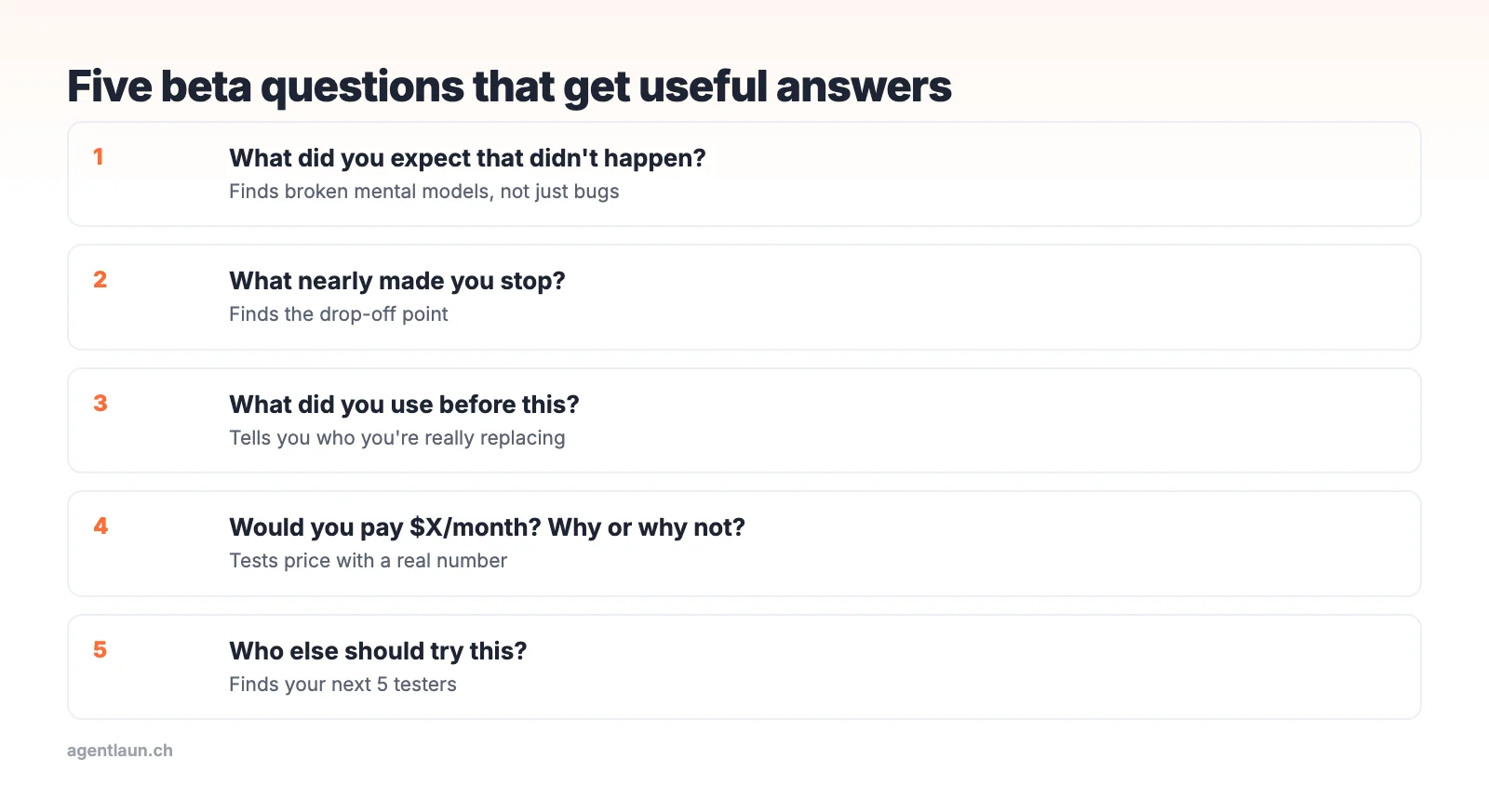
Generic "any feedback?" emails get generic answers. These five questions each target something specific: broken expectations, the drop-off point, your real competitor, willingness to pay, and your next testers. Send them as plain text, and ask for one-line answers. You'll get more replies than with a form.
Common beta mistakes
- Too many testers too early. 200 sign-ups you can't talk to produce less insight than 20 you onboard personally.
- Testers who aren't buyers. Founder communities give generous feedback, but if your buyer is an accountant, five accountants beat fifty indie hackers.
- No task. "Have a look around" produces "looks nice!" Give a concrete job to complete with their own data.
- Never closing the loop. Testers who never hear what changed stop replying. Testers who see their suggestion shipped become your launch supporters.
- Running the beta forever. Set an end date. A beta without one becomes an excuse not to launch. Use the readiness scorecard to decide when you're done.
Private beta vs open beta
| Private beta | Open beta | |
|---|---|---|
| Who | 20–50 invited, best-fit testers | Anyone who signs up |
| Goal | Fix onboarding and core flow | Test at volume, start word of mouth |
| Support | Personal, every user | Docs and in-app help |
| When to move on | Testers reach value unaided | Activation and retention look healthy |
Most SaaS should run a short private beta (2–4 weeks), then either an open beta or a straight public launch.
Related
FAQ
Where can I find beta testers for my SaaS? People who already asked for the product, your network, communities where the problem is discussed, beta platforms like BetaList and Peerlist, and founder communities.
How many beta testers do I need? 5–10 to find usability problems, 20–50 to validate onboarding, and 30+ in your target segment to test pricing.
Should I pay beta testers? Usually no. Give free access and a direct line to you. Paid panels rarely match your real buyers.
Is BetaList good for finding beta testers? It brings early adopters who like trying new products: BetaList had about 259,000 visits a month in our catalog data. They're good for testing onboarding, less so for finding your exact buyers.
How many beta testers does a new Android app need? New personal Google Play developer accounts need a closed test with at least 12 testers opted in for 14 consecutive days before publishing to production.