Field notes
B2B SaaS Marketing Strategy by Stage: From First 10 Customers to $1M ARR
A B2B SaaS marketing strategy by stage: founder-led sales, narrowing the ICP, one or two repeatable channels, then building the machine. Where B2B buyers research in 2026, channel playbooks, and the metrics to watch at each stage.
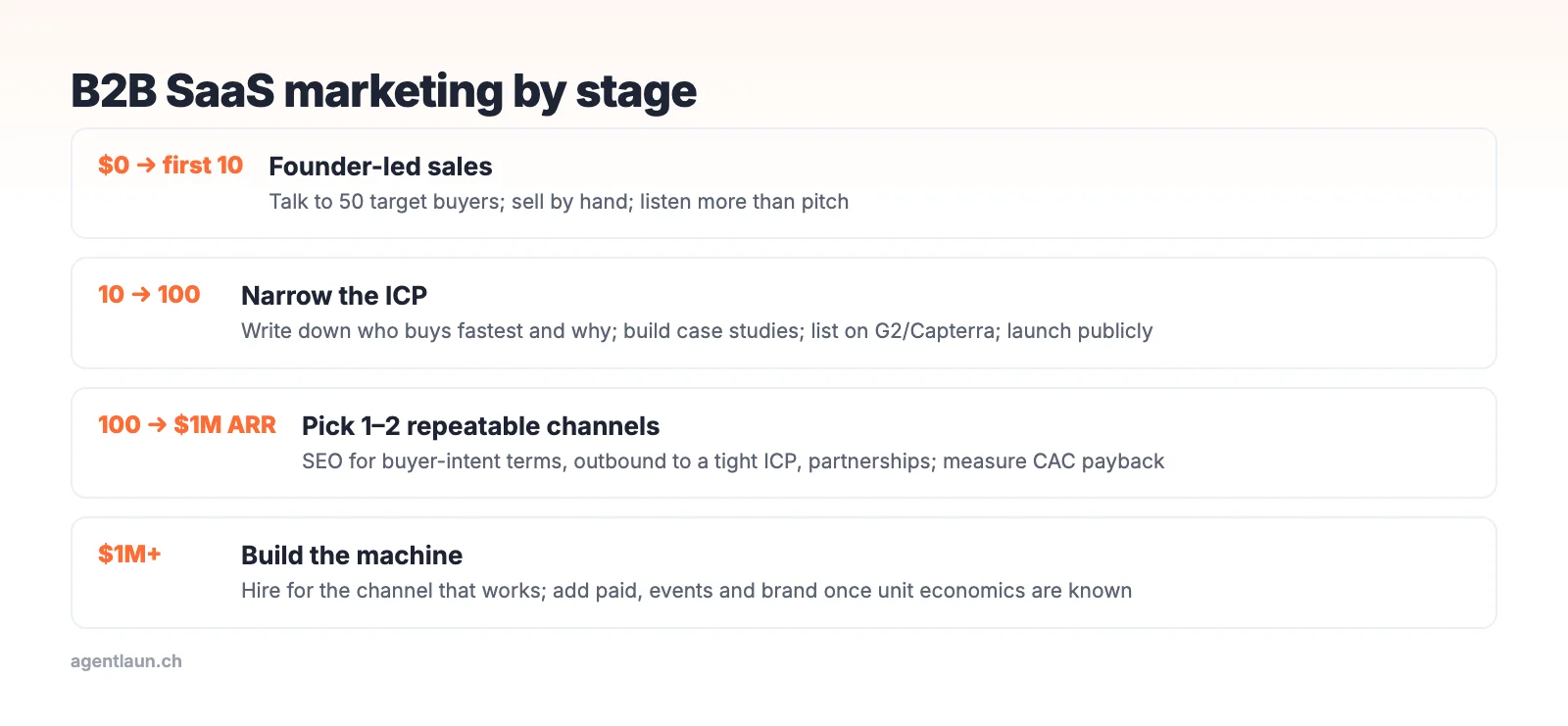
A B2B SaaS marketing strategy should change with your stage. Before 10 customers, it's founder-led sales: talk to buyers and sell by hand. From 10 to 100, narrow your ideal customer profile (ICP), build proof (case studies, G2 and Capterra reviews) and launch publicly. From 100 customers to about $1M ARR, commit to one or two repeatable channels, usually SEO for buyer-intent searches, targeted outbound or partnerships, and measure CAC payback. Only after $1M does it make sense to add paid, events and brand at scale.
Below is each stage in detail, with what to do, what to skip and what to measure.
Stage 1: zero to 10 customers, founder-led
- Do: 50 conversations with target buyers. Sell by hand. Write down the exact words customers use for the problem.
- Skip: brand campaigns, paid ads, hiring marketers.
- Measure: conversations, demos, closed deals, and why people said no.
Your job is to learn which buyer feels the pain most and will pay to fix it.
Stage 2: 10 to 100 customers, narrow and prove
- Write your ICP down: industry, company size, role, trigger event ("just raised Series A", "hiring their first RevOps person").
- Build proof: 3 case studies, and 10–20 reviews on G2 or Capterra (how to get them).
- Launch publicly for discovery and credibility (30-day launch plan), and list on the B2B review sites.
- Measure: win rate by segment, sales cycle length, time to value.
Stage 3: 100 customers to about $1M ARR, one or two repeatable channels
Choose by ACV (annual contract value):
| ACV | Channels that usually work |
|---|---|
| Under $2K | SEO, product-led growth, integrations and marketplaces, review sites |
| $2K–$20K | SEO for comparison terms, targeted outbound, webinars, partnerships |
| $20K+ | Account-based outbound, events, analyst relations, partners |
- SEO for B2B: target searches that show buying intent: "[category] software for [industry]", "[competitor] alternative", "[competitor A] vs [competitor B]", and "how to [job]" where your product is the answer.
- Outbound: small lists (200–500 accounts) that fit the ICP and trigger events, with personal messages.
- Measure: CAC by channel, CAC payback (under 12 months is healthy for most SMB and mid-market SaaS), pipeline by source.
Stage 4: past $1M ARR, build the machine
Hire for the channel that's already working. Add paid search and social with known unit economics, then events and brand. Invest in content that sales uses (comparison pages, ROI calculators, security docs).
Where B2B buyers research in 2026
Your strategy should put you where buyers already look before they talk to sales:
- Review sites. G2 alone gets about 2.25 million visits a month (SimilarWeb, our catalog). Buyers check reviews, grids and comparison pages there. Note that review sites are a trust channel, not an SEO link source: the free G2 profile we checked had no clickable link to the vendor (review sites compared).
- Google, including Reddit threads. When we checked 11 founder and buyer questions in Google in October 2026, a Reddit thread was the #1 result for seven. Buyers read those threads for unfiltered opinions (Reddit guide).
- Comparison and alternatives pages. "[Incumbent] alternative" and "[A] vs [B]" searches are where switching buyers start.
- AI assistants. Buyers increasingly ask an assistant for a shortlist. The same sources (review sites, comparison pages, community threads, your own clear product pages) are what those answers draw on.
- Peers. Slack and LinkedIn communities, and colleagues at other companies.
Channel playbooks
Comparison SEO
Build one page for each "[incumbent] alternative" and "[A] vs [B]" query your prospects mention on calls. Be honest about where the incumbent is better. These pages convert because the reader is already shopping.
Review sites
Concentrate your first 10 reviews on one site (G2 for mid-market and enterprise, Capterra for SMB), using the platform's own review campaigns. G2 allows gift cards for honest reviews through its campaigns; never tie an incentive to a positive rating (first reviews).
Targeted outbound
Small lists, tight ICP, a trigger event (a new hire, a funding round, a tool migration) and a personal first line. Two or three touches, then stop.
Partnerships and integration marketplaces
If your product integrates with a big platform, its marketplace is a buyer channel. The two integration marketplaces in our catalog have a median DR of 92 and around 4 million visits a month. A listing there, plus a co-marketing post with the partner, often beats months of cold outreach.
Launch platforms and directories
Less about buyers, more about early users, proof and followed links from high-DR sites. Useful in stage 2, especially for self-serve tiers (launch guide).
Metrics by stage
| Stage | Watch | Ignore for now |
|---|---|---|
| 0–10 customers | Conversations held, demos to close, why people say no | Traffic, MQLs |
| 10–100 | Win rate by segment, time to close, reviews collected | Brand awareness |
| 100 to ~$1M ARR | Pipeline and wins by channel, CAC payback per channel | Channels without attribution |
| $1M+ | Net revenue retention, CAC payback, sales efficiency | Vanity reach metrics |
CAC payback is how many months of gross margin it takes to earn back what you spent to win a customer. Track it per channel, not blended, or the good channel hides the bad one.
B2B-specific essentials at any stage
- Security page: SOC 2 status, data handling, subprocessors. Mid-market buyers ask early.
- Pricing transparency: even "from $X/month" filters out bad-fit leads.
- Review site presence: B2B buyers check G2, Capterra and TrustRadius before shortlisting (which first).
- Comparison pages for the competitors buyers mention on calls.
Choosing channels by contract value
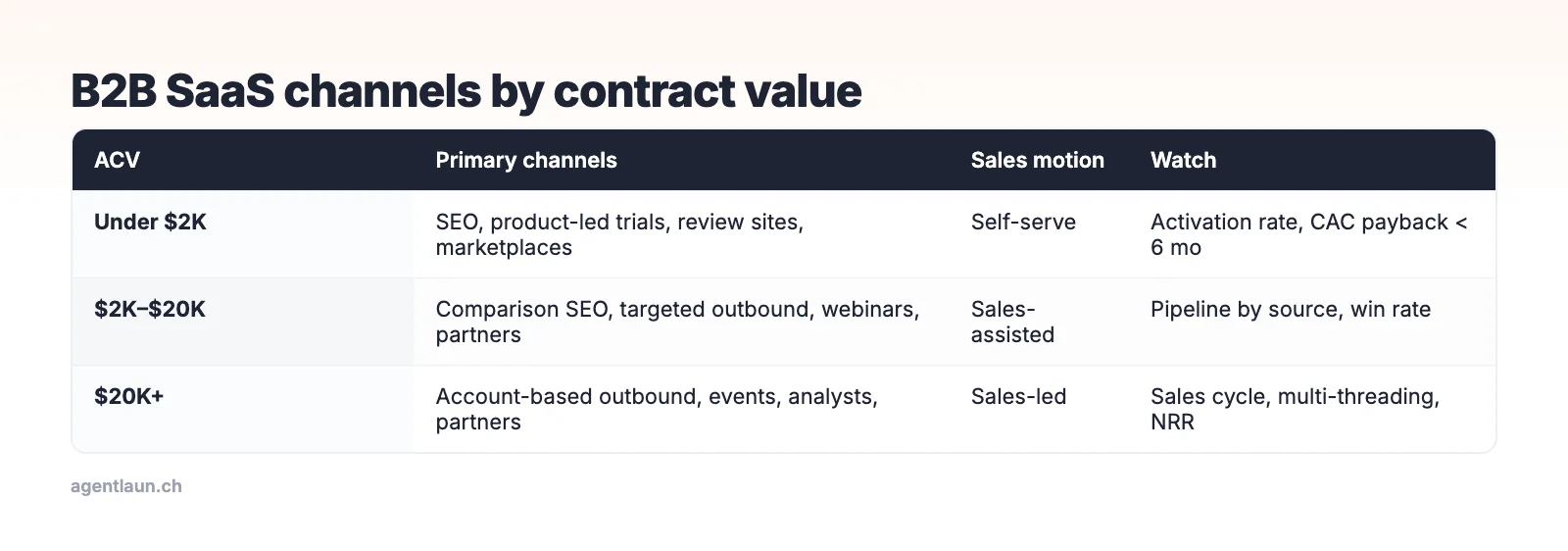
The reason ACV matters so much: it sets what you can afford per customer. If a customer pays $1,200 a year and you want CAC payback under 12 months, you can spend at most about $1,200 to acquire them, including the time of anyone selling. That rules out human-heavy outbound for most sub-$2K products and makes SEO, review sites and product-led trials the workhorses. At $20K+, a few months of a salesperson's time per deal is affordable, so account-based outbound and events become rational.
An example: a $6K ACV product at 40 customers
An illustrative plan for a workflow tool for 20–200 person agencies, $500/month, 40 customers, two founders:
- ICP from the data: 70% of current customers are agencies with 30–80 staff that just hired an operations lead. That trigger event becomes the outbound filter.
- Proof: three case studies with hours saved per month, and a G2 profile pushed to 15 reviews with a three-week review sprint.
- Channel 1, comparison SEO: pages for "[incumbent] alternative for agencies" and "[incumbent A] vs [incumbent B]", because prospects mention both on calls.
- Channel 2, targeted outbound: 300 agencies matching the ICP and trigger, personal emails from a founder referencing the new ops hire, and a two-step sequence.
- Measure monthly: pipeline and won deals by source, CAC payback per channel. After 90 days, keep the channel with the shorter payback and double its time.
What they skip: paid social, a brand refresh, conferences. None of those pay back at 40 customers.
Mistakes B2B teams make early
- Copying enterprise playbooks (analyst relations, big events) before there's a repeatable sale.
- Marketing to "SMBs" instead of a specific segment with a trigger event.
- Gating everything behind demos when buyers at sub-$5K ACV prefer to try first.
- Ignoring review sites even though B2B buyers check them before shortlisting (which to start with).
Related
- How to market a SaaS product: channel comparison and a 90-day plan
- How to get listed on G2 and TrustRadius
- AgentLaunch covers the B2B directories and review sites in one catalog, with eligibility rules like G2's B2B-only requirement
FAQ
What is a good B2B SaaS marketing strategy? Founder-led sales first, then a narrow ICP with proof, then one or two repeatable channels chosen by ACV, measured by CAC payback.
Which marketing channels work best for B2B SaaS? It depends on ACV: SEO, product-led growth and review sites under $2K; SEO, outbound and partnerships from $2K–$20K; account-based outbound and events above that.
When should a B2B SaaS hire its first marketer? Usually once one channel is working and needs more capacity, often around $500K–$1M ARR.
Do G2 reviews help B2B SaaS marketing? Yes, as proof buyers check before a demo. They don't give you an SEO link from a free profile, so count them as a trust channel.
What's the best marketing channel for early B2B SaaS? Founder-led sales and conversations first. After about 10 customers, comparison SEO and targeted outbound are the most common repeatable channels.