Vibe coding growth guidesSaaS launch and marketing
How to Get Users for Your App With No Audience: 8 Discovery Channels, Step by Step
Zero-audience ways to get users for a web or mobile app: directories, review sites, app stores, marketplaces, SEO pages and AI answers, with time and cost for each.
 By Pruthvi RajNovember 23, 2026
Here's how to get users for your app when nobody follows you: put it where people already search for tools. Then you don't need an audience of your own.
Quick answer:
- Fix discoverability first: custom domain, indexed pages, a sitemap.
- List on 20–30 launch platforms and directories that fit your app.
- Add it to alternatives and review sites, next to the tool it replaces.
- Ship to an app store or marketplace if your app belongs there.
- Write one page per problem or comparison people search for.
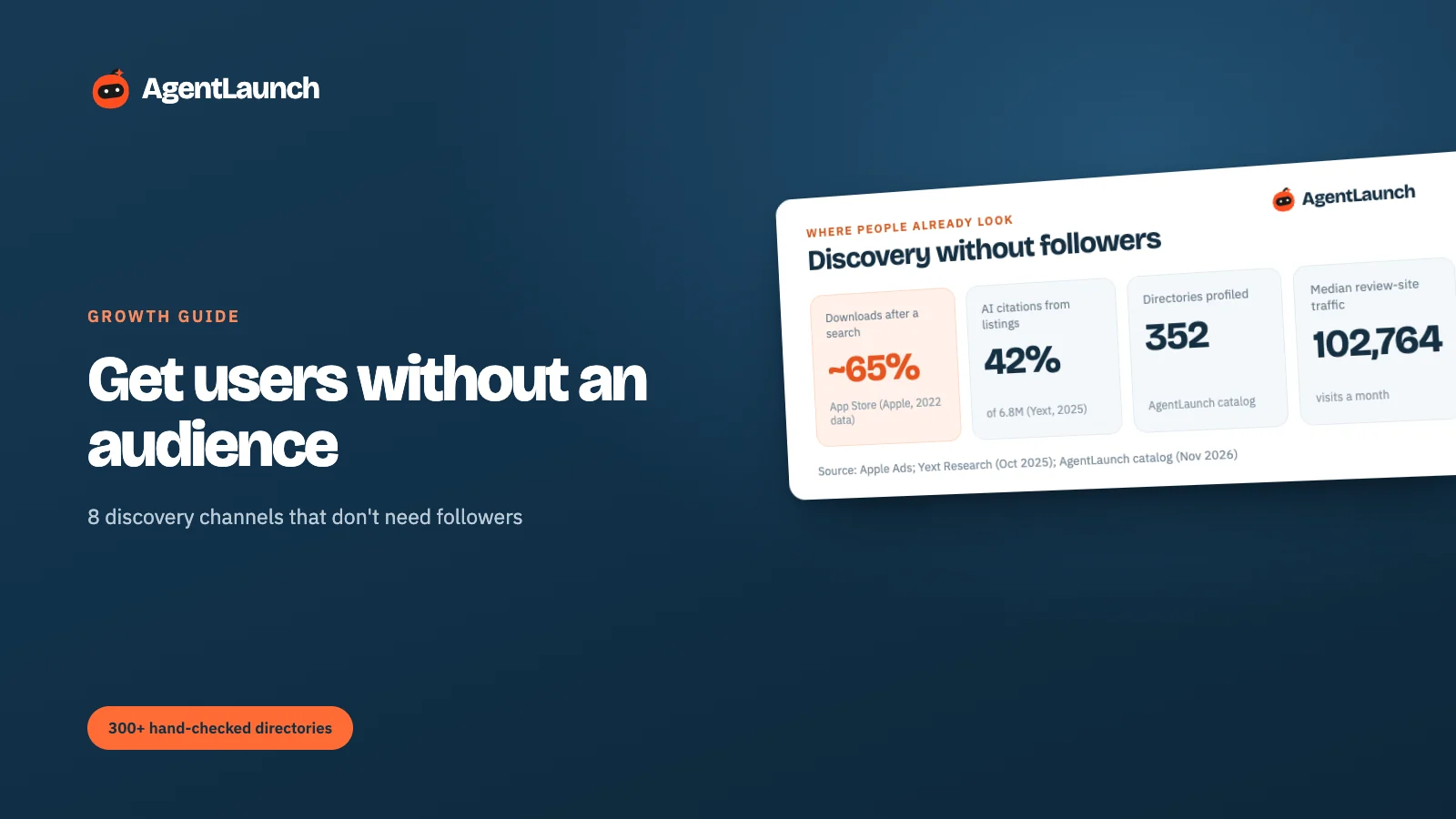
Search drives a lot of this. Apple says almost 65% of App Store downloads happen right after a search. In a Yext study of AI answers, 42% of citations came from listings.
This guide covers the channels that need no followers. For DMs, communities and referrals, read how to get your first 100 users too.
What you'll need
| What | Time | Cost |
|---|---|---|
| A custom domain | 1 hour | Domain fee |
| Google Search Console | 30 minutes | Free |
| Listing kit: logo, screenshots, tagline, descriptions | 2–3 hours, once | Free |
| Spreadsheet of listings with UTM tags | 30 minutes | Free |
| Developer accounts, mobile only | 1 day to 2 weeks | Apple $99/year, Google Play $25 once |
How to get users for your app: 8 channels compared
None of these needs followers. They differ in how long they take and what they ask for.
| Channel | Time to first user | Cost |
|---|---|---|
| Launch platforms and directories | Same day to months | Free to paid |
| Alternatives and review sites | Days to weeks | Free listings exist |
| App stores | After review | Apple $99/yr, Google $25 |
| Extension and integration marketplaces | Weeks, after real usage | Varies |
| Problem-search SEO pages | A few weeks or more | Your time |
| AI answers | No published timeline | Free |
| Niche communities | Days, after weeks of participation | Free |
| Partnerships | Days to weeks | Your time |
Directories and review sites are the fastest to start. SEO pages and AI answers are slow, but they keep working after you stop.
Step 1: Choose your path: web app or mobile app
Most vibe-coded apps are web apps. Lovable and Bolt build React web apps, and v0 builds Next.js. If you wrapped the app for iOS or Android, the store path applies too.
What changes for a mobile app:
- Search comes first. Apple says 70% of App Store visitors use search to find apps.
- It costs more up front. The Apple Developer Program is $99 a year. Google Play is $25 once.
- There's a gate. Google Play personal accounts made after 13 Nov 2023 need 12 testers opted in for 14 days before launch.
- Competition is rising. About 560,000 new apps hit the App Store in H1 2026 while downloads grew 2%, per Sensor Tower via 9to5Mac.
A mobile app still needs a web landing page. Directories, review sites and AI answers link to websites, not store pages.
Step 2: Make sure Google and AI crawlers can see the app
Every channel below sends people or crawlers to your site. If it renders as an empty shell or isn't indexed, they bounce.
Google's guide to getting on Google says a new site can take a few weeks to be noticed. Sites with no links from other sites can get missed.
What to check by builder:
- Lovable: apps created from 13 May 2026 render on the server. Older apps get prerendering for verified crawlers. Lovable makes a robots.txt but not always a sitemap, so ask for one and submit it.
- Bolt: Bolt Cloud added automatic SEO prerendering for new projects and custom domains in August 2025.
- Replit: the SEO Agent sits in the Growth pane after you publish. It runs a technical audit on paid plans.
- v0, Cursor, Claude Code: v0's Next.js can render on the server. A plain Vite app ships near-empty HTML, so add prerendering.
Our SEO checklist for vibe-coded apps has the full list. Then check your authority with the free DR checker. A new domain starts at 0.
Step 3: List on launch platforms and directories
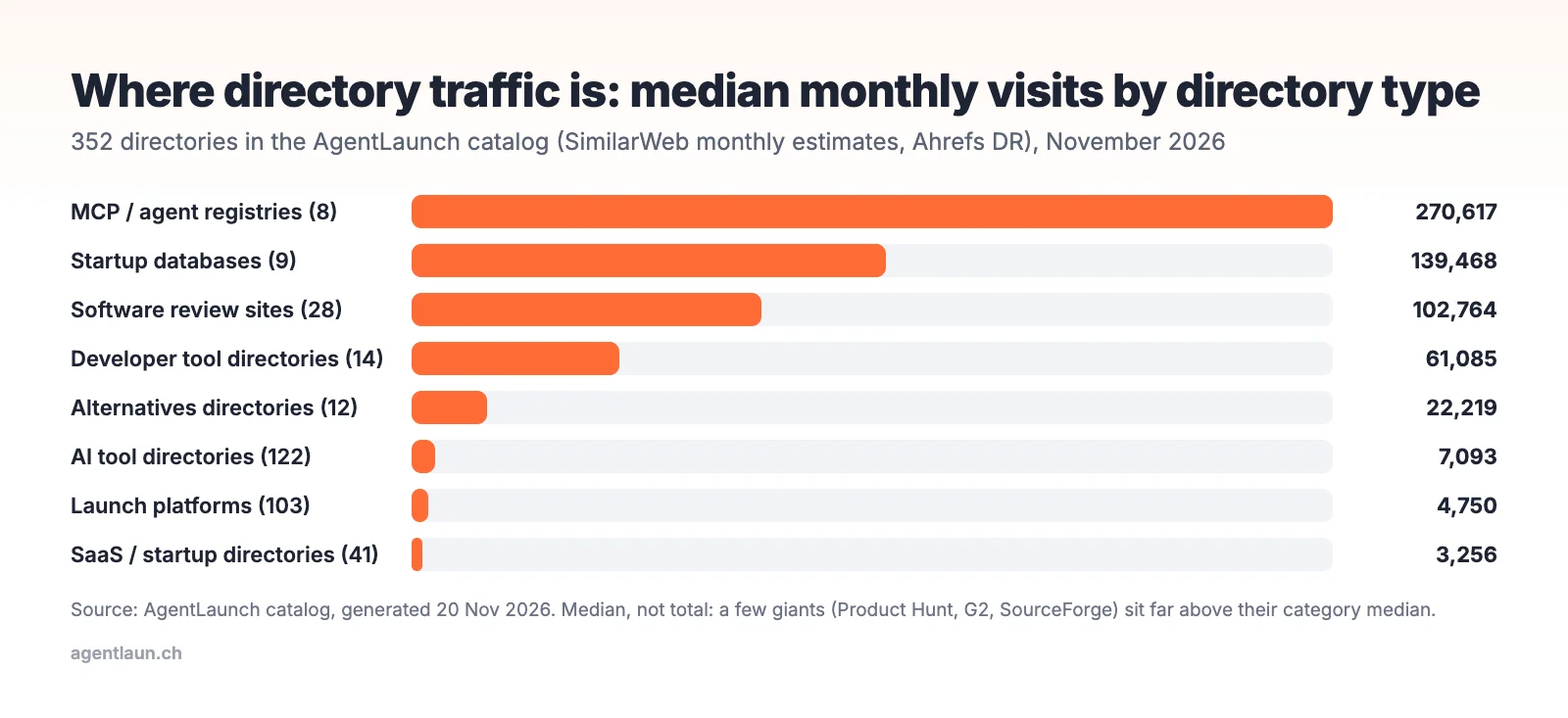
You can do a batch of directories in an afternoon, and every listing stays up.
Traffic varies by type. In the AgentLaunch catalog, the median launch platform gets 4,750 visits a month. The median software review site gets 102,764. Pick by fit and traffic, not count.
What directories send
Expect a trickle. ShieldLabs submitted to about 160 directories and got 171 sessions in two months. BetaList alone sent 94.
The founder's advice: build the pages your links should point to first, and fix tracking before you submit.
What slows you down
Niv Nisanov tried 40 free directories in October 2026. A month later, 5 were live, 10 were queued and 15 had blocked him.
Three of the five live ones needed a badge on his site first. One queue was full through December 2027, and another quoted about four months. Start the long queues on day one.
The order we'd use
- Check fit first. AI tools go in AI directories, dev tools in developer directories. You can check which directories fit your app for free.
- Submit to the long-queue sites first, then the instant ones.
- Write a different description for each directory type.
- Tag every link with its own
utm_source.
Our list of where to submit a vibe-coded app ranks the sites by DR, traffic and cost.
If you'd rather not fill 30 forms by hand, AgentLaunch is an AI agent you run from Claude Code, Codex or Cursor. It submits your app in a real browser, writes copy for each site, and stops only for CAPTCHAs, payments or 2FA.
Step 4: Get on review and alternatives sites
These catch people searching "alternative to [tool]" or comparing a category. Numbers come from the AgentLaunch catalog.
| Site | DR | Monthly visits |
|---|---|---|
| SourceForge | 93 | 22.5M |
| AlternativeTo | 80 | 2.1M |
| G2 | 91 | 2.2M |
| SaaSHub | 81 | 407K |
| Capterra | 59 | 87K |
All five have a free listing. AlternativeTo is the best free option if your app replaces a tool people know.
G2 and Capterra only matter once you can get real reviews, and they aren't built for consumer apps. G2 has owned Capterra since February 2026.
The full set is on the software review sites hub. Each listing is also a link to your domain, which our guide on how to get backlinks for a new website covers.
Step 5: Use app stores, extension stores and marketplaces
If part of your product lives inside another tool, that tool's marketplace is a search engine full of its users.
App stores. For a mobile app, the store listing is your main page. The name, subtitle and keywords do the work a homepage does on the web. Budget for Google Play's 14-day closed test if your account is new.
Extensions. A Chrome extension needs a Chrome Web Store developer account and a one-time fee. The VS Code Marketplace is huge, but it only helps if you ship an extension.

Integration marketplaces. These have entry bars. Slack's guidelines turn away apps on fewer than 10 active workspaces with fewer than 20 monthly active users.
Zapier wants the app fully launched, not invite-only or beta. Get a few users first, then list.
Step 6: Answer problem searches with pages
People with a problem search for the problem, not your brand. Write one page per problem or comparison, like "[competitor] alternative" or "how to [task] without [tool]."
These also give directories something better to link to than your homepage. ShieldLabs pointed most of its 160 links at the homepage because its comparison pages didn't exist yet.
Each page needs real content: screenshots, steps, a comparison with facts. Expect weeks, not days, for a new domain to get noticed.
Step 7: Get cited in AI answers
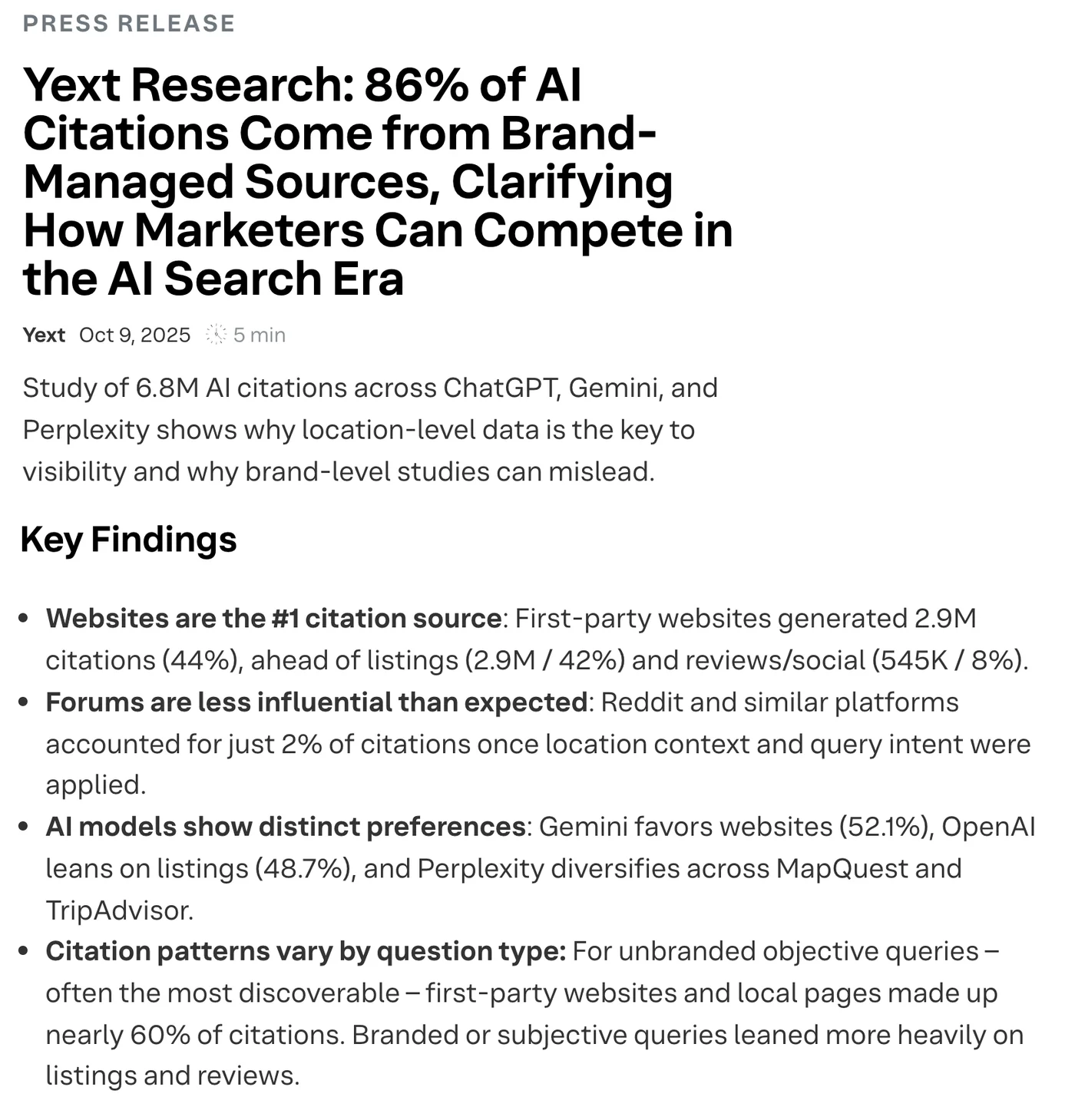
Yext analysed 6.8 million citations from ChatGPT, Gemini and Perplexity. Brand websites made up 44%, listings 42%, and reviews and social 8%. Forums like Reddit were just 2%.
The study covered retail, finance, healthcare and food, not software. Treat it as a direction, not a number for your app.
In practice: keep your site crawlable, and use the same name, one-liner and category on every listing. Our guide on how to get recommended by ChatGPT goes step by step.
Step 8: Borrow audiences: communities and partnerships
You don't need followers if you show up where your users gather. The catch is time. Communities expect weeks of participation, and many remove self-promotion from new accounts.
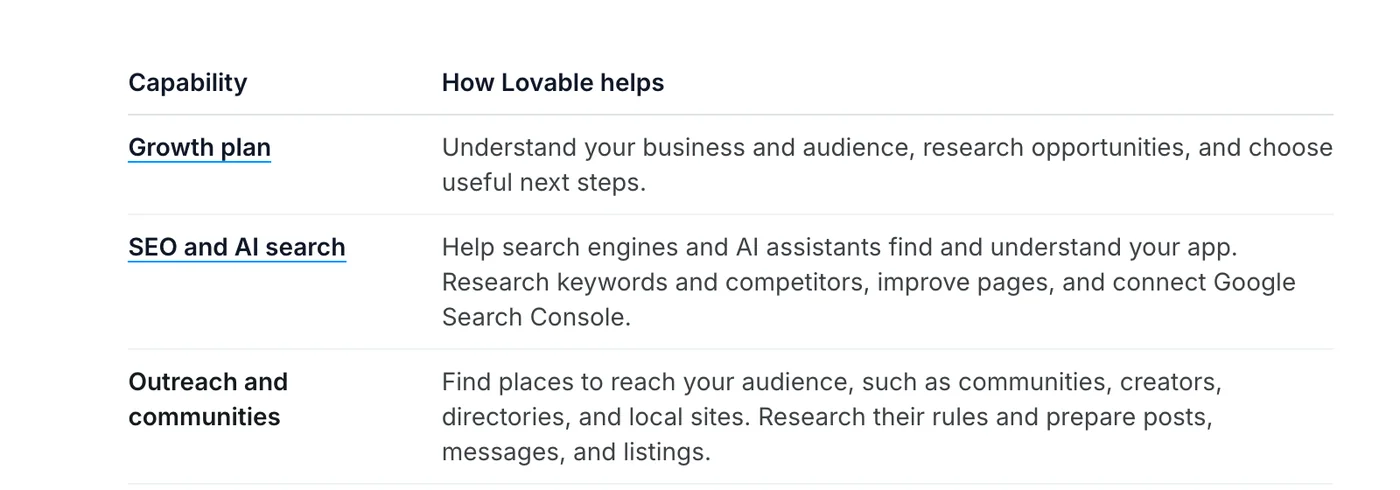
If you built with Lovable: its Growth tools include "Outreach and communities." It researches communities, creators and directories and drafts posts, but you publish them yourself. With other builders, ask your coding agent to do the research and drafts.
Partnerships: find a newsletter, moderator or complementary tool with your audience. Offer their readers something useful, like a free template or a guest tutorial. A short first message:
Hi [name], I built [app], which helps [your users] do [task]. Your readers ask about [problem] a lot. Would a free [template or tutorial] for them be useful? No cost, and I'll write it to fit your format.
Common mistakes
- Listing an app Google can't see. Check rendering and indexing first.
- 200 directories, one description. Fit and tailored copy beat volume.
- Every link to the homepage. Build comparison and problem pages first.
- Ignoring badge and queue rules. Read the last step of a form before writing copy.
- Applying to marketplaces too early. Slack and Zapier expect real users.
- No UTM tags. You won't know which channel worked.
What results to expect
- Directories: about 160 submissions brought 171 sessions in two months.
- Free directories: 40 tried, 5 live and 10 queued after a month.
- App stores: almost 65% of App Store downloads follow a search.
- SEO pages: a new site can take a few weeks just to be noticed.
No source we found gives a reliable users-per-channel number for new apps. For the full plan, see how to market a vibe-coded app, and for free places to post, where to promote your app for free.
FAQ
How do I get users for my app with no audience?
Use channels where people already search: directories, review sites, app stores, problem pages and AI answers. Start with directories that fit your app and one page per problem.
How do I get users for my app, according to Reddit?
Founders who report results joined niche communities for weeks first and posted about the problem, not the product. Those who dropped a launch link right away report removals and bans.
How do I get my app noticed?
Make it findable before you promote it: custom domain, indexed pages, a sitemap. Then list it on sites with real traffic.
How do I get users to download my app?
Treat the store listing as your homepage. Most App Store downloads follow a search, so your name, subtitle, keywords and screenshots decide most installs.
How do I get more users for my app once I have a few?
Double down on the channel that brought them. Ask happy users for referrals and reviews, then apply to marketplaces that need real usage.
Are directories worth it for getting users?
As a permanent trickle and a source of links and AI citations, yes. As your main source of signups, no.