Vibe coding growth guidesSubmission strategy
Are Startup Directories Worth It? A Data-Backed Guide to Picking the 10–20 That Count
What 352 directories and one 160-submission case say about links, traffic and spam risk, and how to pick the 10 to 20 listings that are worth your time.
 By Pruthvi RajNovember 23, 2026
Are startup directories worth it? Yes for links and getting found, no for signups. Submit to 10 to 20 relevant ones, not 100.
Quick answer:
- Treat directories as background link and discovery work, not a user channel.
- Pick 10 to 20 that fit your product, give a followed link and get real traffic.
- Skip low-quality link directories: Google counts them as spam.
- Don't pay for a dofollow link. Pay only for an audience you want.
- Check every live listing for the link, and tag each one so you can see who sends visitors.
In one public case, about 160 submissions brought 171 referral sessions out of roughly 3,300, and only 2 signups analytics could trace.
What you'll need
| What | Time | Cost |
|---|---|---|
| A custom domain, not a free subdomain | 30 min | Domain fee |
| Google Search Console | 20 min | Free |
| Analytics that reads UTM tags | 30 min | Free tiers exist |
| A shortlist with link type, traffic and cost | 1 hour | Free |
| A DR checker | 5 min per site | Free |
| A tracker for every listing | Ongoing | Free |
Are startup directories worth it? What the numbers say
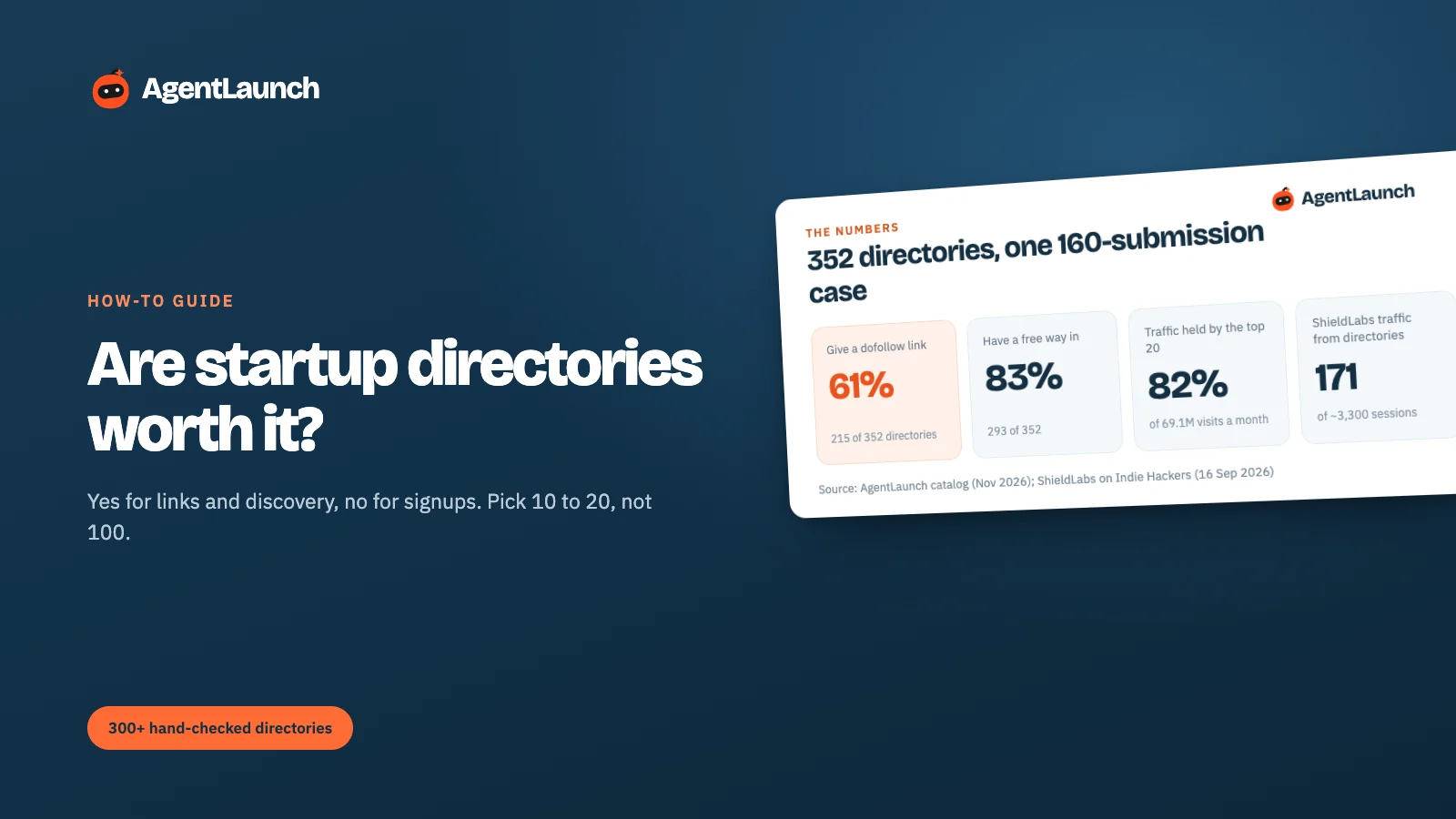
The AgentLaunch catalog profiles 352 directories. DR is Ahrefs Domain Rating. Visits are monthly SimilarWeb estimates of each directory's own traffic, not what it sends you.
| Question | Catalog answer |
|---|---|
| Give a dofollow link | 215 of 352 (61%) |
| Have a free route | 293 of 352 (83%) |
| Paid only | 59, median listed price $27 |
| Traffic held by the top 20 | 82% of 69.1M visits a month |
| Get under 10,000 visits a month | 188 of 352 (53%) |
| Median authority | DR 49 |
This catalog is already curated, and a random list of 1,000 looks worse. Either way, a short list gets most of the value.
The ShieldLabs case: what 160 submissions did
The best public numbers come from Yahor Papou, who runs marketing at ShieldLabs, a fraud detection tool. He posted the results on Indie Hackers on 16 September 2026, after two months of submitting.
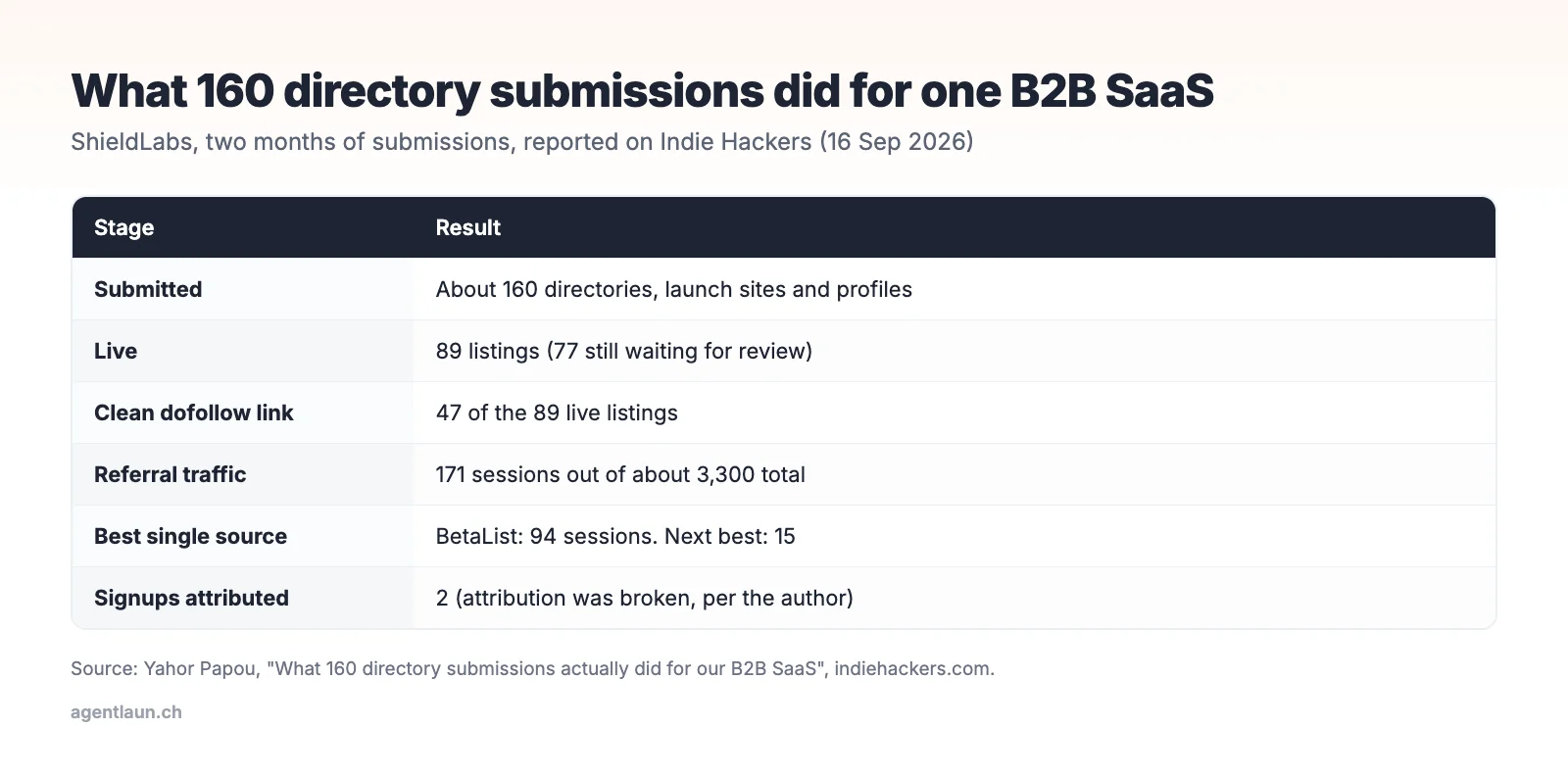
- Listings: 89 live, 77 still in review.
- Links: only 47 gave a clean dofollow link. 15 had no direct link at all.
- Traffic: 171 sessions from directories out of about 3,300. BetaList sent 94, the next best sent 15.
- Signups: 2 traced to a directory. Tracking broke when visitors moved from the site to the app subdomain.
- Authority: DR 12, with most links not counted yet because link indexes lag by weeks.
His summary: directories give "breadth, not weight." Editorial mentions moved DR more.
Even BetaList's 94 sessions led to 5 signup-button clicks and no signup he could confirm. Other founders in a separate Indie Hackers thread report the same. One got four visits a month from about 30 directories.
Step 1: Decide which job you want directories to do
What directories are good for
- Getting found. Google discovers new pages by following links from pages it already knows. A new domain with no links has nothing to follow.
- First referring domains. A new site starts at DR 0. Followed links from DR 50+ directories are the easiest first links you'll get.
- Brand searches. People see you on a directory and search your name later. That shows up as direct or organic, so it's real but hard to measure.
- AI citations. In a Yext study of 6.8 million AI citations, 42% came from listings. The sample was local businesses, not software, so take it as a direction.
- Trust. A review site profile gives a prospect a third-party page to check you on.
What they're not good for
- Signups this week. ShieldLabs got about 5% of its traffic from 89 live listings.
- Moving DR fast. Editorial mentions did more.
If you need users now, read how to get your first 100 users first. Let directories run in the background.
Step 2: Check the spam risk before you submit
Are directory submissions spam?
Some are. Google's spam policies list low-quality directory links as an example of link spam. The test is whether links exist mainly to manipulate rankings.
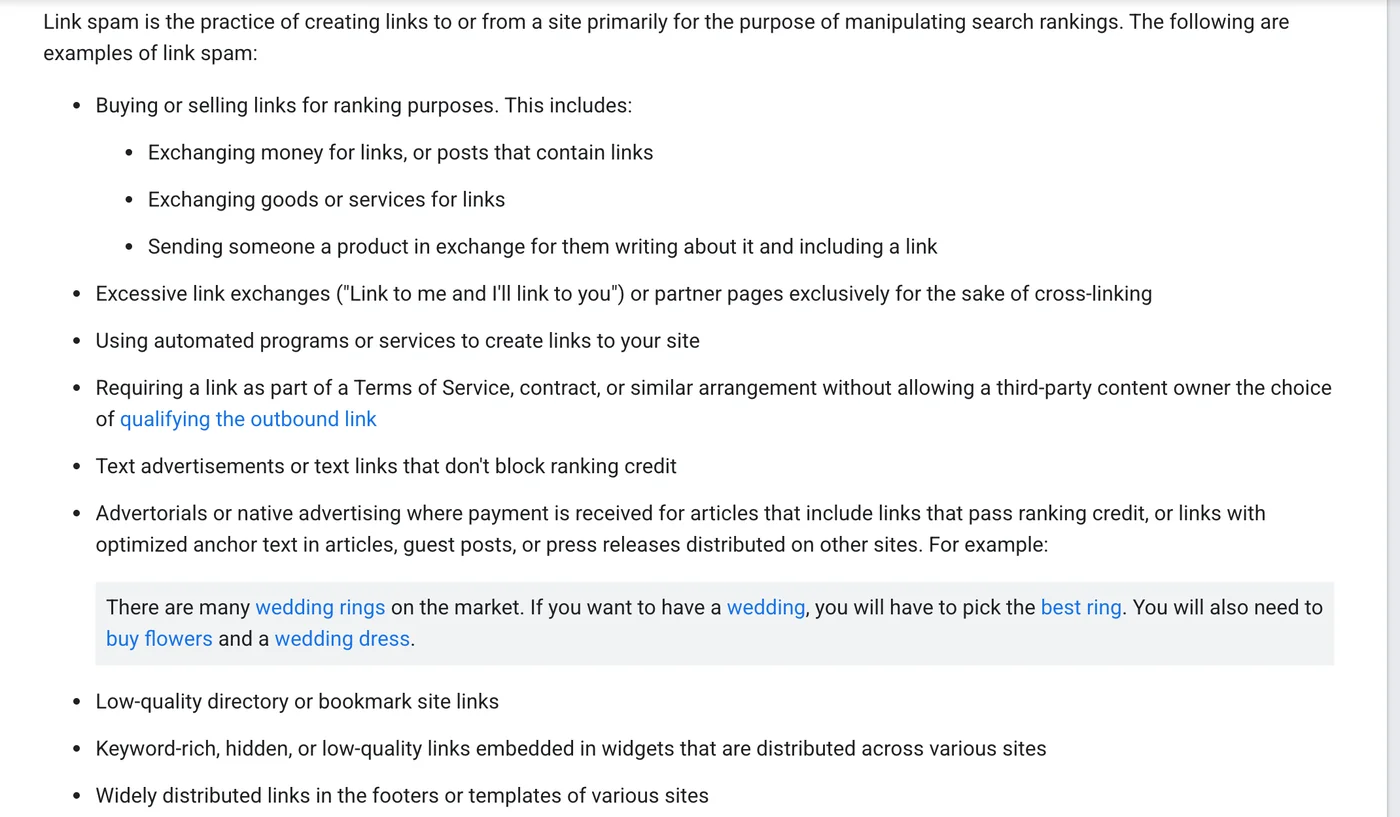
In 2021 John Mueller said directory submissions are generally seen as artificial links, per Search Engine Roundtable. That was about old link-building tactics. A product directory that reviews listings and has its own visitors is a different thing.
Three items on Google's list matter most here:
- Paid links that pass ranking credit. Google wants paid placements marked rel="sponsored". Yet 37 of the 59 paid-only directories in the catalog give a dofollow link. Pay for the audience, not the link.
- Excessive link exchanges. 86 directories want their badge on your site for a free listing. One badge is fine. A footer full of them looks like a link exchange.
- Automated link creation. This targets tools that blast links onto sites that publish anything. Hundreds of live links in a day is the warning sign.
Quick spam test
- Does it have its own search traffic?
- Does it review submissions, or publish instantly?
- Is it for products like yours, or any URL?
- Do its listing pages show up in Google?
If the first two answers are no, skip it.
Step 3: Filter by link type, then verify the live link
Do directory backlinks help SEO?
A followed link from a crawled, relevant page helps discovery and passes some authority. A nofollow link still helps discovery and can send visitors, but won't move DR.
The dofollow vs nofollow difference is the rel attribute on the live page. The directory's marketing doesn't decide it.
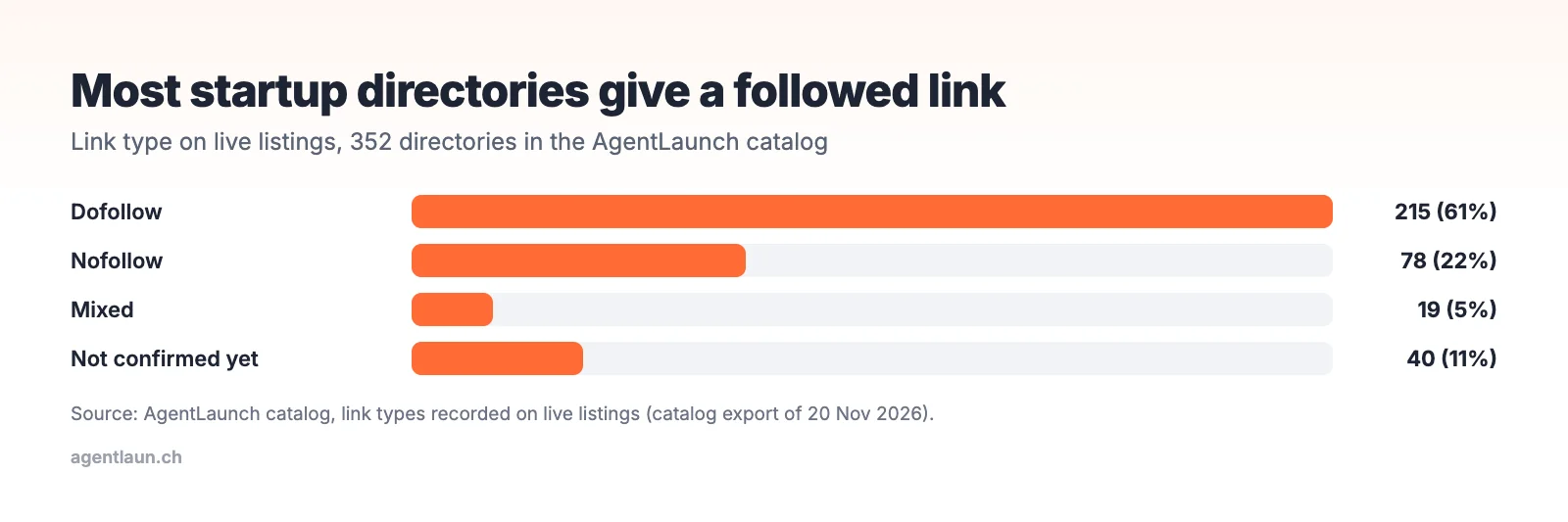
Dofollow share by category in the catalog:
- AI tool directories: 70% of 122
- Launch platforms: 59% of 103
- Software review sites: 54% of 28
- SaaS and startup directories: 51% of 41
- Startup databases: 44% of 9
Some big names are nofollow, like G2, Crunchbase and Peerlist. They're still worth it for the audience and trust.
After a listing goes live, view the source and check the rel on your link. Our guide to checking directory backlink quality shows how. The list of dofollow directories is a good starting filter.
Step 4: Filter by traffic, because 20 directories hold most of it
Which directories send users?
The ones people browse. The 352 directories get about 69.1 million visits a month, and the top 20 get 82% of it. SourceForge alone has 32.6%.
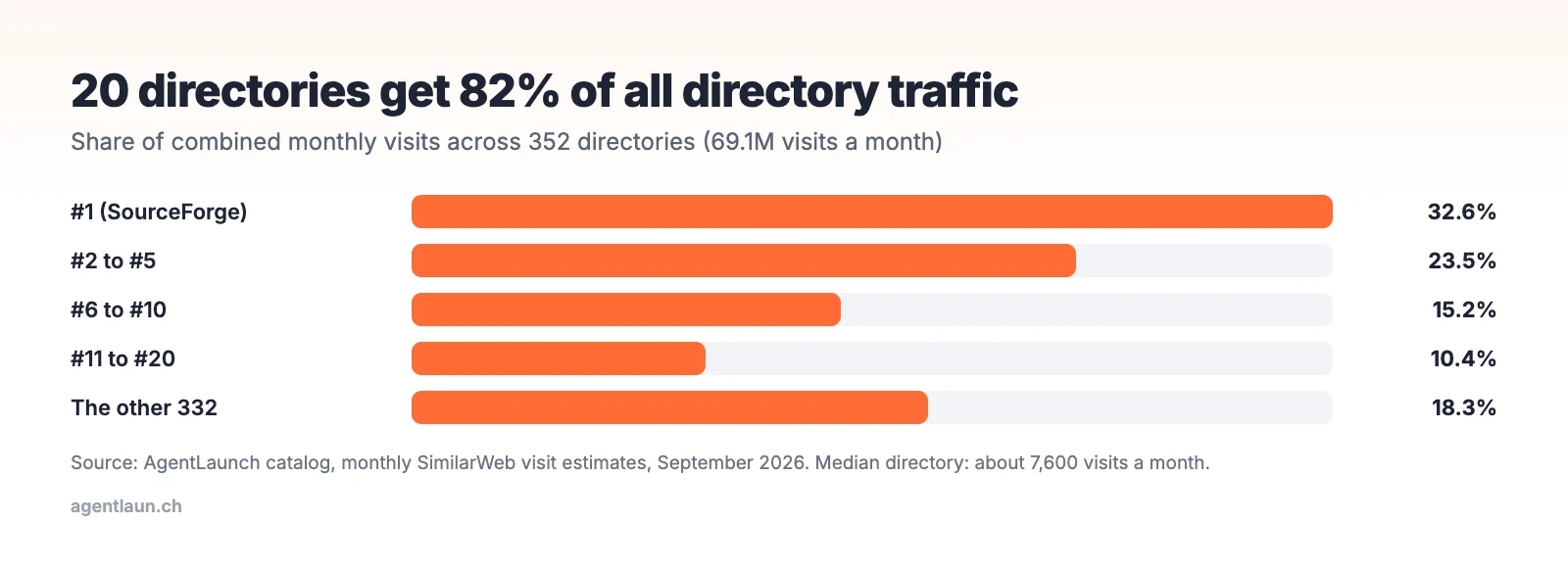
The top 20 include SourceForge, There's An AI For That, Product Hunt, G2, AlternativeTo, Peerlist and SaaSHub. Some only fit certain products. VS Code Marketplace is for extensions and RapidAPI is for APIs.
A directory's traffic is a ceiling, not a forecast. BetaList gets about 259,000 visits a month and sent ShieldLabs 94 sessions. A site with 3,000 visits spread over thousands of listings will send you close to zero.
Use traffic to pick where you want visitors. Use link type to pick where you want authority.
Step 5: Decide where free is enough and where paying makes sense
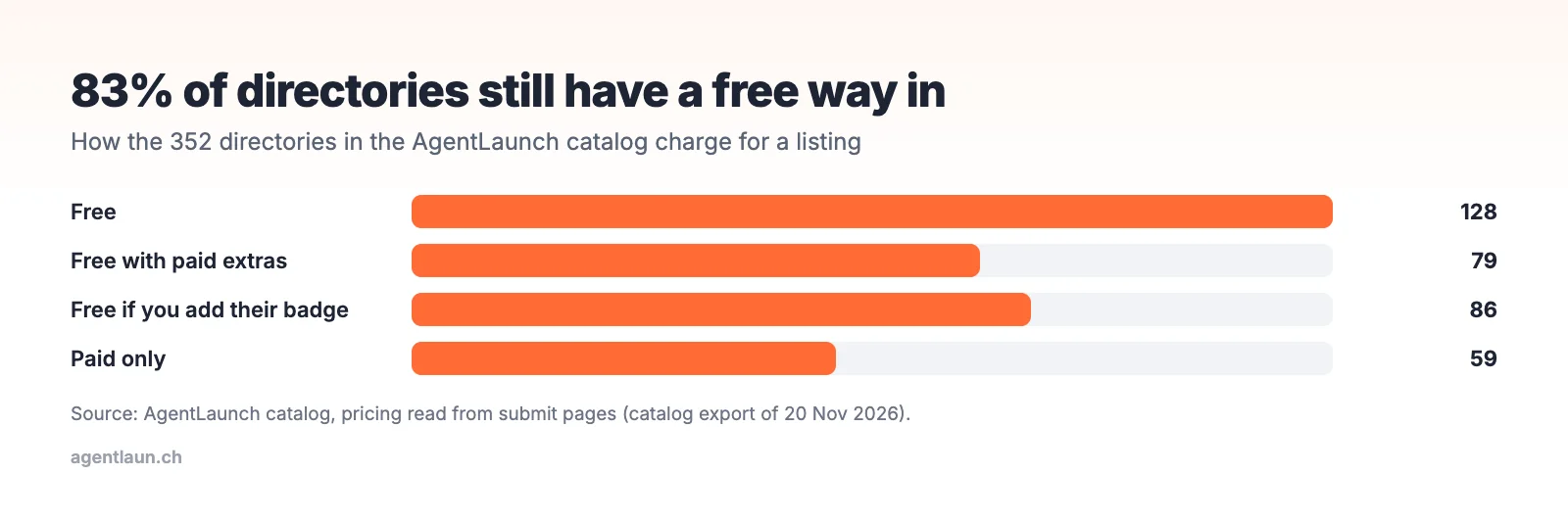
Most directories don't need money. But free often comes with a catch: a badge, a long queue or a points system.
Founders report Launching Next has a 2 to 4 month free queue unless you pay. Fazier's free tier asks for comments on other launches, its badge and a DR above 0.
Pay when:
- The directory has your audience and the paid tier buys a date or placement. BetaList, the one source that sent ShieldLabs real traffic, is paid only.
- A long free queue would push your listing past launch week.
Don't pay when the main offer is a dofollow backlink. That's the paid-link problem from Step 2, and the link may not even be there when you check.
Step 6: Pick 10 to 20 relevant listings, not 100
Is it worth submitting to 100 directories?
For most new products, no. The traffic sits in the top 20, and over half the catalog gets under 10,000 visits a month. Every extra form costs time, a login and often a CAPTCHA.
ShieldLabs' own advice was to spend that time on reviews and editorial outreach instead.
Keep a directory if it passes all four checks:
- Fit: it lists products like yours, such as AI tools, SaaS, dev tools or mobile apps.
- Link: dofollow or mixed on live listings, verified.
- Audience: real monthly traffic, ideally 10,000+.
- Cost: free, or a paid tier that buys reach, not just a link.
Then add the leaders for your category even if they're nofollow, like G2 for B2B software or Product Hunt for a launch. That gives you 10 to 20 listings that do most of what 160 would.
Start with our list of where to submit a vibe-coded app, check which directories fit your app, and confirm authority with the free DR checker.
Submitting the shortlist
Every form wants different copy. Tagline limits run from 80 to 300 characters across the forms we parsed, and Product Hunt caps it at 60. Write for each directory instead of pasting one blurb.
If you'd rather not fill 20 forms by hand, AgentLaunch is an AI agent you run from Claude Code, Codex or Cursor. It submits to a hand-checked catalog, writes copy for each form and stops for CAPTCHAs, payments and 2FA.
Our automated directory submission guide compares it with services and extensions.
Step 7: Fix attribution, then measure for 90 days
ShieldLabs' biggest regret was tracking. Do this before the first listing goes live:
- Tag each listing with its own
utm_source. Many forms take only a bare domain, so you'll rely on the referrer for those. - Carry the source into your app. If signup happens on
app.yourdomain.com, pass the source through, or every directory signup shows as direct. - Point links at the right page. A comparison or use-case page converts browsing visitors better than the homepage.
- Log each listing: submitted date, live date, link type, and visits at 30 and 90 days.
Our guide to measuring directory referral traffic has the setup.
Who should and shouldn't bother
| You are | Worth it? | Do this |
|---|---|---|
| New domain, DR 0 | Yes | 10 to 20 followed listings |
| AI tool | Yes, selectively | AI directories, check before paying |
| B2B SaaS | Yes | Review sites plus a few launch boards |
| Still on a free subdomain | Not yet | Move to a custom domain first |
| Need signups this week | No | Communities and outreach first |
| Established site, DR 50+ | Low value | Category leaders only |
| Agency or local business | Mostly no | Use local listings instead |
Common mistakes
- Counting submissions, not live links. ShieldLabs had 160 submitted, 89 live, 47 clean dofollow.
- Submitting before tracking works. You can't recover lost attribution later.
- Submitting from a free subdomain. BetaList refuses it, and the links point at a subdomain you'll leave.
- One description everywhere. Papou called it easy and pointless.
What results to expect
Listings go live over weeks to months. ShieldLabs still had 77 in review after two months.
Most referral traffic will come from one or two directories, like BetaList's 94 of 171 sessions. DR moves slowly because link indexes lag.
No public case here shows directories alone bringing a steady stream of signups. Get users elsewhere and let listings work in the background. For the wider link plan, see how to get backlinks for a new website.
FAQ
Are startup directories dead?
No, but their job changed. They rarely send signups, but they help a new site get found, earn first links and show up in AI answers.
Do directory backlinks help SEO?
Followed links from relevant, crawled directories help discovery and add some authority. Low-quality link directories don't, and Google calls them spam.
Which directories send users?
The ones with real browsing traffic that fit your product. For ShieldLabs, BetaList sent 94 of 171 directory sessions.
Is it worth submitting to 100 directories?
Usually not. Half of even a curated catalog gets under 10,000 visits a month. 10 to 20 good listings give most of the value.
Are directory submissions spam?
Mass submissions to low-quality link directories are. A reviewed product directory with its own audience is not. Don't pay for dofollow links or stack badges.
How long until directory links show up?
Reviews take days to months, and link indexes like Ahrefs lag by weeks after that. Judge results at 90 days.