Vibe coding growth guidesSaaS launch and marketing
Why Does My App Have No Users? 9 Reasons and How to Fix Each One
Nine reasons apps get zero users, each with a test you can run in minutes and the fix, from Google indexing and backlinks to signup walls and app-store fit.
 By Pruthvi RajNovember 23, 2026
If you're asking "why does my app have no users?", the cause is usually discovery, not the product. Google hasn't indexed it, nothing links to it, or you only posted where other founders hang out.
Quick answer:
- Test discovery first: is the app indexed, and does anything link to it?
- Then test the page: is it clear in 5 seconds, and fast on a phone?
- Then test the channel: are you posting where buyers are?
- Then test the product: can people try it before signing up, and do they come back?
- Fix the first test that fails before you touch the next one.
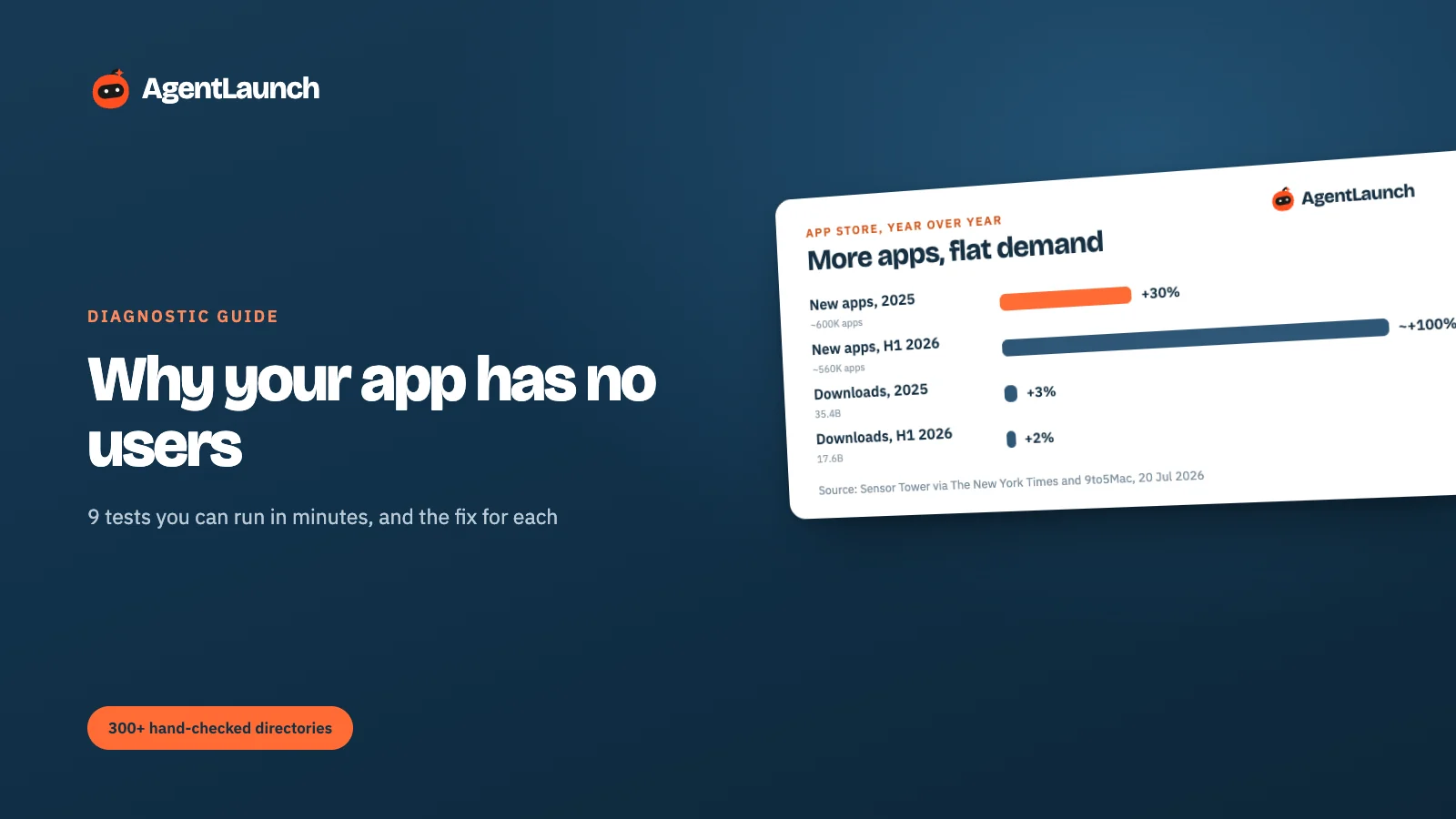
Every gap hurts more now. The App Store added about 560,000 new apps in the first half of 2026, nearly as many as in all of 2025. Downloads grew 2%.
What you'll need
| What | For | Time |
|---|---|---|
| Google Search Console access | Tests 1 and 2 | 10 min |
| Free DR checker | Test 2 | 2 min |
| Five people who haven't seen your app | Test 3 | 15 min |
| PageSpeed Insights | Test 4 | 2 min |
| Your analytics | Tests 5, 7 and 8 | 15 min |
| An incognito browser window | Test 6 | 5 min |
All of it is free.
Why does my app have no users? The 2-minute triage
| Cause | Quick test | If it fails |
|---|---|---|
| 1. Not indexed | URL Inspection in Search Console | Sitemap, links, fix rendering |
| 2. Nothing links to it | Check your Domain Rating | 20 relevant directories |
| 3. Unclear one-liner | 5-second test with 5 people | Rewrite the hero line |
| 4. Slow on mobile | PageSpeed Insights | Fix LCP, INP, CLS |
| 5. Wrong channel | Sources of your last 20 visitors | Go where buyers ask |
| 6. A wall before value | Steps to the first result | Try before signup |
| 7. No reason to return | Week-2 return rate | One recurring trigger |
| 8. Launched once, stopped | Actions in the last 14 days | A weekly routine |
| 9. Wrong store | Is it a wrapped website? | Web first, or make it app-like |
Work top to bottom. Causes 1 and 2 hide all the others, because nobody can find the app to test the rest.
Step 1: Check whether Google has indexed your app
2-minute test: in Google Search Console, paste your homepage URL into the inspection bar. Then open the Pages report under Indexing and read why pages aren't indexed. A site:yourdomain.com search is a rough second check.
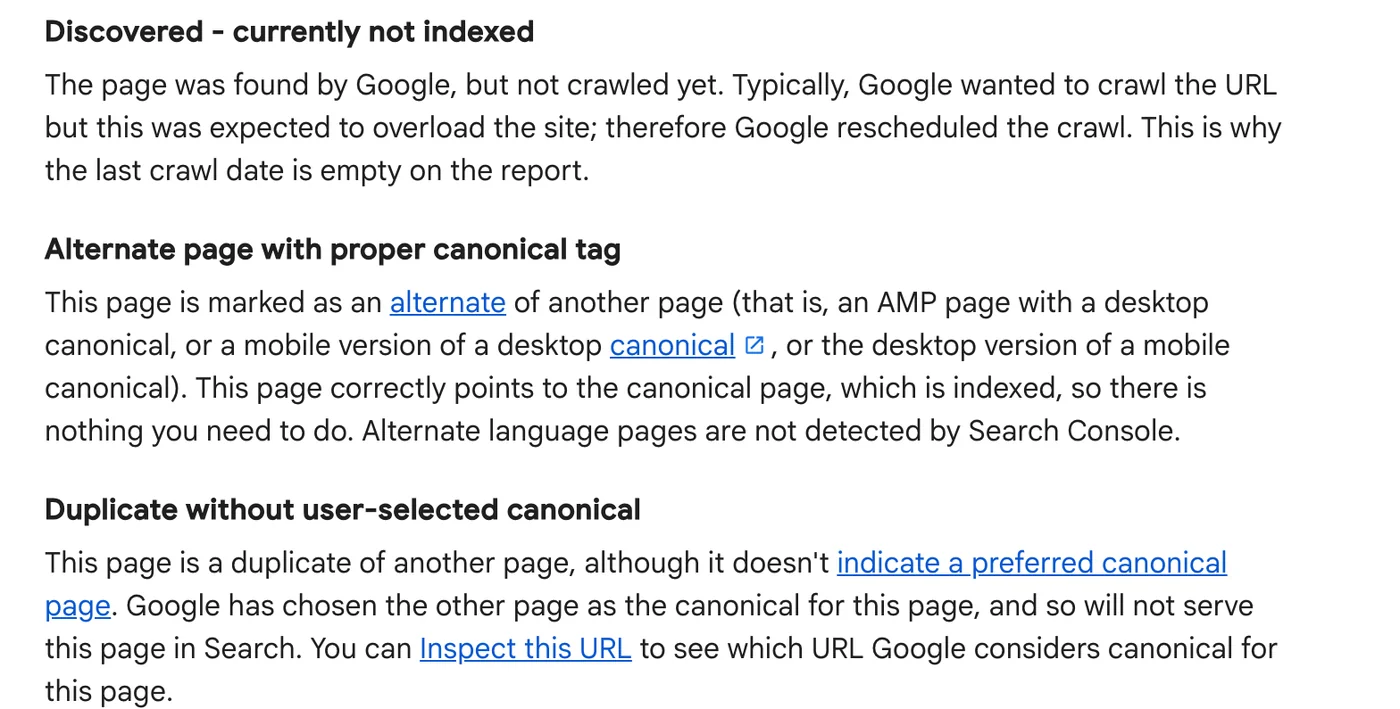
Google's Page indexing docs explain the common statuses.
- Discovered - currently not indexed: Google found the page but hasn't crawled it yet.
- Crawled - currently not indexed: Google crawled it and chose not to index it for now.
- Duplicate without user-selected canonical: Google picked another URL as the main one. Often that's your
lovable.apporvercel.appaddress. - URL marked 'noindex': a leftover
noindextag, common when a preview setting ships to production.
Fix: do these in order.
- Submit a sitemap in the Sitemaps report. Link every important page from your homepage.
- Set a canonical tag on each page that points at your custom domain.
- Check rendering. Lovable apps created from 13 May 2026 are server-rendered, and older ones are pre-rendered for verified crawlers.
- Click Test live URL, then Request indexing, once. Google says crawling can take a few days to a few weeks, and repeat requests don't speed it up.
If you built a Vite + React app in Cursor or Claude Code, view the page source. An almost empty <div id="root"></div> means crawlers that don't run JavaScript see nothing.
Our SEO checklist for vibe-coded apps and Lovable SEO guide walk through each builder.
Step 2: Check whether anything links to your app
2-minute test: run your domain through a Domain Rating checker. A new domain usually starts at or near zero, which means almost no sites link to it yet.
New to the metric? The glossary entry on domain rating explains it.
Fix: get listed on about 20 directories that fit your product. Then work on real mentions in articles and newsletters.
ShieldLabs submitted to 160 directories: 89 went live and 47 gave a clean dofollow link. Directories sent 171 of about 3,300 sessions.
Ahrefs also takes weeks to count new links. That's why domain rating isn't increasing after backlinks right away.
Start by checking which directories fit your app. Then use our list of where to submit a vibe-coded app.
Step 3: Run a 5-second test on your one-liner
15-minute test: show your homepage to five people who haven't seen it, for five seconds each. Hide it and ask what it does and who it's for.
If fewer than four of five can answer both, your headline is the problem.
Nielsen Norman Group found users often leave a page within 10–20 seconds. Five seconds is a harsh but useful bar.
Fix: rewrite the hero as what it does and for whom. "AI-powered productivity platform" fails. "Invoices for freelancers that chase late payers for you" passes.
Put a screenshot of the main screen right under it. Keep a 60-character version too, since that's Product Hunt's tagline limit.
Step 4: Test speed and mobile layout
2-minute test: paste your URL into PageSpeed Insights and read the mobile tab. Then open the app on your phone and try the main action.
Google's Core Web Vitals are good at these levels, measured at the 75th percentile of page loads.
- Largest Contentful Paint is within 2.5 seconds.
- Interaction to Next Paint is 200 milliseconds or less.
- Cumulative Layout Shift is 0.1 or less.
Fix: ask your coding agent to compress images, lazy-load below the fold, cut unused libraries and reserve image space. Re-run the test after each change.
Step 5: Check whether you're talking to the wrong audience
10-minute test: list where your last 20 visitors came from. Next to each source, write whether people there have the problem your app solves.
If most of the list is maker communities, that's the cause. One founder's Indie Hackers post got 500 views and 50 comments in a day. Then he noticed not one commenter was the person he built for.
Another founder, Andy Ward, hit the top 50 on Product Hunt and got zero signups in five days. His takeaway: launch sites and directories bring awareness, not users.
Fix: find three places where your user describes the problem, like a subreddit or a Slack group for their job. Answer threads there for two weeks before you mention the app.
Our list of the best subreddits to promote your app has the self-promotion rules. How to get users for your app goes channel by channel.
Step 6: Count the steps between your homepage and the first result
5-minute test: in an incognito window, start at your homepage. Count every click, field and email check until you get what the app promises.
If people must create an account before they see anything, many leave without knowing whether it works. Hacker News asks Show HN posters to skip signups and emails for the same reason: "You'll get more feedback that way."
Fix: make the first result easy to reach.
- Let people try one real run without an account, like a sample file or a demo workspace.
- Ask for the email when you have something to save or send.
- Show the price on the page if you charge. A visitor who must sign up to see it is guessing.
Step 7: Check whether anyone comes back
10-minute test: in your analytics, find users who first visited two weeks ago. See how many returned the following week.
If almost no one comes back, the app solved a one-off need or never reached its main result.
Fix: give people one reason to return, like a weekly results email, saved history or a well-timed reminder.
If returns stay near zero two weeks later, ask five users who left what they used instead.
Step 8: Count what you've done to get the app seen
5-minute test: list every distribution action from the last 14 days: listings, community answers, posts, emails, launches. Fewer than five usually means you launched once and stopped.
Launch traffic doesn't last. ShieldLabs saw most launch sites send a small spike on launch day, then close to nothing.
Fix: keep a weekly routine you can stick to:
- Three directory listings.
- Five community answers.
- One useful post.
- One new search page, like a comparison or use case.
Our 30-day plan for marketing a vibe-coded app lays it out day by day. Getting your first 100 users covers the next stage.
Step 9: Check whether the app belongs in an app store
5-minute test: is your mobile app a website in a wrapper? And do your users look for tools like yours in the App Store, or on Google?
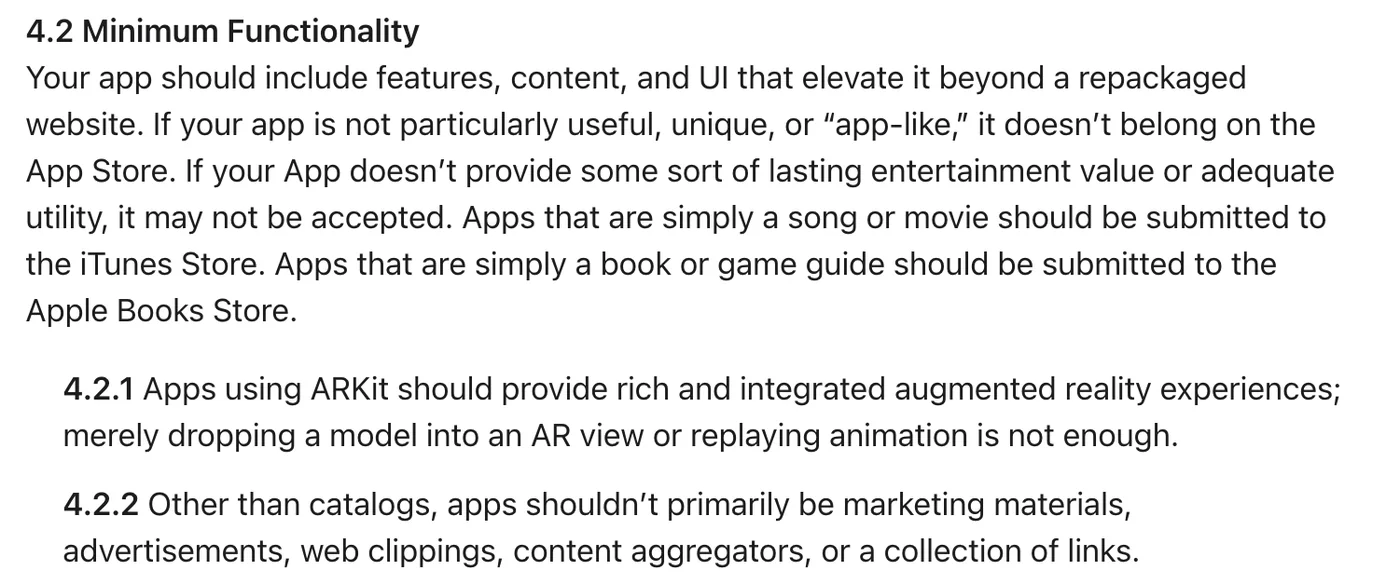
Apple's guideline 4.2 says an app must go beyond a repackaged website. If it isn't useful, unique or app-like, it doesn't belong on the App Store.
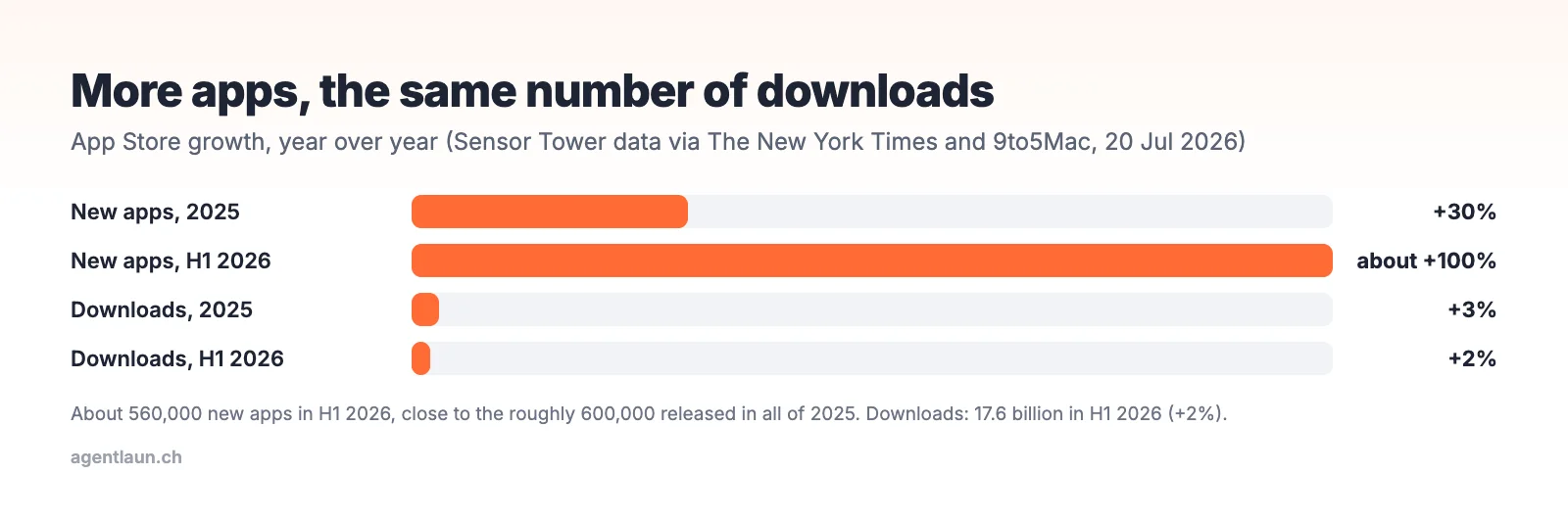
Sensor Tower data reported by 9to5Mac shows new apps doubled in the first half of 2026. Downloads rose 2% to 17.6 billion.
Fix: if users search Google for your kind of tool, ship and market the web app first. Search pages and directory listings work for you there.
If you need the store, build features a website can't offer, like offline use or notifications, and do keyword work before launch.
How to fix it in a week
| Day | Do this |
|---|---|
| 1 | Tests 1 and 2. Submit the sitemap, fix canonicals, request indexing once. |
| 2 | Test 3. Rewrite the hero line and add a screenshot. |
| 3 | Test 4. Fix the slowest item on mobile. |
| 4 | Test 6. Remove one step before the first result. |
| 5 | Test 5. Pick three buyer communities and answer five threads. |
| 6 | Start listings: the first 5 of 20 relevant directories. |
| 7 | Tests 7 and 8. Add one return trigger and plan next week. |
AgentLaunch is an agent you run from Claude Code, Codex or Cursor that submits your app to hand-checked directories in a real browser. It stops only for CAPTCHAs, payments or 2FA.
Common mistakes
- Rebuilding the product first. Most zero-user apps fail test 1 or 2. New features don't fix discovery.
- Reading launch-day silence as a verdict. Product Hunt and directory visitors are browsing, not looking for a fix.
- Counting founder feedback as demand. Other founders are your peers, not your buyers.
What results to expect
Fixing these gets you a working funnel, not a flood. In the ShieldLabs case, BetaList sent 94 of the 171 directory sessions over about two months.
Most vibe-coded projects aren't earning yet either. Benzatine's coverage of Lovable's June 2026 user report says 60.5% of users hadn't turned a profit yet. Lovable says 8 in 10 intend to monetize.
Spend the first month finding out which test you failed, and the second fixing it.
FAQ
Why does my app have no users even though it works?
Working isn't the same as being found. Check indexing in Search Console and your Domain Rating first.
Why is my app not getting downloads?
App stores are crowded, with new apps up far faster than downloads. Check whether your users search the store or Google, and whether your app is more than a wrapped website.
I built an app no one uses. Should I shut it down?
Not before you run the tests. If a month of fixes and outreach still brings no signups, change the audience or the problem.
How long does it take to go from 0 users to the first ones?
Days if you answer threads where buyers ask for a fix. Weeks for search.
Do directories help a vibe-coded app get users?
A little traffic, mostly links and discoverability. Pick about 20 that fit your product type rather than hundreds that don't.
Is Product Hunt enough to get my first users?
Rarely on its own. Use it after indexing, listings and community work, as our Product Hunt guide for vibe-coded apps explains.