Vibe coding growth guidesSaaS launch and marketing
Vibe Coded Apps That Make Money: 10 Real Examples and How Each Got Users
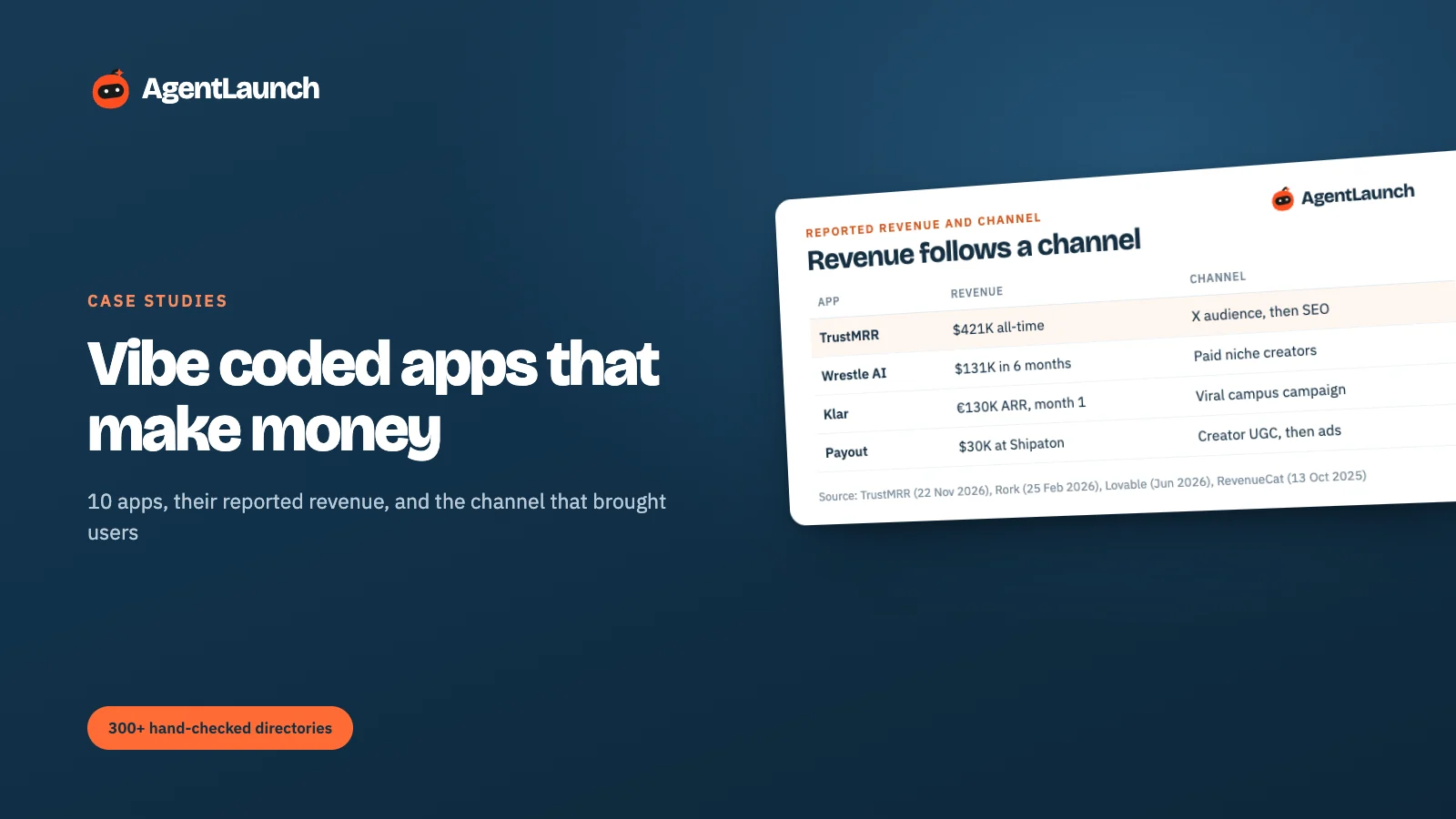
Ten vibe-coded apps with public, dated revenue, from TrustMRR to Wrestle AI, the tool each was built with, and the channel that brought its first users.
 By Pruthvi RajNovember 23, 2026
Vibe coded apps that make money exist, and at least ten have public, dated revenue. TrustMRR, built in Cursor in about six hours, shows $421,531 in Stripe-verified revenue.
Quick answer:
- Ten apps below have public revenue, mostly self-reported.
- Each had a channel before the code, or built one right after launch.
- The channels repeat: an audience, paid niche creators, daily short videos, in-person sales, search pages.
- None got users by launching and waiting.
What you'll need to copy these patterns
| Item | Used in | Cost |
|---|---|---|
| One-line pitch and 10-second demo clip | Steps 2–3 | Free |
| 30 creators or businesses in your niche | Steps 3–4 | Free |
| Stripe, RevenueCat or Lovable Payments | Step 6 | Transaction fees |
| A short-video account | Step 2 | Free |
| Search Console on a custom domain | Step 5 | Domain fee |
| A small creator budget (optional) | Step 3 | $2–5 CPM in one case |
Vibe coded apps that make money: the table
| App (built with) | Reported revenue | How it got users |
|---|---|---|
| TrustMRR (Cursor) | $421,531 all-time, Stripe-verified | Founder's X audience, then search pages |
| fly.pieter.com | $1M ARR in 17 days | Built live on X, in-game ads |
| Stanley | $1M+ ARR in 7 months | Building in public, existing customers |
| Klar (Lovable) | €130K ARR in month one | Viral campus campaign |
| QuickTables (Lovable) | €100K ARR in 2 months | Door-to-door restaurant sales |
| Lumoo (Lovable) | €700K ARR in 9 months | B2B sales to fashion brands |
| Wrestle AI (Rork) | $131,863 in 6 months | Paid wrestling influencers |
| Payout (Claude Code, Cursor) | $30,017 during Shipaton | Niche creator, then ads |
| STOPPR (Cursor) | $12K/month at 5 months | Influencers, TikTok and Meta ads |
| ToneAdapt (Cursor, Claude Code) | $25K+ in 4 weeks | Three short videos a day |
Only TrustMRR's figure is verified. The rest are self-reported, with dates in the profiles below.
Lovable and Rork publish stories about their own users, so read those as case studies, not audits.
How each app got its first users
TrustMRR: an audience first, then search pages
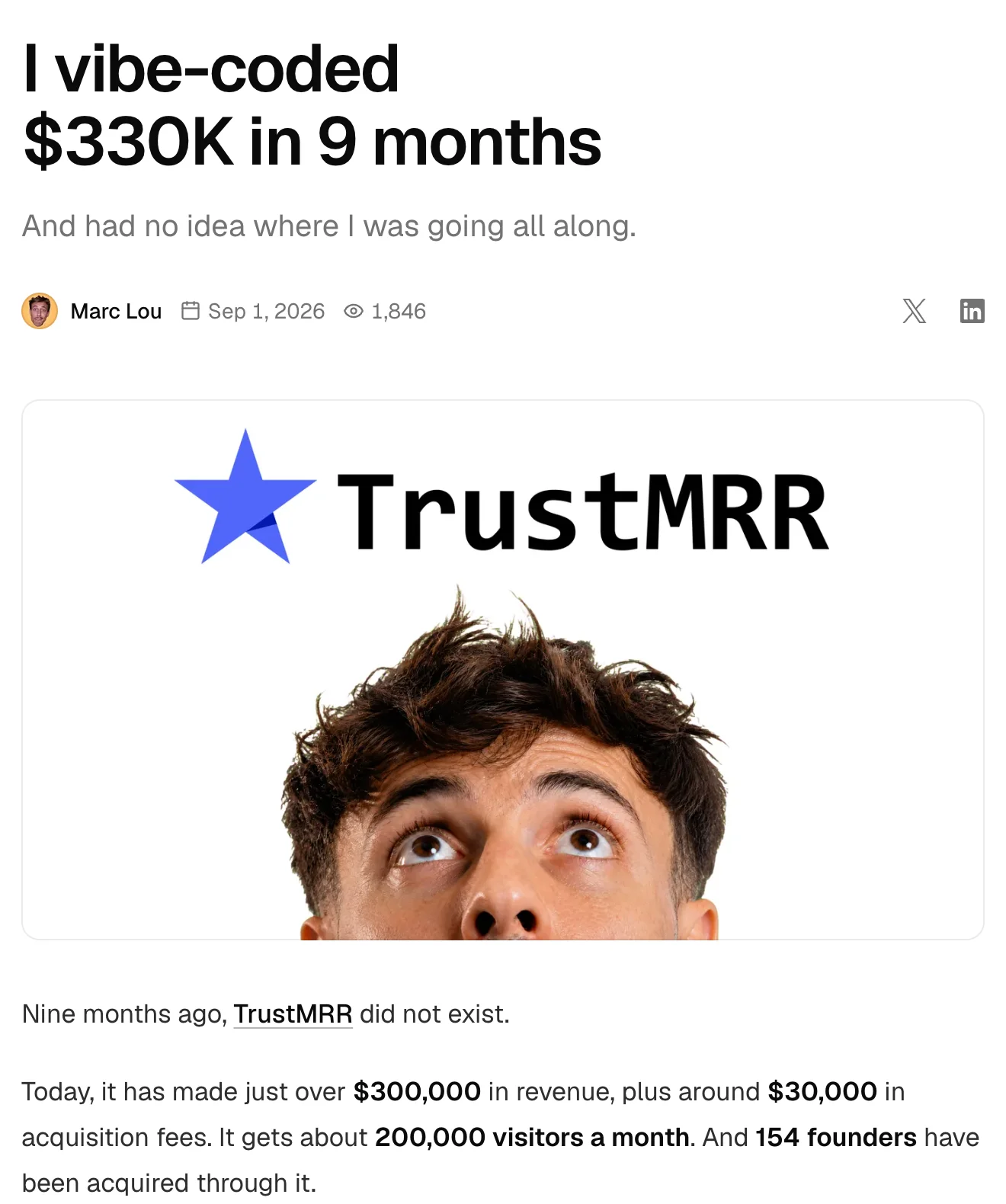
Marc Lou built the first version in Cursor in about six hours and launched it on 30 October 2025. In his own write-up, the launch post reached 2.9M views.
Side ad spots priced from $299 to $1,499 a month sold out in three days, for $20,378.
Then traffic fell, from 146,810 visitors in November to 91,415 in December. A marketplace feature and search brought it back. By March, Google had indexed 5,000+ startup pages, and TrustMRR passed 1M impressions.
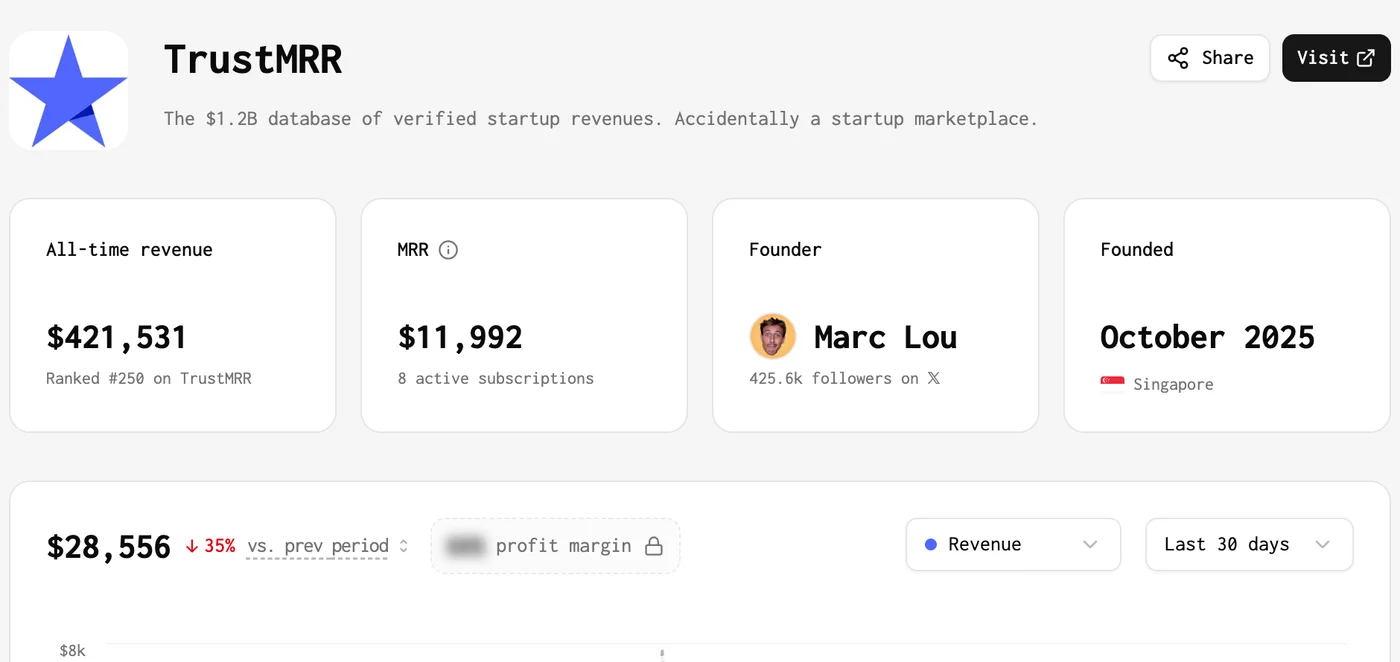
You can't copy his 425.6k X followers next week. You can copy the 5,000 indexed pages. TrustMRR's own listing shows the verified number.
fly.pieter.com: built in public, paid by sponsors
Pieter Levels started the flight simulator on 22 February 2025, building mostly live on X. He says it hit $1M ARR in 17 days. The game is free and sells in-game ads to startups.
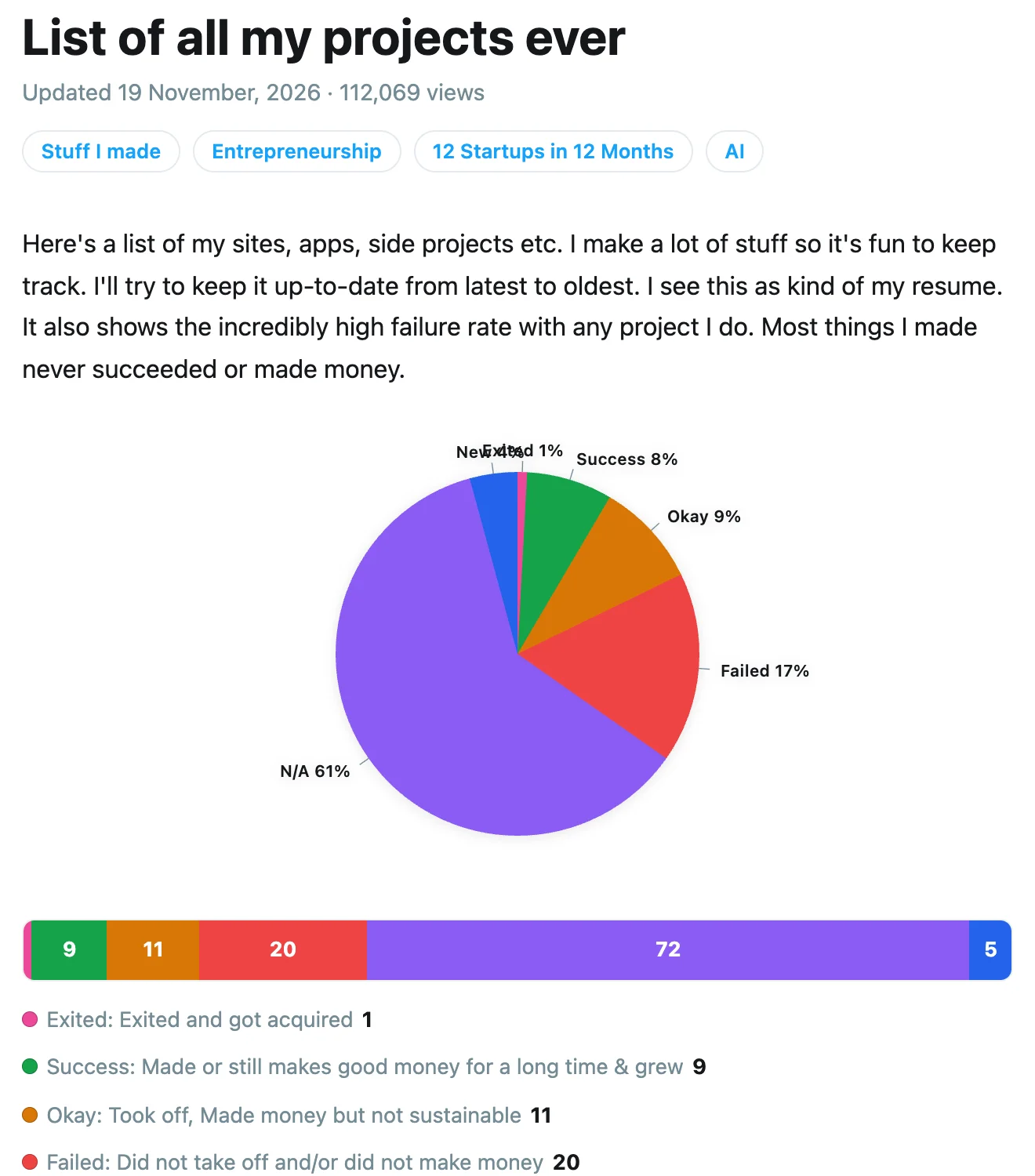
His own project list files it under "Okay: took off, made money but not sustainable". A viral spike pays well, then stops.
Stanley: a customer base and a launch post
Stan's founders built Stanley in 14 days while documenting every step on LinkedIn. Stan already had 70,000+ creators as customers.
Before launch, they analyzed the top posts of five big LinkedIn creators and cold-emailed each one the analysis. The launch post drew 2,000+ comments and $200K.
Seven months later, Stanley passed $1M ARR with no paid ads.
Klar: one campus, one viral campaign
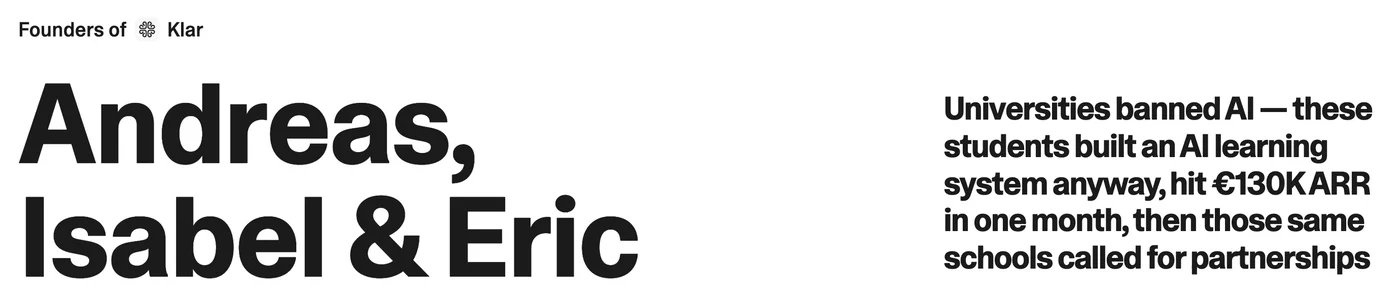
Three Swedish students built Klar in Lovable, with two of them focused on marketing. One early campus campaign went viral: 2,500+ sign-ups in two days and 4,000 more on a waitlist.
Lovable's founder story says ARR hit €130K by the end of month one, all organic. They now run an ambassador program across Swedish universities.
QuickTables: door-to-door sales
Jaleel noticed the restaurants under his office couldn't market themselves, so he went downstairs and talked to them. He started with SMS marketing for a burger chain and a pizza shop.
Then he and his co-founder built the platform in Lovable. QuickTables hit €100K ARR two months after launch and was acquired 10 months in.
Lumoo: industry access
Lumoo's founders have 25 years of combined fashion and retail experience. Lovable's case study lists clients like Gant, and €700K ARR nine months after launch.
The source doesn't break down channels. It shows founders selling into an industry they already knew.
Wrestle AI: paid creators at a fixed CPM
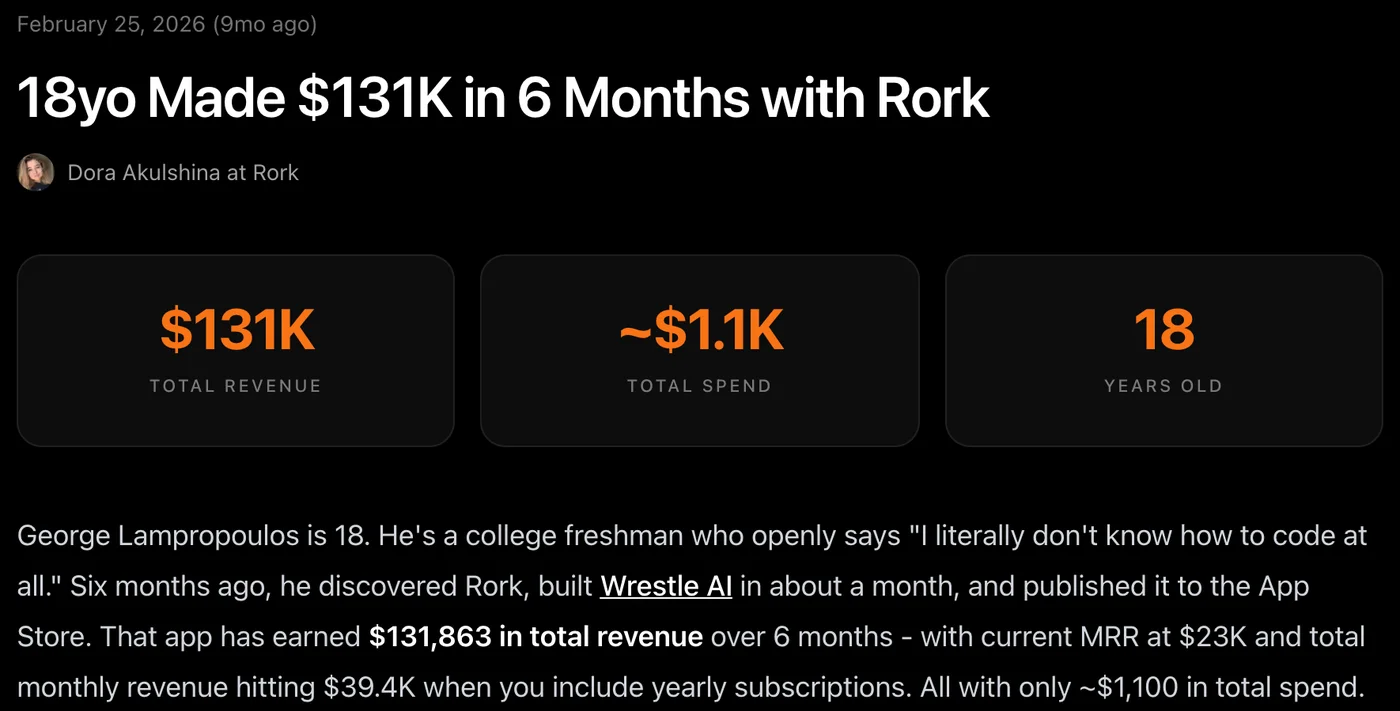
George Lampropoulos says he can't code. Per Rork's case study, he DMs about 100 influencers a day asking about paid promo, negotiates by phone, and pays $2–5 CPM with a view guarantee.
One $350 deal with a kickboxer took his second app, Fight AI, from $500 to $1,800 a month.
His co-founder is a big wrestling creator, and launch-day pre-orders put the app at #18 in its App Store category.
Payout: a creator first, ads second
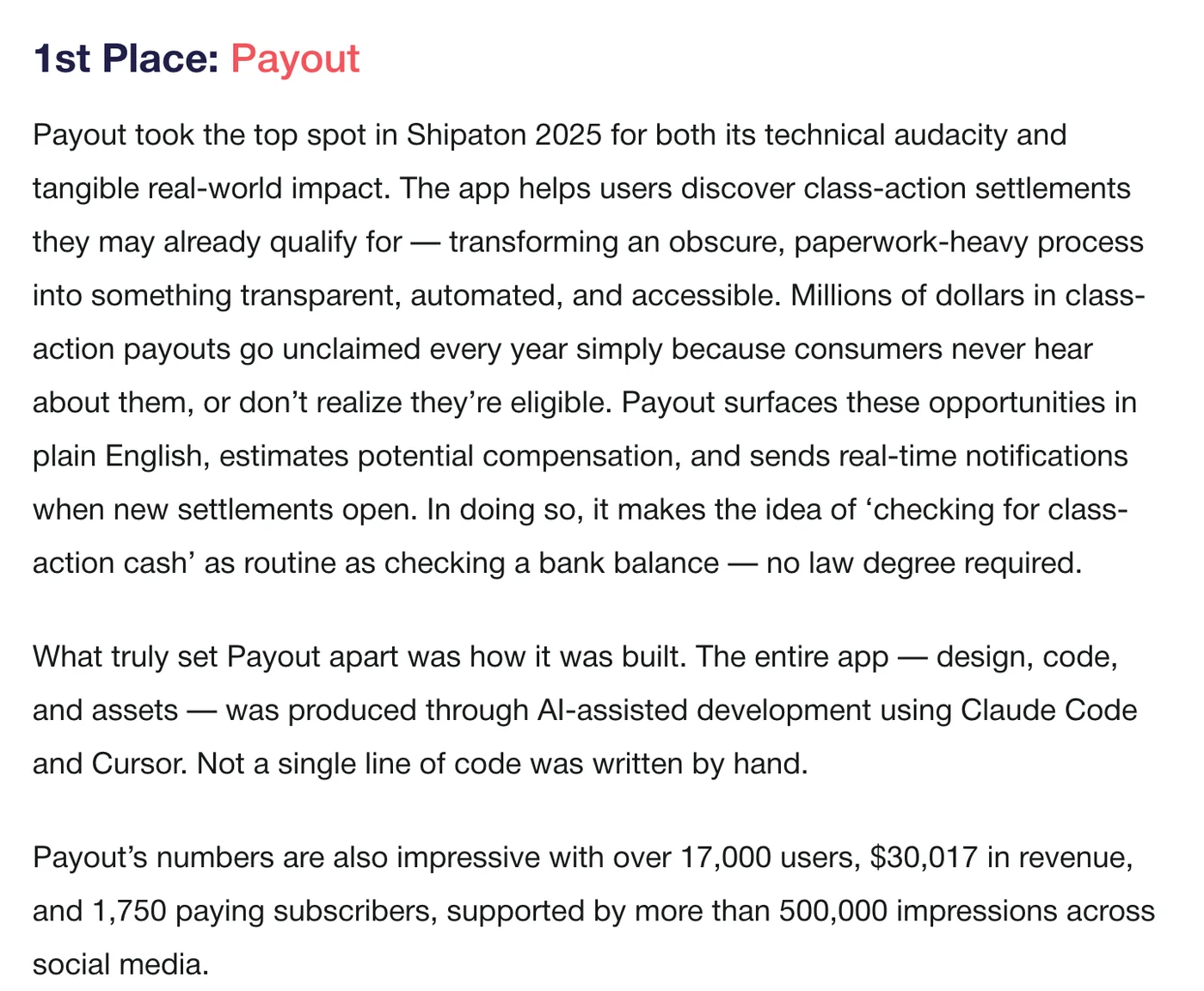
RevenueCat's Shipaton results say Payout was built entirely with Claude Code and Cursor. It had 17,000 users and 1,750 paying subscribers during the event.
The founder partnered with a creator already in the niche and ran UGC campaigns to build a library of ads. Facebook ads came only once the funnel converted.
STOPPR: clone the model, rent the reach
David Attias found an app making $200K a month and rebuilt its model for a new niche in Cursor. He found French influencers with a scraping tool, boosted working videos with TikTok Spark Ads and ran Meta ads.
Five months in, Starter Story reported 60,000 downloads, about 900 paying customers and $12K a month.
On 23 Nov 2026, stoppr.app showed a domain-for-sale page. A revenue snapshot isn't a status report.
ToneAdapt: a face and three posts a day
Kyan, a college student, built ToneAdapt in Cursor and later Claude Code without writing code himself. He posted on Instagram, TikTok, YouTube and Facebook three times a day, with his own face on the brand.
Then he scaled the formats that converted. In four weeks he made $25,000+: about $11,500 on the web and $14,000 from the mobile app.
How to make money with vibe coding: the patterns as steps
Step 1: Pick the channel before you build
TrustMRR, fly.pieter.com and Stanley launched to big audiences. QuickTables had a street of restaurants, and Lumoo had an industry.
Write down the one place your first 100 buyers gather and how you'll reach them. If you can't, that's the work, not the code.
Our guide on how to market a vibe-coded app turns this into a 30-day plan.
Step 2: Make the result fit in 10 seconds of video
Rork calls it the "gotcha moment". Upload a wrestling clip to Wrestle AI and get a score, weaknesses and drills, all showable in under 10 seconds.
ToneAdapt and Klar spread the same way. If your main result can't be filmed, short video won't be your channel.
Step 3: Pay niche creators before ad platforms
Wrestle AI, Payout and STOPPR all started with creators and added ads later. Copy the mechanics:
- List 30 creators in your niche, not general tech accounts.
- Ask directly about paid promotion. Agree a CPM with a view guarantee and a cap.
- Ask for content that looks like their normal posts.
- Reuse the best clips as ad creative later.
Step 4: Sell directly when the buyer is a business
QuickTables sold in person, Stanley's team cold-emailed creators, and Lumoo sold to brands. For B2B, a personal demo beats any launch.
Our playbook for your first 10 customers covers the outreach.
Step 5: Turn the product into pages people search for
TrustMRR's recovery came from 5,000+ indexed pages. That only works if Google can crawl your app and some sites link to it.
Run the SEO checklist for vibe-coded apps and check your starting point with the free DR checker. Then check which directories fit your app for your first relevant backlinks.
AgentLaunch can submit the app to those directories from Claude Code, Codex or Cursor. It stops only for CAPTCHAs, payments or 2FA.
Step 6: Charge early
None of these apps waited for scale to charge. Wrestle AI charges $9.99 a month or $59.99 a year, with a free trial on the yearly plan only.
TrustMRR sold ad spots before it had a business model. fly.pieter.com sold sponsors inside the game.
Step 7: Plan for the spike to fade
TrustMRR lost 38% of its traffic in month two. Decide now what you'll ship in weeks 2 to 8: a shareable feature, new indexable pages or a second creator round.
Check whether Product Hunt suits a vibe-coded app before you spend your one launch there.
Common mistakes
- Copying the outcome, not the channel. fly.pieter.com's $1M ARR came with a big following. Without one, copy Wrestle AI's DMs or QuickTables' door-knocking.
- Treating builder case studies as typical. Lovable and Rork publish their winners. Our vibe coding statistics show more typical numbers.
- Mixing ARR, MRR and one-off revenue. Wrestle AI reported $39.4K in monthly revenue, boosted by annual plans. Its MRR was $23K.
- Launching without payments. Every example charged within its first weeks.
- Stopping after launch week. Both viral launches faded within weeks.
What results to expect
These ten are outliers, picked because their numbers are public. Secondary coverage of a June 2026 Lovable survey, by Benzatine, says 60.5% of surveyed users hadn't turned a profit yet.
A New York Times report, summarized by 9to5Mac, describes a first vibe-coded iOS app with 1,300 downloads and about $500 in profit. The founder's second app reached 20,000 downloads and about $3,000.
A realistic first goal is one paying customer from a channel you chose on purpose, then a $1K month. If you'd rather exit, see how to sell a vibe-coded app.
FAQ
Are there vibe coded apps making money right now?
Yes. TrustMRR shows $421,531 in Stripe-verified revenue. Wrestle AI and Klar report six-figure numbers, but those are self-reported.
How do you make money with vibe coding?
Charge early and pick one channel before you build. Every app here used an audience, paid creators, short video, direct sales or search pages.
Which Lovable apps are making money?
Klar, QuickTables and Lumoo, per Lovable's own stories. Lovable also says users have received more than $20M through Lovable Payments.
What vibe coded apps made money, according to Reddit?
Reddit has plenty of revenue claims, but a screenshot proves little. Look for a Stripe-verified TrustMRR page or a dated founder write-up instead.
How long does it take a vibe coded app to make money?
From days to months here. TrustMRR sold ad spots in three days; STOPPR took five months to reach $12K a month.
Do I need an audience to make money from a vibe coded app?
No, you need a channel. Wrestle AI and STOPPR rented reach from creators, and QuickTables sold in person.