Vibe coding growth guidesSaaS launch and marketing
How to Get Your First 10 Customers: A Step-by-Step Guide for Vibe-Coded SaaS
Turn free users into paying ones: who to pick, where to find them, outreach templates, pricing advice from YC and Stripe, and how to take your first payment this week.
 By Pruthvi RajNovember 23, 2026
Here's how to get your first 10 customers: list 100 named people who fit one narrow profile, message each yourself, and charge on the first call.
Quick answer:
- Pick a profile narrow enough to list 100 people by name.
- Start with your own free users, then LinkedIn, communities and competitor reviews.
- Send short, plain-text messages you write yourself, and track every reply.
- Onboard each customer on a call and charge from day one.
- Take payment with a Stripe link, then claim a free G2 profile.
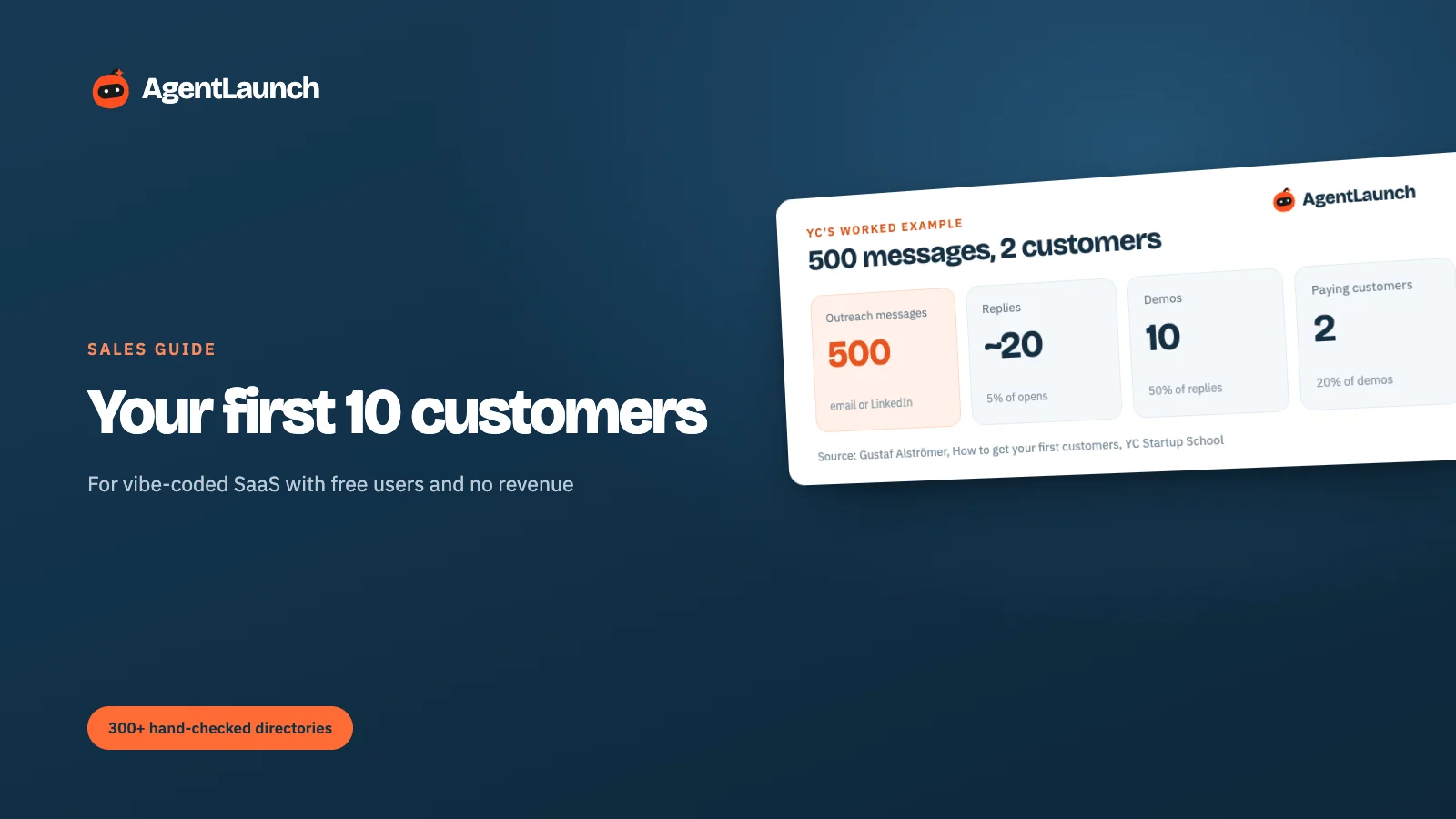
Plan for hundreds of messages, not ten. In YC's Startup School talk on first customers, 500 messages turn into 2 paying customers.
Still need users first? Start with getting your first 100 users and come back.
How to get your first 10 customers: what you'll need
| What | Time | Cost |
|---|---|---|
| Spreadsheet or simple CRM | 30 minutes | Free |
| 100 named prospects | 1–2 evenings | Free |
| LinkedIn and an email on your domain | Already have | Free tiers exist |
| A calendar link | 10 minutes | Free tiers exist |
| Stripe account with one product | 30 minutes | Per-payment fees |
| A G2 profile | 20 minutes, then days of review | Free |
Expect a week of setup, then an hour or two of outreach a day.
Step 1: Pick your first 10 customers before you message anyone
"Small businesses" is not a profile. "Bookkeepers at 2–10 person firms who use Xero and chase receipts by email" is.
The test: can you open LinkedIn and write down 100 specific people who match? If not, narrow it.
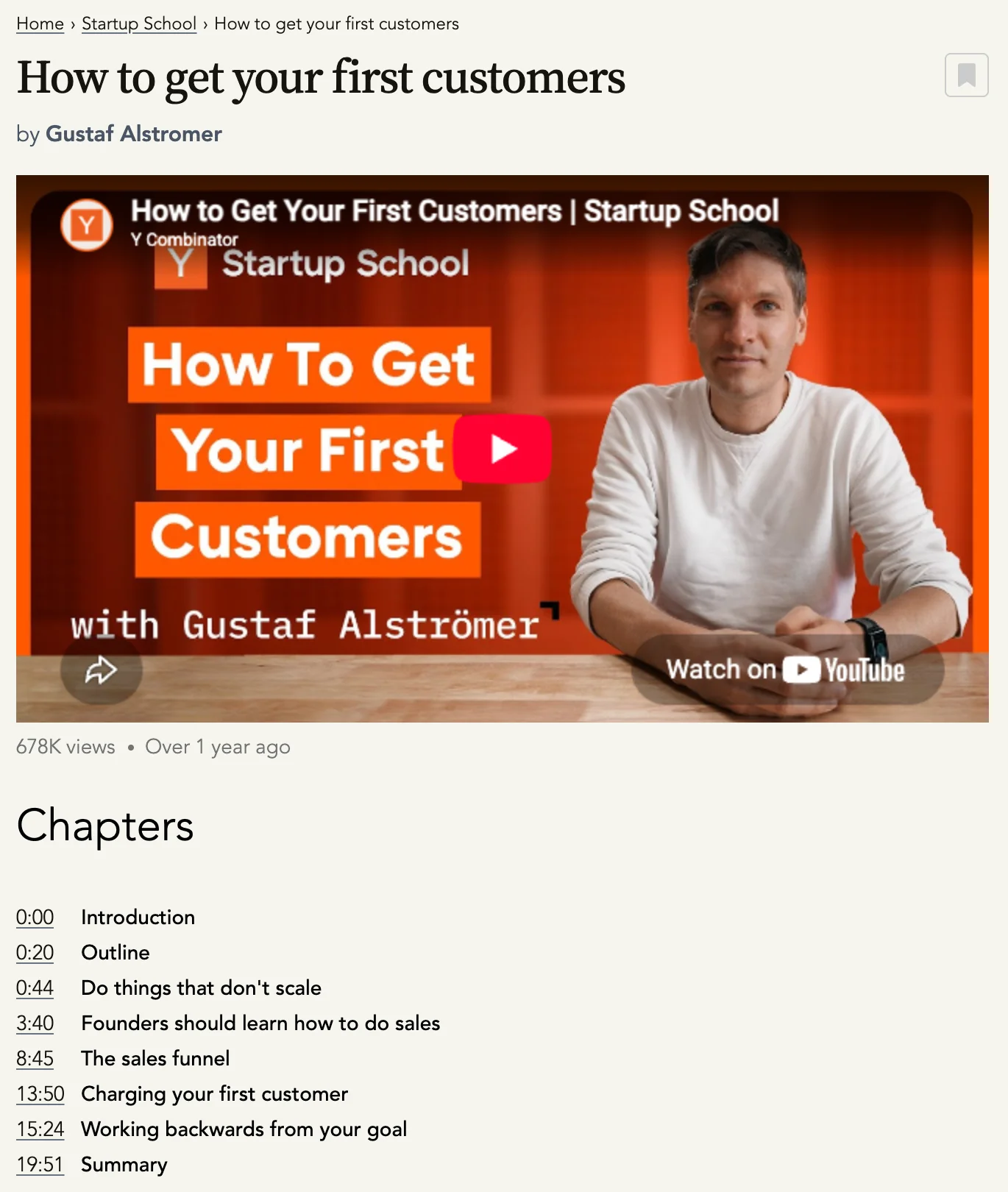
Gustaf Alströmer's YC talk, How to get your first customers, gives three rules for the list:
- Your first customers should be your easiest. Drop anyone who drags you through three calls.
- Sell to people you know first. Strangers are harder.
- Startups are the easiest buyers. They decide fast and have no procurement team.
Start with the free users you have
Your free users already chose your app once. Sort them by how often they come back, and put the top 20 at the top of your list.
Brex did a version of this: its founders found their first ten customers in their own YC batch.
Set up the right columns
YC suggests industry, company, title, name, email and LinkedIn. Add three of your own:
- Source: free user, LinkedIn, community or review site
- Status: messaged, replied, call booked, paid
- Their words: how they describe the problem
Step 2: Find them where buyers already show up
In a growth AMA on the YC blog, Alströmer starts with who signs the bill. Put 100 matching LinkedIn profiles in a spreadsheet and find their emails with a tool like Hunter.
Search by job title plus company size. Anyone who posted about the problem recently goes to the top.
Communities and Reddit
The same AMA suggests Reddit if your users are online. It also warns that subreddits react badly to commercial messages. Become one of them and ask for feedback instead of pitching.
Our guides to promoting a SaaS on Reddit and the best subreddits to promote your app cover the rules.
Competitor reviews
Open the G2 or Capterra category page for the tool your app replaces. Each review shows the reviewer's role and company size, so you see exactly who buys.
Then read the 1–3 star reviews of the top competitors. They list what people hate in their own words, which makes a great first line. Find those companies on LinkedIn rather than messaging through the review site.
Step 3: Do founder-led outreach (templates you can copy)
Follow YC's rules for the message
The talk says a good sales email is:
- Short, six to eight sentences at most.
- Plain words, no jargon.
- About the customer's problem.
- Plain text, written like you'd write to a friend.
- Clear that you're the founder, with proof shown, not claimed.
- Linked to a simple site with screenshots.
- Ended with one clear ask.
First message to a free user
Subject: your [App] account
Hi [Name], I'm [your name], I built [App]. I saw you've used it [X] times since [month], more than almost anyone.
I'm picking 10 teams to work with closely before I open paid plans. You'd get [specific thing: setup done for you, a feature you asked for] and a founding price.
Worth a 15-minute call this week? [calendar link]
First message to a stranger
Hi [Name], I'm the founder of [App]. Your post about [exact problem in their words] is why I built it: it [one-line result, e.g. "pulls receipts out of email into Xero"].
Three [role]s at [similar company type] use it now. Could I show you in 15 minutes? If it doesn't fit, I'll say so.
Follow up once
Hi [Name], one last note on [App]. Happy to set it up for you on a call so you see it on your own data. If now isn't the time, no reply needed.
Stay legal when you email strangers
In the US, the FTC's CAN-SPAM guide applies to commercial email. You need:
- accurate sender details and a subject line that matches the email
- your valid postal address
- a clear opt-out, honored within 10 business days
Each email that breaks the rules can cost up to $53,088. Other countries have their own rules, so check yours first.
Track the funnel, because the numbers are brutal
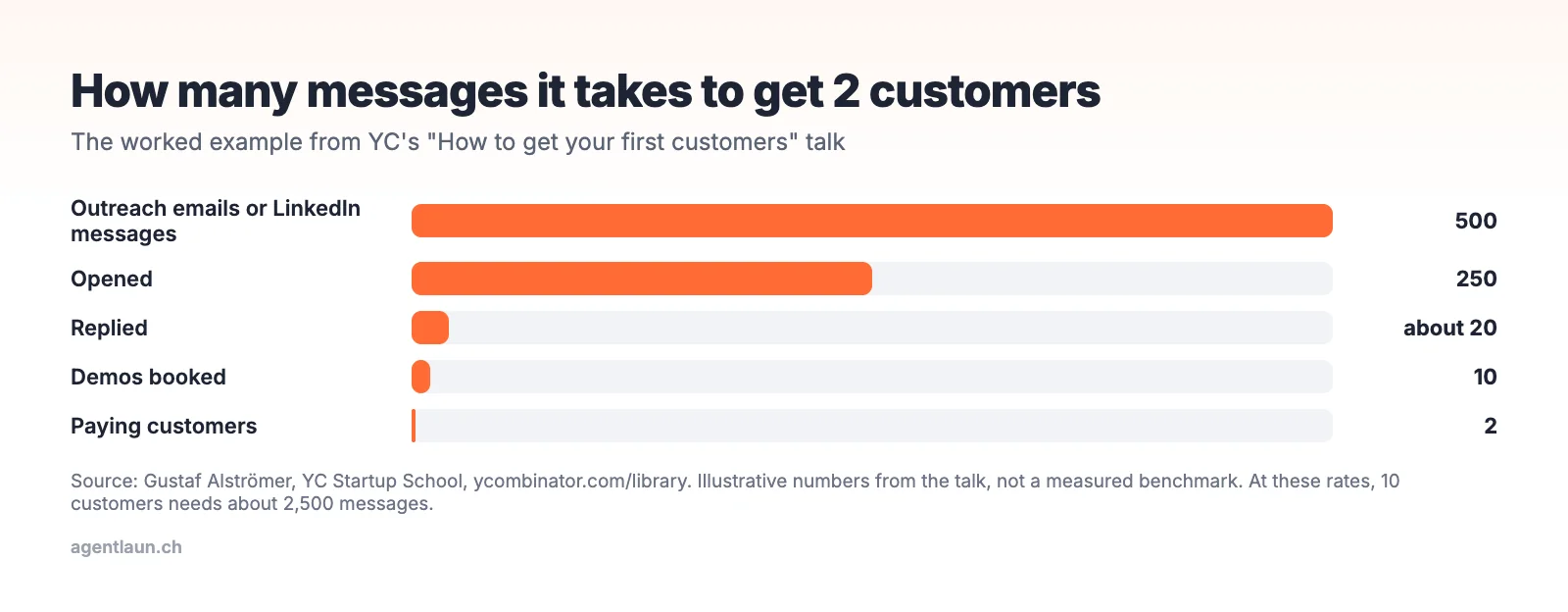
The talk's example: 500 messages, 250 opens, about 20 replies, 10 demos, 2 customers.
Run the same rates on 100 messages and you get zero customers. Track your own rates from day one, so you know which step is weak.
Step 4: Onboard each customer yourself
Set them up while they watch
Paul Graham's essay Do Things that Don't Scale describes the "Collison installation". When anyone agreed to try Stripe, the founders took their laptop and set it up on the spot.
Your version is a screen share. Create their account, import their data and run the first task with them. The YC talk warns that early products churn when people don't know how to use them.
Use the call to learn
In Stripe's guide to pricing low-touch SaaS, Patrick McKenzie suggests a call with everyone who starts using the software. Spend 80% learning about their business and 20% showing the product.
Write down how they describe the value. That becomes your landing page copy.
If a customer hits a bug on the call, describe it to your builder that afternoon. Ship the fix before your follow-up email.
Step 5: Price for your first 10 customers
Charge from the first call
The YC talk is blunt: if they don't pay, they aren't a customer. A prospect who won't pay is a cue to move on, not to drop the price.
For B2B, it advises against free trials. Offer a money-back guarantee, or a monthly opt-out from an annual plan, instead.
Use the 10/5/20 rule
YC partner Kevin Hale's Startup pricing 101 calls undercharging the number one pricing mistake YC sees. His rule of thumb:
| Rule | What it means |
|---|---|
| 10 | Price at about a tenth of the value you create |
| 5 | Raise prices 5% at a time |
| 20 | Keep raising until you lose about 20% of deals |
He also notes that early adopters care more about benefits than price. A low price won't win them.
Turn free users into founding customers
The Stripe Atlas guide describes a company with a free version. McKenzie's advice: shut it down, email the free users, and give them 20% off the paid plan for their loyalty.
You can reuse that line:
Free plan ends on [date]. As one of the first users, you keep [discount] for as long as you stay.
The same guide says dropping the card requirement from a trial tends to lower conversions.
Step 6: Get paid with a Stripe payment link
You don't need a billing system for 10 customers. Stripe's Payment Links give you a no-code checkout page to share in an email or DM.
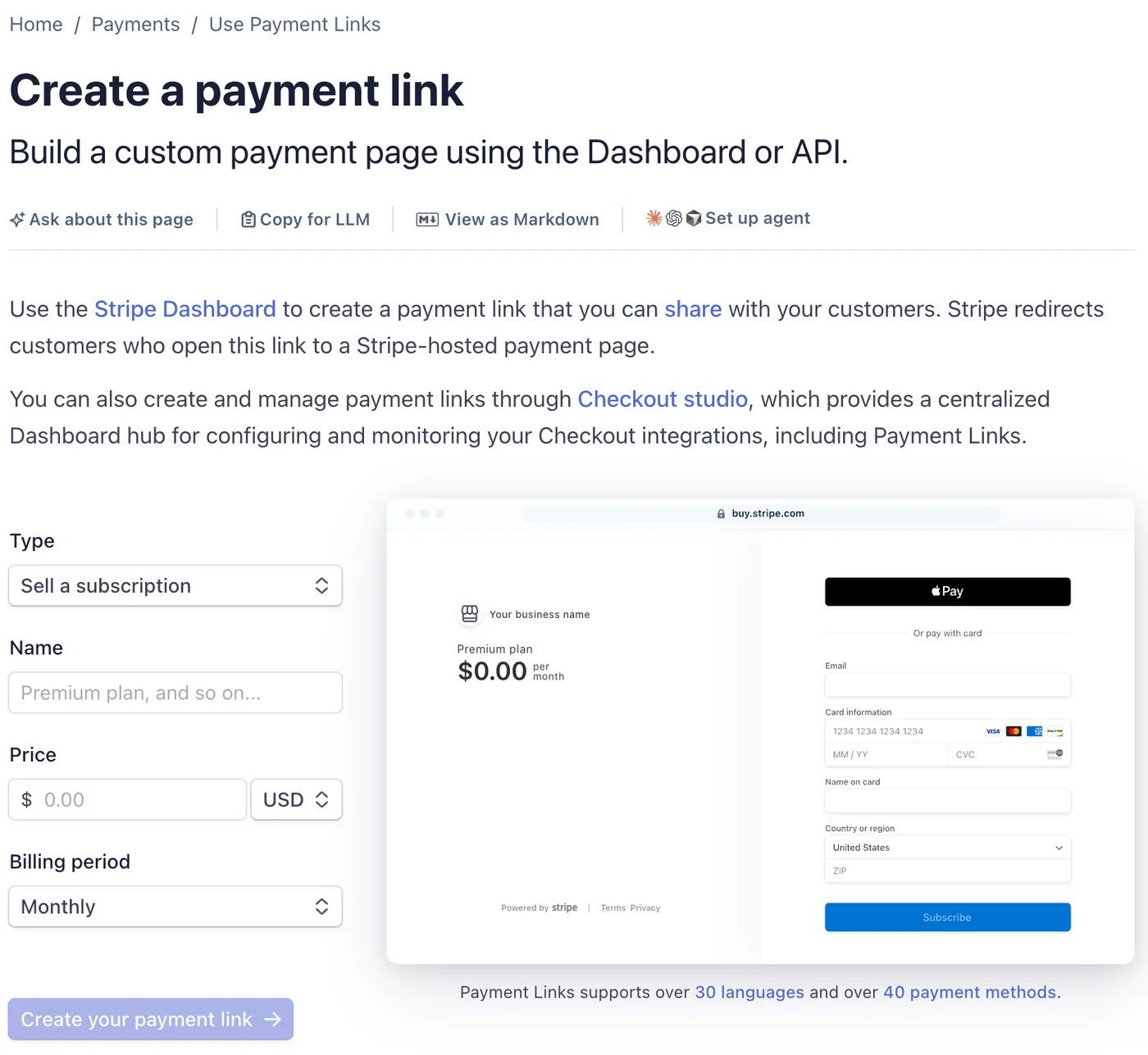
- In the Stripe Dashboard, open Payment Links and click +New.
- Pick a product, or click +Add a new product and fill it in.
- For a monthly plan, choose Sell a subscription and set the billing period.
- Click Create link and paste it into your follow-up email.
A few limits to know:
- The subscription starts at checkout, or when a free trial ends. You can't set a billing date or end date.
- Links support over 40 payment methods and over 30 languages.
- As of November 2026, Stripe's US pricing is 2.9% + 30¢ per domestic card payment. Stripe Billing adds 0.7% on pay-as-you-go.
If you built on Lovable: it has built-in Paddle and Stripe payments. Live checkout only works after you finish its go-live checklist. Our guide on how to sell a vibe-coded app compares the payment options and fees.
Step 7: Be findable where SaaS customers check
Your first 10 customers will look you up before they pay.
Claim a free G2 profile
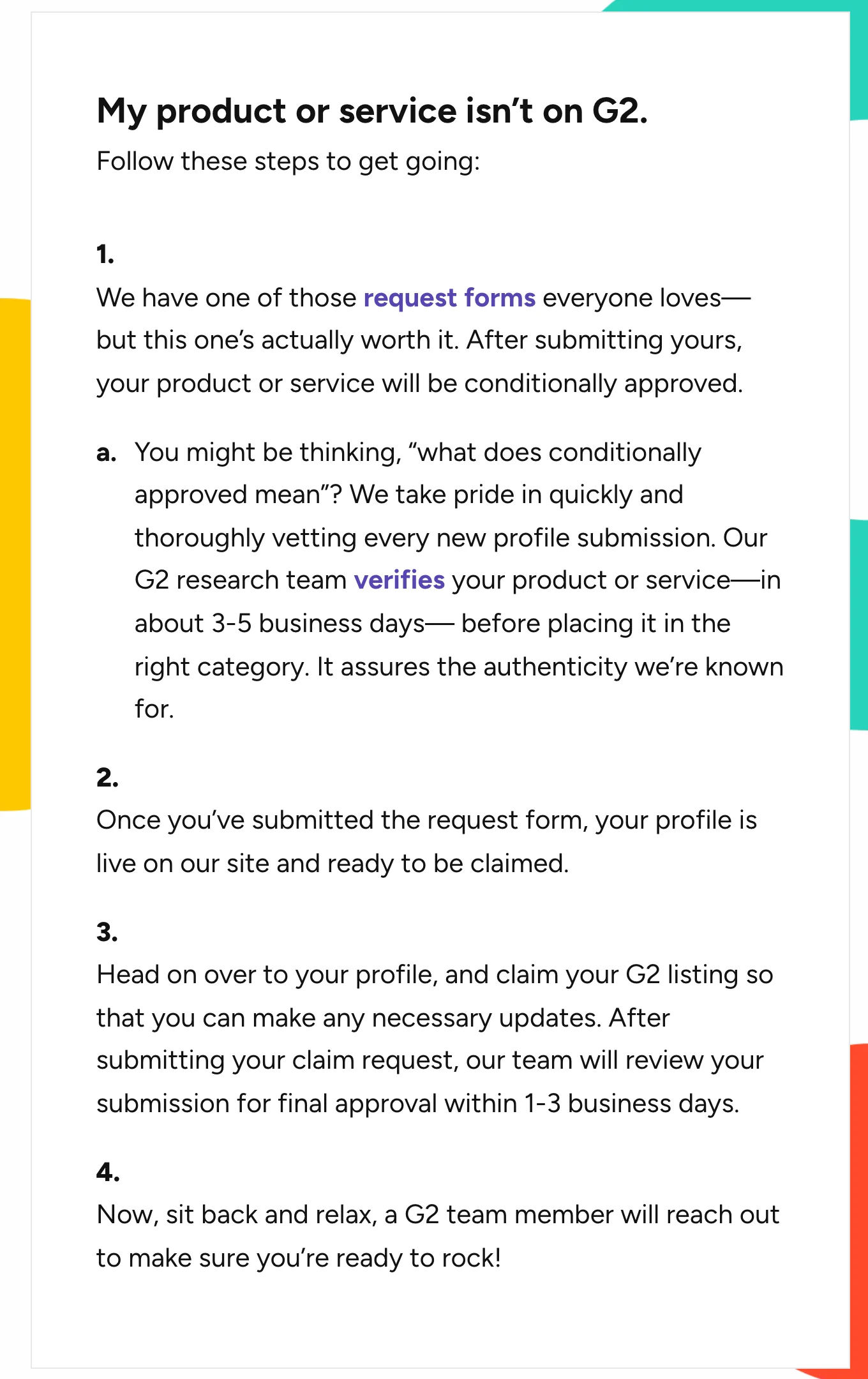
G2 lets you claim a profile for free. Its team verifies a new product in about 3–5 business days, then final approval takes 1–3 more.
Two catches: G2 doesn't accept consumer products or apps in alpha or beta. If your app is B2C, skip it.
Capterra is now part of G2. Our Capterra vs Software Advice vs GetApp comparison explains what that means. Once a customer is happy, ask for a review with the scripts in how to get your first software reviews.
List where your buyers browse
Your app should also show up on the software review sites and SaaS directories buyers search. Our list of where to submit a vibe-coded app ranks them.
Before submitting, check which directories fit your app. AgentLaunch is an AI agent you run from Claude Code, Codex or Cursor that submits your product to hand-checked directories. It writes copy for each one and stops only for CAPTCHAs, payments or 2FA.
Listings build trust. They don't replace outreach.
What results to expect
- Hundreds of messages. At the YC example's rates, 10 customers would take about 2,500 messages. Warm free users do better, but expect a three-figure number.
- Most people ignore you. The talk says most recipients just archive your email, because most people aren't early adopters. That's normal.
- Directories bring a trickle. One B2B SaaS got 171 sessions and 2 signups from about 160 submissions, as covered in our vibe-coded app marketing guide.
Common mistakes
- Sending 10 messages and giving up. The talk's 100-message example ends at zero customers.
- Keeping a free plan until it's ready. Free users who are never asked to pay never become customers.
- Pricing low to be safe. Undercharging is the most common mistake YC sees.
- Pitching in communities. Ask for feedback as a member. Pitch in DMs only when asked.
FAQ
How long does it take to get your first 10 customers?
There's no published benchmark. At YC's example rates and 50 messages a day, 2,500 messages take about 50 working days. Warm free users convert faster, so start there.
How do I get my first customers for a SaaS with no network?
List 100 people who fit one narrow profile from LinkedIn, communities and competitor reviews. Then message each one yourself, starting with startups, which decide fastest.
How do I get first customers from Reddit?
Join the subreddits where buyers talk, help for a few weeks, and ask for feedback as a member. Move to DMs when someone shows interest.
Should I offer a free trial to my first paying customers?
For B2B, YC says no: charge, and offer a money-back guarantee. If you run a trial, asking for a card up front tends to convert better.
How much should I charge my first 10 customers?
Start at about a tenth of the value you create. Raise prices 5% at a time until you lose about 20% of deals.
How do I get SaaS customers to pay without building billing?
Create a Stripe payment link and send it after the call. It takes no code, and Stripe hosts the checkout.