Field notes
Domain Rating vs Domain Authority: What's the Difference?
Domain Rating (Ahrefs) vs Domain Authority (Moz): how each is calculated, the difference in one table, and what 394 directories show: DR and traffic are only loosely linked, and a site's DR can move 20+ points between checks.
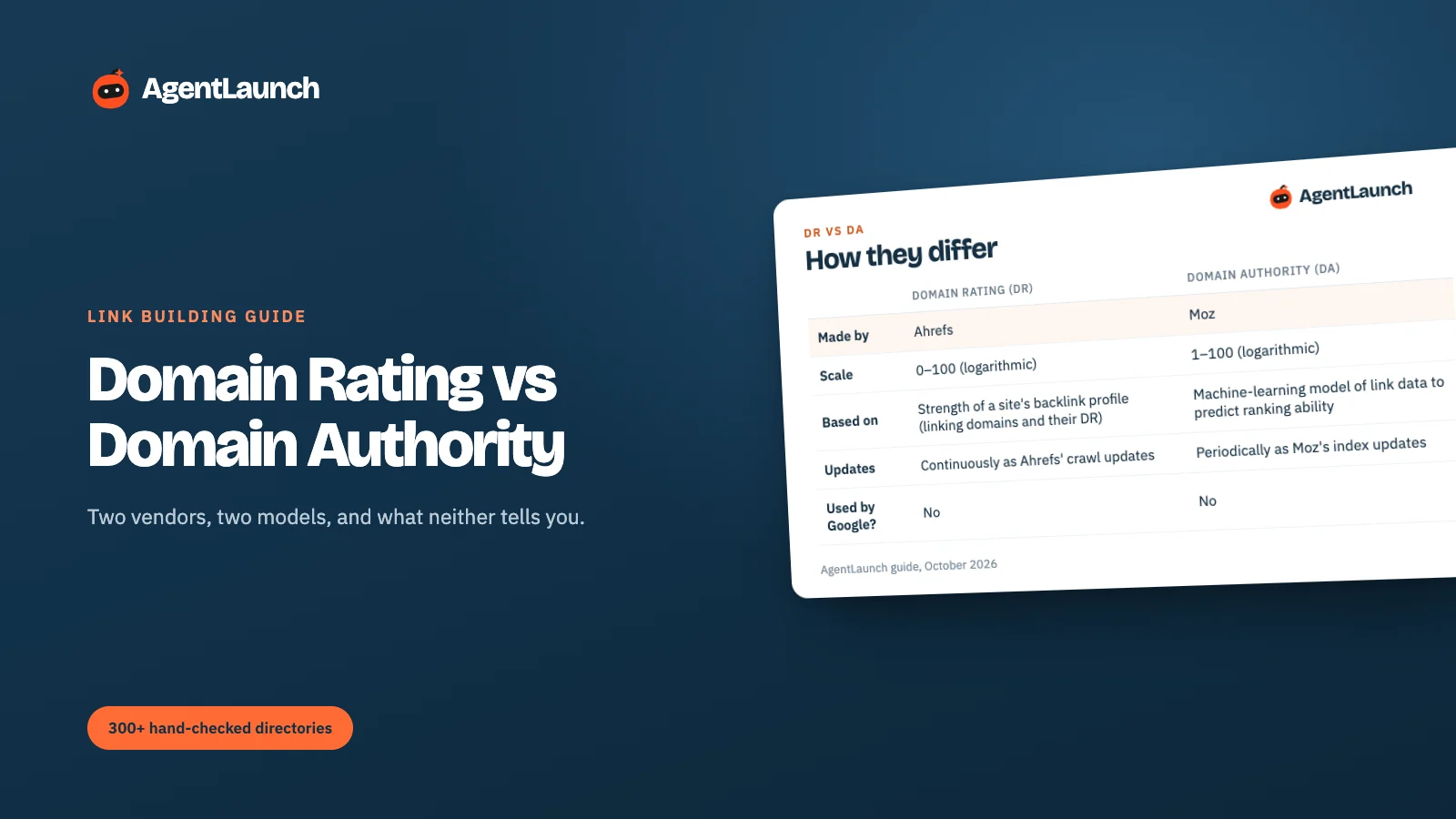
Domain Rating (DR) is Ahrefs' 0–100 score of the strength of a site's backlink profile. Domain Authority (DA) is Moz's 1–100 score predicting how well a site might rank, based on a model of Moz's own link data. Both are logarithmic (going from 20 to 30 is far easier than 70 to 80), both are third-party metrics, and Google uses neither. Use them to compare sites inside the same tool: DR against DR, DA against DA, never across.
Below: how each is calculated, how they differ in practice, when to use which, and what they don't tell you.
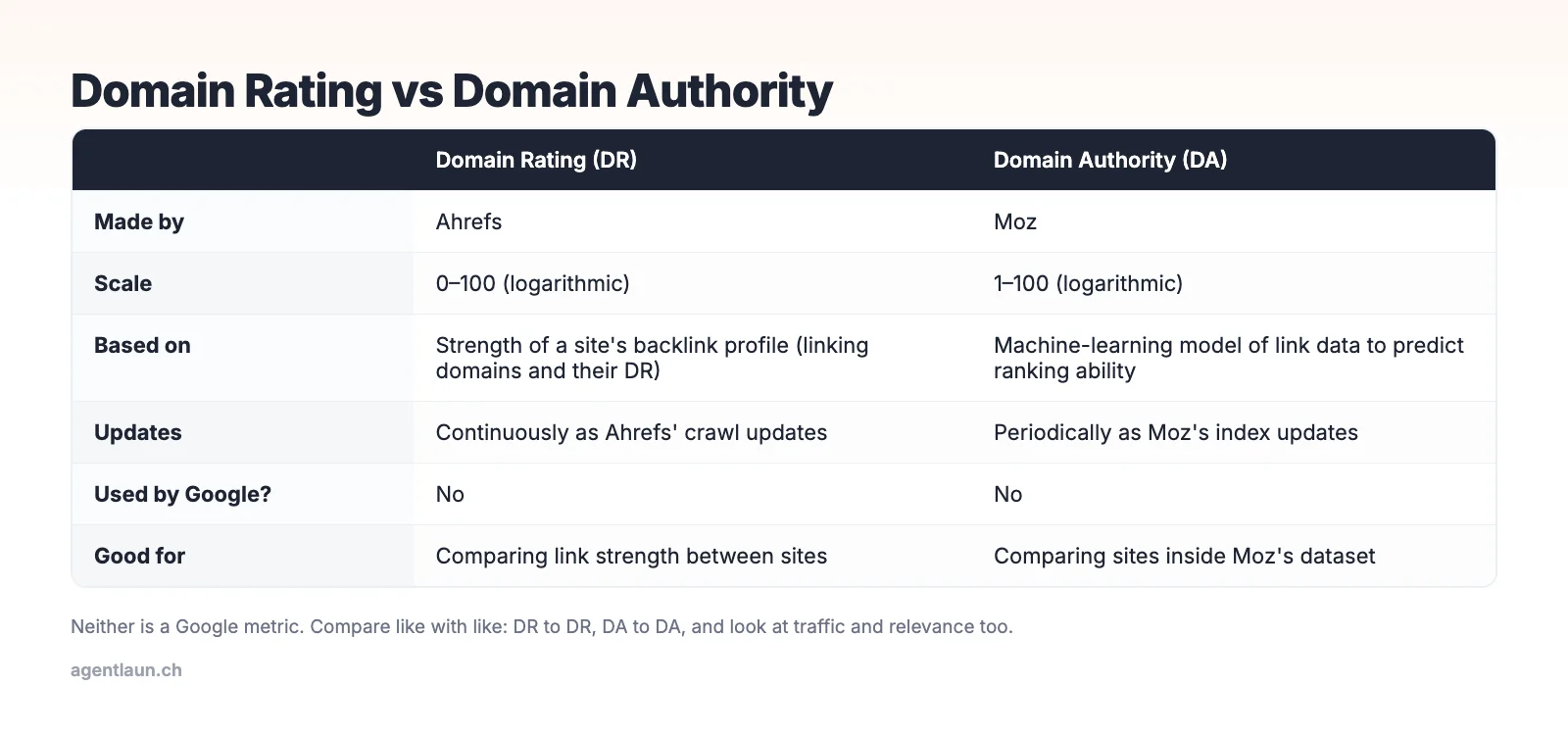
The difference in one table
| Domain Rating (DR) | Domain Authority (DA) | |
|---|---|---|
| Made by | Ahrefs | Moz |
| Scale | 0–100, logarithmic | 1–100, logarithmic |
| What it measures | Strength of a site's backlink profile (followed links from unique domains) | Predicted ranking ability, from a machine-learning model of Moz's link data |
| Page-level version | URL Rating (UR) | Page Authority (PA) |
| Updates | Continuously as Ahrefs crawls | With Moz index updates |
| Used by Google? | No | No |
| Best for | Comparing link strength between sites, tracking link building | Comparing competitiveness inside Moz's data |
Semrush has a third score, Authority Score (0–100), built on its own data. Same rule: compare within one tool only.
How each is calculated
Domain Rating (Ahrefs). Based on how many unique domains link to a site with at least one followed link, and how strong those linking domains are. It's purely about the link graph, and only followed links count. It updates continuously as Ahrefs crawls the web.
Domain Authority (Moz). A machine-learning model trained to predict ranking ability from Moz's link index (linking root domains, link quality and other signals). It updates periodically with Moz's index.
The practical upshot: the same site has different numbers in each. A site might show DR 76 and DA 52. Neither is wrong. They're different scales from different datasets.
How they compare in practice
| Question | Better metric |
|---|---|
| "Is this directory's link profile strong?" | DR (pure link strength) |
| "How competitive is this site in Moz's data?" | DA |
| "Will a link from here help me?" | Neither alone. Add traffic, relevance and link type |
| "Did my link building work?" | Whichever you track consistently over time |
What neither tells you
- Traffic: a DR 80 directory can get almost no visitors. In our catalog of 394 directories, many high-DR sites get under 10,000 visits a month (how to check quality).
- Relevance: a high-DR general directory may matter less than a small niche one.
- Whether your listing is indexed or the link is followed.
- Google's view: Google doesn't use DR or DA. It has its own systems.
What 394 directories tell us about DR
AgentLaunch tracks DR and traffic for every directory in its catalog. Three things in that data are worth knowing before you trust any authority score.
DR and traffic are only loosely related
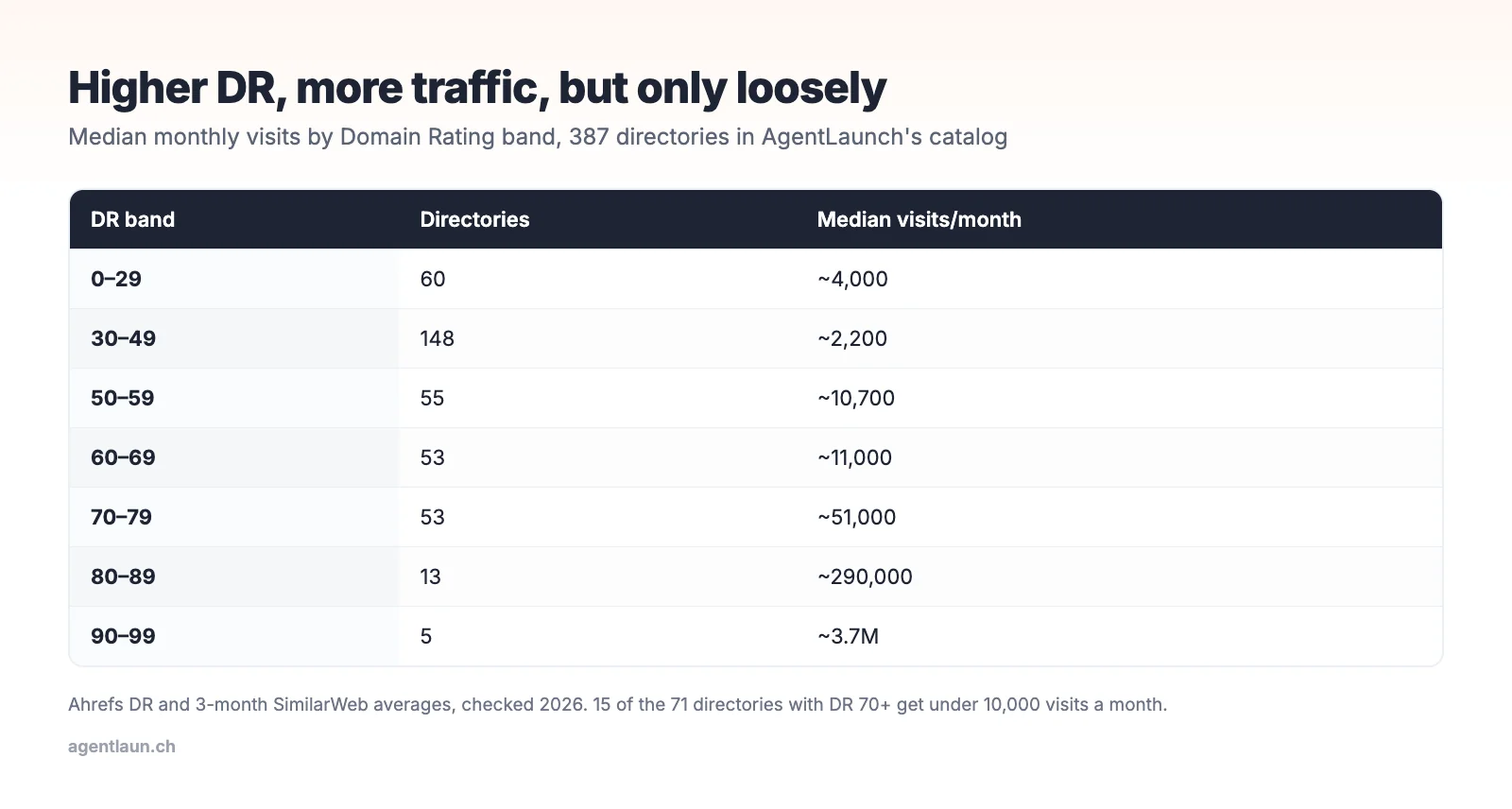
Across 387 directories with both numbers, the correlation between DR and (log) monthly visits was only 0.36. Median traffic barely moves from DR 30 to DR 69, then jumps above DR 70. And 15 of the 71 directories with DR 70+ get under 10,000 visits a month. A high score tells you the link profile is strong. It doesn't tell you anyone visits.
The same site's DR moves, sometimes a lot
For 165 directories we have both an older DR from earlier research and a freshly checked Ahrefs DR. The median difference is 5 points, but 59 of them (36%) differ by 10 or more and 30 (18%) by 20 or more. Some launch platforms grew fast: StartupBase went from 27 to 73, PeerPush from 35 to 75. Any DR in a blog post or a sales page is a snapshot. Check it yourself before you pay.
Sites mix up DR and DA in their own marketing
| Directory | What it claims | Ahrefs DR we measured |
|---|---|---|
| Launch Llama | "DA 73" (citing Ahrefs) | 72 |
| Uneed | "75 DR" | 76 |
| PeerPush | "76 DR" | 75 |
| StartupBase | "DR 74" | 73 |
| Fazier | "DR 83+" | 83 |
| mcp.so | "DR 72" | 73 |
Launch Llama labels its Ahrefs number "DA", which is Moz's term. The numbers are close, so nobody's lying, but it shows how loosely the terms get used. If a directory quotes "DA", ask which tool.
Typical ranges
Roughly, for DR (DA tends to run lower for the same site):
| DR | Typical sites |
|---|---|
| 0–20 | New sites, small blogs, most new startups |
| 20–40 | Established small businesses and niche sites |
| 40–60 | Strong niche sites, many directories |
| 60–80 | Major directories, popular SaaS, media |
| 80+ | Platforms like G2 (91), SourceForge (93), Crunchbase (91) |
In our catalog, 128 directories sit below DR 40, 135 between 40 and 59, 106 between 60 and 79, and 18 at 80 or above.
Which should you track?
Pick one and stick with it. Most launch and directory data, including our catalog, uses Ahrefs DR, so if you're comparing directories it's the convenient choice. Check yours free with our DR checker.

A worked example: comparing three directories
| Directory | DR (Ahrefs) | DA (Moz) | Monthly visits | Link |
|---|---|---|---|---|
| A | 78 | 41 | 600 | dofollow |
| B | 52 | 38 | 45,000 | dofollow |
| C | 71 | 55 | 210,000 | nofollow |
(Illustrative.) Two lessons. First, DR and DA disagree on the order: A beats C on DR, C beats A on DA. Second, neither score tells you that A has almost no visitors or that C's link won't pass ranking credit. For choosing where to submit, traffic, indexing and link type usually matter more than which authority score you look at (quality checks).
Why scores jump around
- Index updates: both vendors periodically refresh their link indexes, which can shift scores across the board.
- Lost links: removed pages and expired listings drop referring domains.
- Relative scales: as the rest of the web gains links, your score can move without anything changing on your side.
Track the trend over months, not week-to-week changes, and always compare against competitors measured the same way.
How to raise either one
The same things move both: followed links from more unique, relevant, established domains. For a new SaaS, that usually means a mix of launch platforms and directories with confirmed dofollow links and real traffic, review-site profiles, integration marketplaces, and content that earns links on its own. See why DR isn't increasing after backlinks if you've built links and the number hasn't moved.
Related
FAQ
Is Domain Rating the same as Domain Authority? No. DR is Ahrefs' metric, and DA is Moz's. They use different data and models, so the same site has different scores.
Does Google use DR or DA? No. Both are third-party metrics.
Which is better, DR or DA? Neither is objectively better. Use one consistently, and pair it with traffic and relevance.
What is a good Domain Rating? It's relative. Compare against competitors in your niche. Most new startups start under DR 20.
Is a Domain Authority of 20 good? For a new site, yes. Most new startups start under 20 on both DA and DR. Compare against competitors in your niche rather than an absolute number.
What's the difference between DA and PA? Domain Authority scores a whole domain; Page Authority (also Moz) scores a single page. Ahrefs' equivalents are Domain Rating and URL Rating.
Does a high DR mean a site gets traffic? Not necessarily. In our catalog, 15 of 71 directories with DR 70 or higher get under 10,000 visits a month.