How to List an API on RapidAPI Hub: Fees, Plans and Payouts (2026)
How to list an API on RapidAPI Hub in 2026: Studio setup, BASIC to MEGA plans, the 25% marketplace fee, PayPal-only payouts, and cheaper alternatives.
 By Pruthvi RajNovember 20, 2026
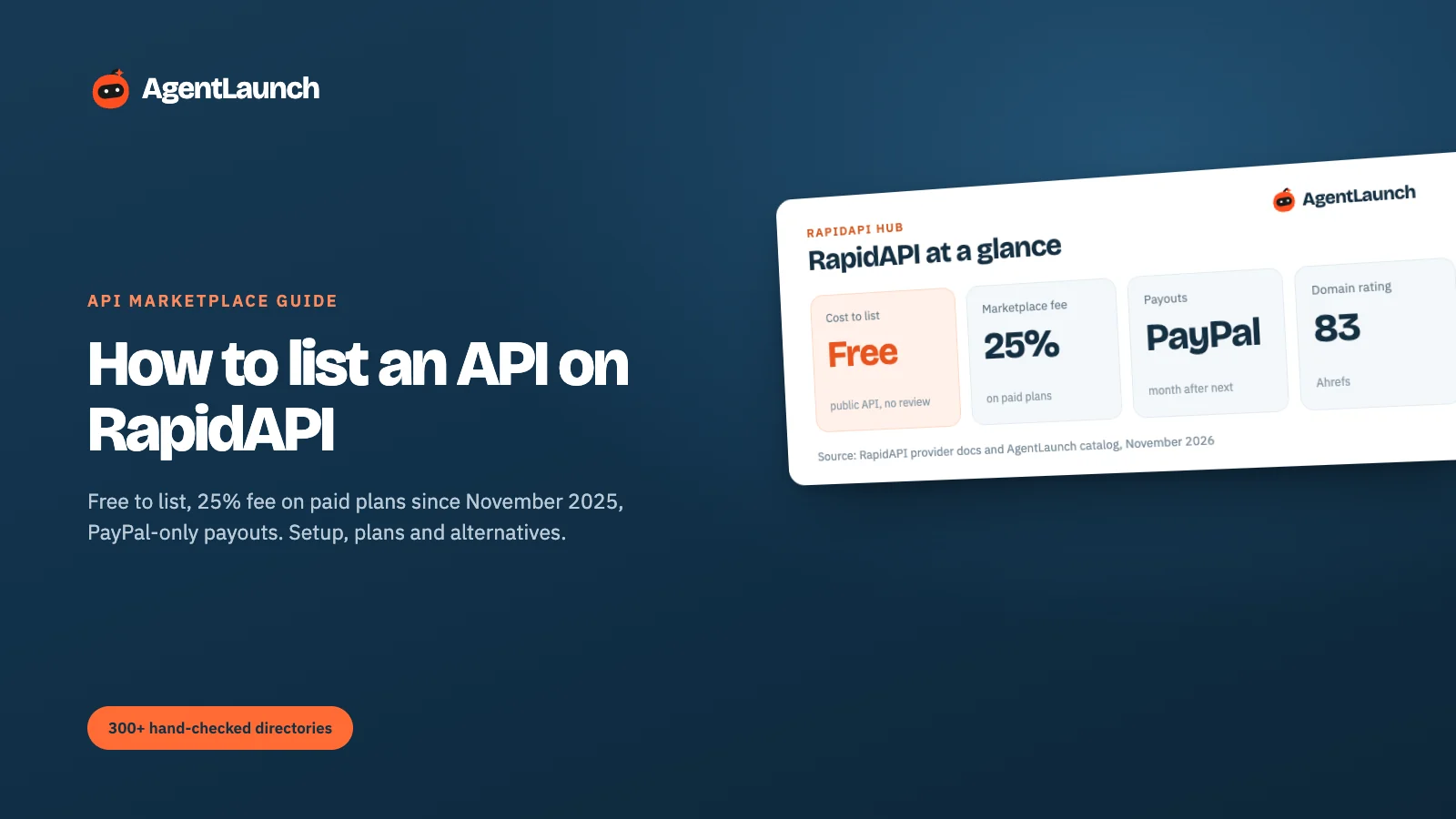
Listing an API on RapidAPI Hub is free. You create an API project in Studio (rapidapi.com/studio), import an OpenAPI file, set a base URL and up to four public plans (BASIC, PRO, ULTRA, MEGA), then switch the API to public. Rapid keeps a flat 25% marketplace fee on every payment that goes through the hub (up from 20% before 15 November 2025) and pays providers only through PayPal, at the end of the month after the charge.
Rapid has been part of Nokia since November 2024, and the hub still takes new providers. Our catalog puts rapidapi.com at DR 83 with about 1.17 million visits a month. Checked on 20 November 2026.
RapidAPI Hub at a glance
| RapidAPI Hub (rapidapi.com) | |
|---|---|
| Cost to list | Free |
| Marketplace fee | 25% of every payment through the hub, since 15 Nov 2025 (was 20%) |
| PayPal fees | Extra. The 25% doesn't cover them |
| Payout method | PayPal only |
| Payout timing | A month's charges are paid at the end of the following month (January sales arrive in the first week of March) |
| Payout minimum | Not published |
| Review | No editorial queue for an API you own personally. You flip it to public. A team-owned API needs an org admin to approve |
| Public plans | Up to 4: BASIC, PRO, ULTRA, MEGA, plus private plans |
| Listing link | Nofollow in our September 2026 catalog check. On 20 Nov the "Product Website" link rendered without rel, but only after JavaScript (details below) |
| Domain Rating / traffic | DR 83, ~1,165,000 visits a month (AgentLaunch catalog) |
| What you need | A running HTTPS API, an OpenAPI or Postman file (optional but saves time), a PayPal account for paid plans |
| Time to list | No approval wait for a personal API. Setup takes as long as your spec, plans and auth |
What RapidAPI Hub is in November 2026
RapidAPI started as a marketplace where developers find, test and subscribe to APIs with one account and one key. The company renamed itself Rapid, and on 13 November 2024 Nokia acquired Rapid's technology assets and its R&D unit. Nokia called it "the world's largest API hub" and is pairing it with its Network as Code platform. Terms weren't disclosed. TechCrunch reported Rapid was once valued at $1 billion and had cut headcount by 82% in layoffs after CEO changes in 2023.
The hub still runs at rapidapi.com. The logo reads "Rapid, Now part of Nokia" and the homepage opens with a Nokia Network as Code banner. Below it is the same third-party marketplace: categories, collections and tiles for independent providers' APIs, many of them data and scraping APIs.
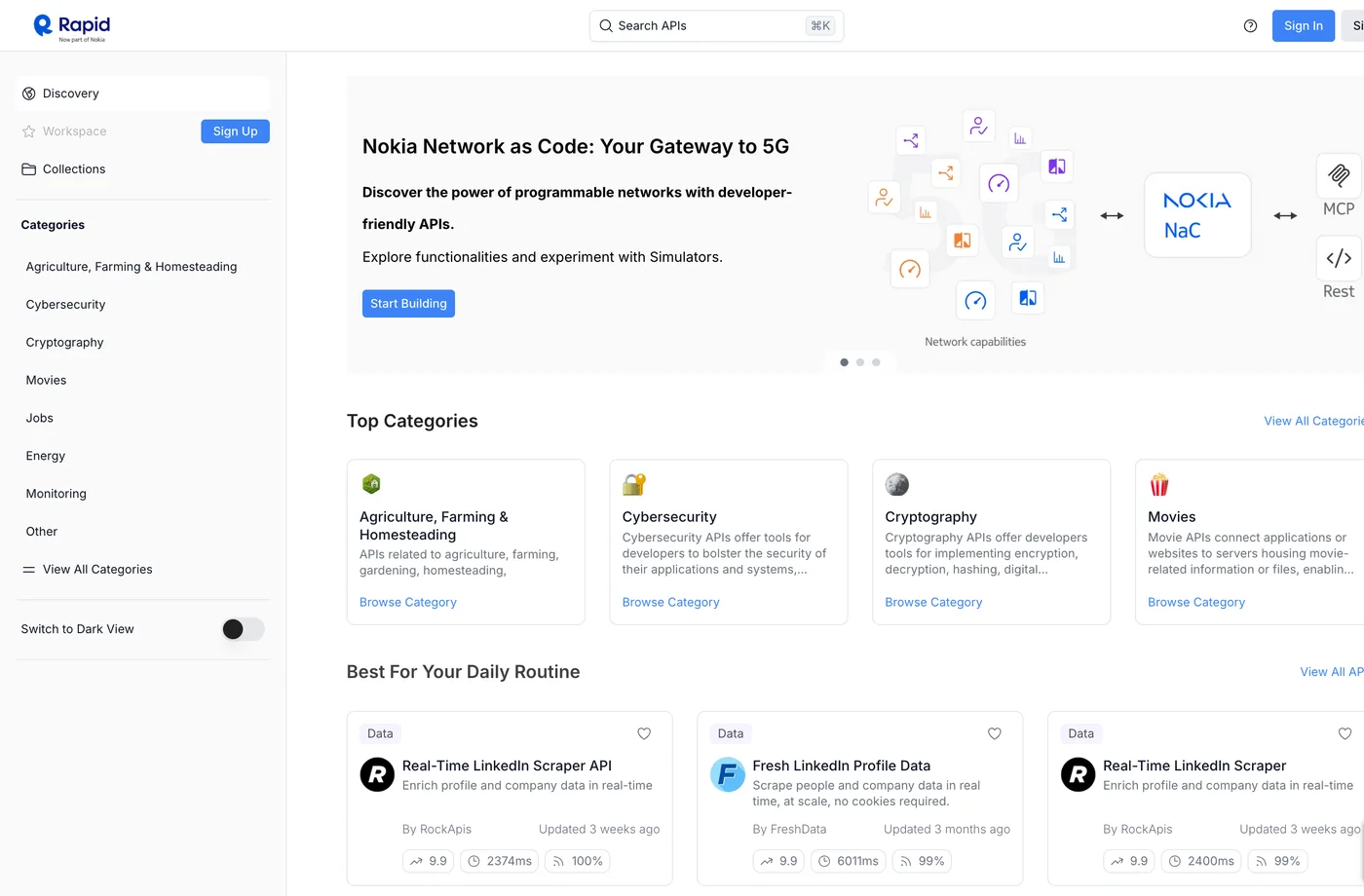
Two additions show on the homepage: MCP for APIs, rolled out across the hub so listed APIs can be used over MCP without building an app, and an AI chat in the Playground that is rolling out gradually.
New provider sign-ups are open. The signed-out sign-up page offers GitHub, Google or email and password, and the docs say "it is also free and easy to add your API to the hub."
How to list an API on RapidAPI, step by step
Everything happens in Studio, Rapid's provider workspace (the "My APIs" link in the hub header). The field names below are Rapid's.
Step 1: create an API project
In Studio, pick Personal in the top-right dropdown and click Add API Project. The dialog asks for:
- Name and Description
- Category: one only. Rapid's admins define the list (Data, Jobs, Cybersecurity, Movies and so on)
- Team: Personal or a team you belong to
- Import data from: an OpenAPI file (JSON, YAML), a Postman Collection (JSON), a GraphQL schema, or a Kafka config
Import a file if you have one. Rapid builds your endpoints from it.
Step 2: fill in the General tab
Open Hub Listing > General. This is what consumers see:
- Logo: JPEG or PNG, up to 500 x 500 px. Without one, Rapid assigns a random image
- Short description: shown on the API tile and in search results, truncated if long
- Long description: Markdown, shown under the short description
- Website: the "Product Website" link under Resources
- Terms of use: a link or text in a popup
- Base URL: where Rapid forwards requests. Several URLs can be load balanced (Round Robin or Geolocation)
- Health check URL: one endpoint Rapid tests daily, with the result shown on your listing
Step 3: endpoints and authentication
Under Hub Listing > Definitions, check the imported endpoints and group them.
Every API on rapidapi.com runs through the Rapid Runtime, Rapid's proxy. Consumers send X-RapidAPI-Key and X-RapidAPI-Host, which Rapid uses for billing and rate limits. If your API has its own auth too, add a security scheme (OAuth 2.0, API Key or HTTP) on the Security tab so the browser tester and code samples work.
Step 4: block traffic that skips Rapid
This step gets missed. Your base URL is a public server, so anyone who finds it can call it for free. The Rapid Runtime adds an X-RapidAPI-Proxy-Secret header to every request, with a value unique to your API. Copy it from Hub Listing > Gateway > Firewall Settings and reject any request where it is missing or wrong.
Rapid also passes X-RapidAPI-User and X-RapidAPI-Subscription (BASIC, PRO, ULTRA, MEGA or CUSTOM), so you know who is calling on which plan. For an IP allowlist, the Gateway tab lists the Runtime's IPs, and you must allow all of them.
Step 5: set up plans
Open Hub Listing > Monetize. A free BASIC plan exists by default. You can add PRO, ULTRA and MEGA as public plans and any number of private plans for custom deals. The next section covers the rules.
Step 6: make it public
New APIs start private. In the General tab's Visibility section, tick the Terms of Service box and slide the toggle to public. For a personally owned API that's it. For a team-owned API, an organization admin has to approve it first. Before you flip it, add your PayPal account under Personal Payouts (avatar menu), or Rapid has nowhere to send your money.
Pricing plans, quotas and overages
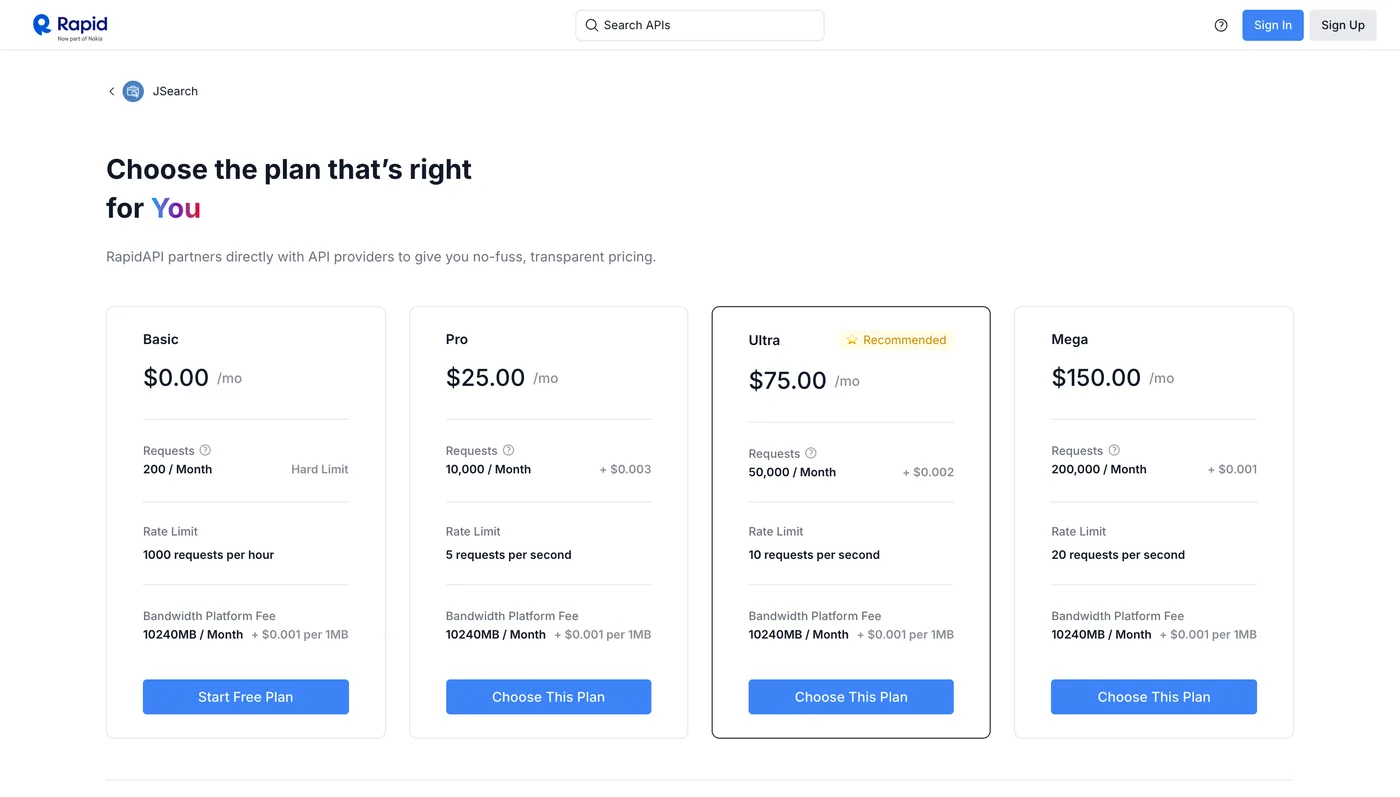
Rapid sorts APIs into Free (no card), Pay Per Use (card, no monthly fee), Freemium (paid plans plus a free tier, card required even for free) and Paid. A plan can be a monthly subscription, pay per use, or Tiers (volume pricing).
| Plan setting | What Rapid allows |
|---|---|
| Public plans | Up to 4 per API: BASIC, PRO, ULTRA, MEGA |
| Private plans | As many as you want, by invitation |
| Quota | A "Requests" object per plan, per month or per day (required on every plan) |
| Rate limit | Optional, per second, minute or hour. Over it, callers get 429 Too Many Requests |
| Overage | A per-call price past the quota, or a hard limit that blocks calls |
| Require approval | Optional question callers answer before you let them in |
| Minimum price | Above 500,000 requests a month, at least $0.00003 per call |
| Rapid's suggested ladder | BASIC free, PRO $25, ULTRA $75, MEGA $150 |
The free BASIC plan
Keep it. Rapid's docs call a small free plan "vital" because developers test in the browser before they pay. Free plans are capped at 1,000 requests an hour, and Rapid emails subscribers at 85% and 100% of quota.
Rate limits vs quotas
A quota is the monthly or daily allowance. A rate limit caps bursts (JSearch's PRO plan allows 5 requests per second). Set both, plan by plan.
Overages and the minimum price rule
Rapid suggests keeping overage under $1 a call unless your cost per call is higher. If a plan allows more than 500,000 requests a month, every call above 500,000 has to be priced at $0.00003 or more. Rapid's example: a 2-million-request plan must cost at least $45 a month (1.5 million x $0.00003). Every plan on the listing also shows a "Bandwidth Platform Fee" of 10,240 MB a month plus $0.001 per MB.
The 25% fee and how payouts work
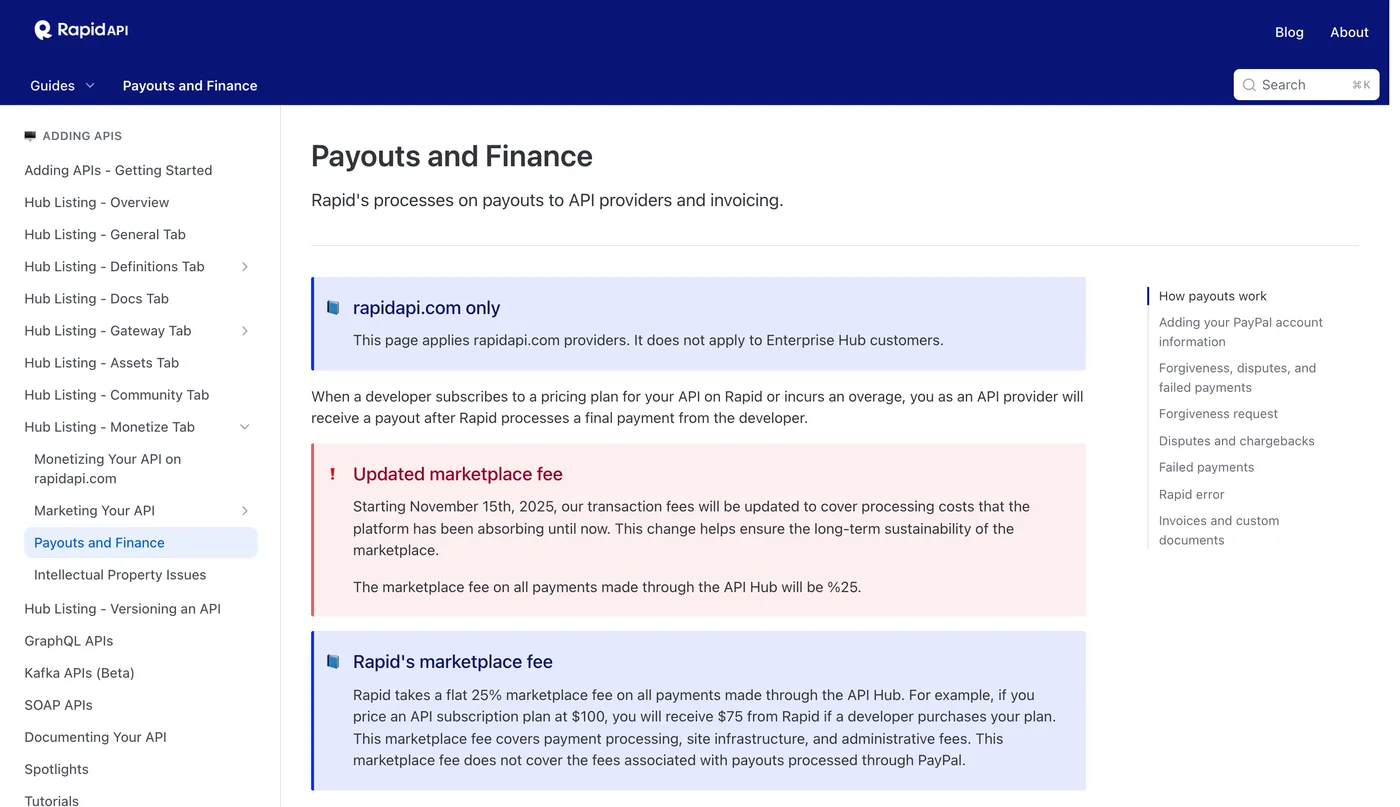
Rapid says the fee rose on 15 November 2025 "to cover processing costs that the platform has been absorbing until now." It covers card processing, infrastructure and admin. PayPal's payout fee comes on top.
| Plan price a developer pays | Rapid keeps (25%) | You receive before PayPal fees |
|---|---|---|
| $25 (PRO) | $6.25 | $18.75 |
| $75 (ULTRA) | $18.75 | $56.25 |
| $100 | $25.00 | $75.00 |
| $150 (MEGA) | $37.50 | $112.50 |
PayPal only
Rapid writes that it "currently only pays out API providers via PayPal" and can't use any other method. If no valid PayPal address is on file, Rapid says it will email you at least three times. W-9 forms are available from support.
When the money arrives
A developer's card is charged when they first subscribe, at each monthly renewal, and when they run up an overage. All of a month's charges are paid out at the end of the following month, once the card payment has fully settled. Rapid's own example: subscriptions on 1, 5 and 20 January land in your PayPal in the first week of March. Plan for a gap of roughly five to nine weeks.
Refunds, chargebacks and forgiveness
Refunds and chargebacks are deducted from your next payout. Rapid won't waive a developer's accidental overage without your permission.
How developers find your API on the hub
Search, categories and collections
Developers search from the top bar, browse categories, or open the collections Rapid curates on the homepage. Your category, name and short description are what they match against.
Popularity, latency and service level
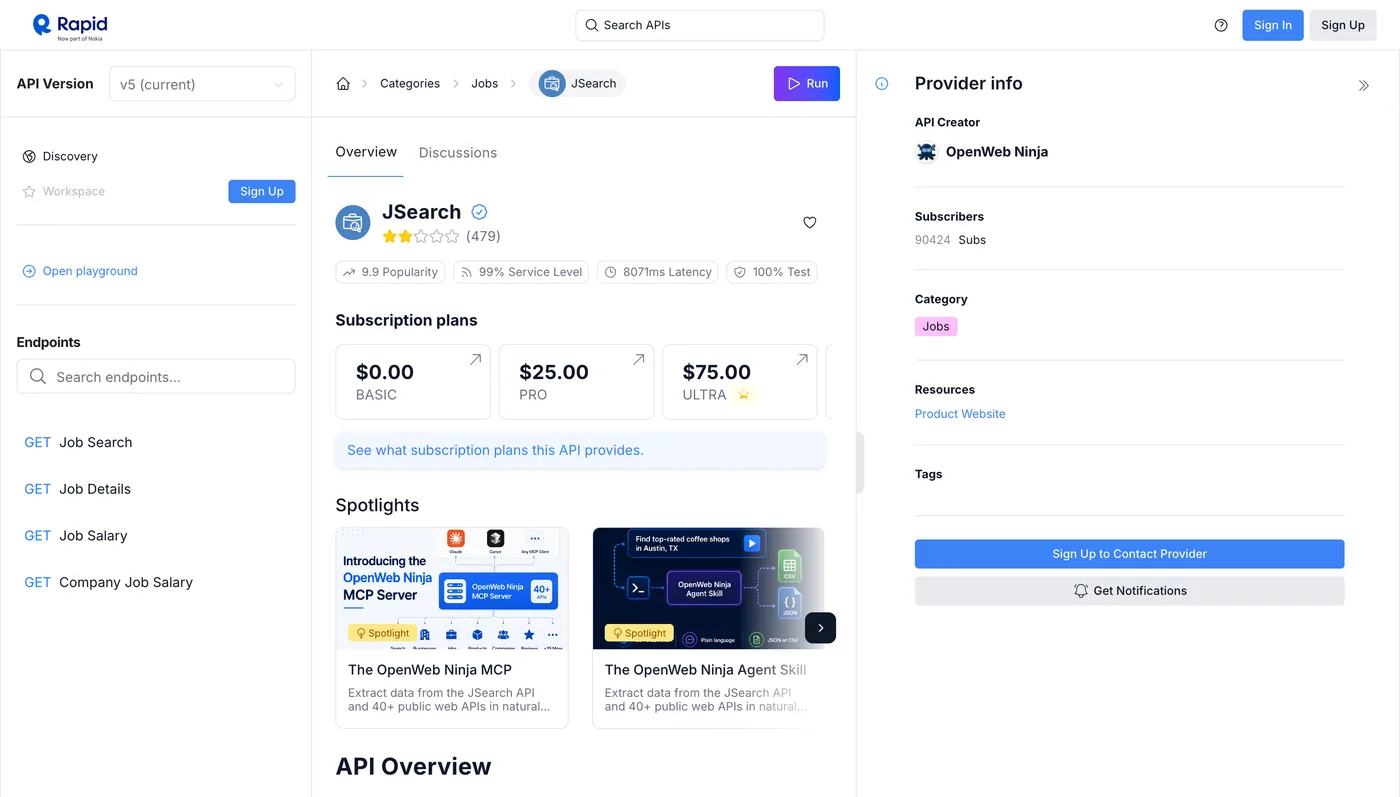
Every tile and listing shows three metrics, defined in Rapid's FAQ:
- Popularity: 1 to 10, based on the number of requests and the number of users
- Average latency: milliseconds, over the last 30 days
- Service level: share of successful calls over 30 days, 2xx responses compared with 5xx
The homepage tiles on 20 November all showed popularity 9.8 or 9.9 and service levels of 97 to 100%. A new API starts with no usage, and popularity grows from calls, another reason to keep a free plan.
Health check badge
The daily health check from the General tab shows its status on your listing. It's free (two tests per API on the free tier) and a visible trust signal for an unknown provider.
Is the RapidAPI backlink worth anything?
For SEO, not much. The AgentLaunch catalog recorded RapidAPI's listing link as nofollow in September 2026. On 20 November we checked four public listings: the "Product Website" link rendered with no rel on the three that had one, but it isn't in the server HTML. It only appears after JavaScript runs, so crawlers that don't render won't see it. Count it as a weak link at best.
What you get is a crawlable listing on a DR 83 site (robots.txt blocks Studio and the dashboards, not listings) and developers ready to make a test call. Measure it by signups and paid plans, not by Domain Rating. For links that do pass value, see our list of dofollow directories for startups and how to check a directory backlink's quality.
Pros and cons
Pros
- Free to list, no editorial review for personal APIs
- Billing, keys, quotas and rate limits handled for you, plus an in-browser tester
- Big existing audience: about 1.17 million visits a month in our catalog, around 15x the median developer-tool directory
- MCP access to listed APIs is now built into the hub
Cons
- 25% of revenue, among the highest fees of the marketplaces we checked, plus PayPal fees
- PayPal is the only payout method, and payouts arrive the month after next
- Rapid's proxy sits between you and your users
- Listing link was nofollow in our catalog check and only renders with JavaScript
- The hub's future sits with Nokia, whose focus is network APIs
Common mistakes
- Leaving the base URL open. Without a proxy secret check, people call your server directly and skip billing.
- No free plan. Developers can't test, popularity stays low, and the listing never climbs.
- Using old fee math. The payouts doc's January example still works out to 80% ($24 from $30). At 25% it's $22.50. Price your plans on 75%.
- No PayPal on file. Rapid has no other way to pay you.
- Vague category and short description. That's what search matches. Use the phrase developers type.
- Editing endpoints by hand. Re-upload your OpenAPI file instead so the listing doesn't drift from the API.
RapidAPI vs other API marketplaces
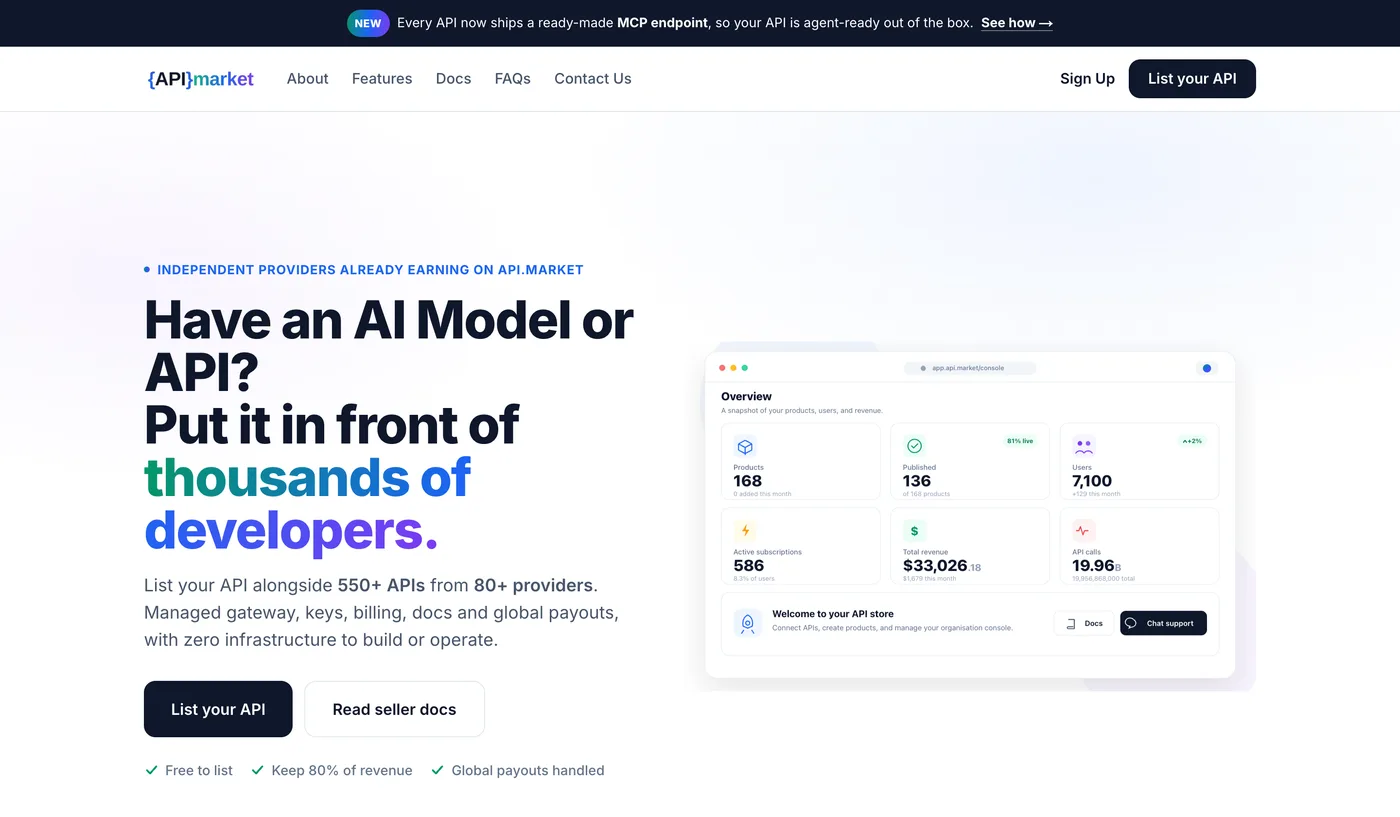
All of these were live and accepting providers on 20 November 2026. Fees are quoted from each platform's own pages. RapidAPI is the only one in the AgentLaunch catalog, so it's the only one with our DR and traffic numbers.
| Marketplace | Cost to list | Fee on sales | Payouts | Review | Best for |
|---|---|---|---|---|---|
| RapidAPI Hub | Free | 25% | PayPal only, month after next | None for personal APIs | Largest audience, any API |
| Zyla API Hub | Free | 20% (you keep 80%) | Not published | Reviewed; 99.8% uptime minimum | Data APIs that can meet the uptime bar |
| API.market | Free | Up to 20%, renegotiable past $2,500 MRR | "Handled in any country and currency" | Seller verification | AI model and API sellers (550+ APIs, 80+ providers, their figures) |
| Apify Store | No charge unless the Actor earns | 20% plus platform usage costs | PayPal or Wise ($20 minimum), other methods $100 minimum, paid days 21 to 25 | Not checked | Scrapers and automations as Actors |
| APILayer Marketplace | Not published | Not published on provider pages | Monthly, bank transfer or invoice | Applications reviewed | Established, documented APIs |
| AWS Marketplace | Fees come out of sales | 3% for SaaS public offers | Not checked | Seller registration | APIs sold to enterprises on AWS bills |
| Postman API Network | Free on every plan | No selling | None | May need Community Manager approval | Discovery and docs only |
RapidAPI has the biggest audience and the highest fee. Scrapers fit Apify better. APIs sold to companies with AWS budgets cost 3% on AWS Marketplace.
Verdict
List on RapidAPI if you have a working API, want paying developers without building billing, and can live with 25% plus PayPal fees and a five-to-nine-week payout gap. Keep a free BASIC plan, check the proxy secret on day one, and price PRO, ULTRA and MEGA on what you keep, not on the sticker price.
Skip it if your margins can't absorb a quarter of revenue, you need bank payouts, or you only want a backlink. Use RapidAPI for buyers, then announce the API where developers look for new tools: Hacker News, Product Hunt (Rapid's own docs suggest both) and the developer tool directories in our catalog. If your API also ships as an MCP server, the same goes for registries like mcp.so. That submission work is what AgentLaunch automates: you run its AI agent from Claude Code, Codex or Cursor, and it submits your API or product to developer-tool directories and launch platforms.
FAQ
Is it free to list an API on RapidAPI?
Yes. Listing is free, and free APIs cost nothing. On paid plans Rapid keeps 25% of each payment, and PayPal's payout fee comes out on top.
What is RapidAPI's commission in 2026?
A flat 25% marketplace fee on all payments through the hub, effective 15 November 2025. Before that it was 20%.
How does RapidAPI pay API providers?
Through PayPal only. A month's charges are paid at the end of the following month, after the card payments settle.
Who owns RapidAPI now?
Nokia. It acquired Rapid's technology assets and R&D unit on 13 November 2024. The hub at rapidapi.com still runs and carries "Now part of Nokia" in its logo.
Can I still sign up as a RapidAPI provider?
Yes. Sign-up was open on 20 November 2026 with GitHub, Google or email, and you build your listing in Studio at rapidapi.com/studio.
Is the RapidAPI backlink dofollow?
Don't count on it. Our September 2026 catalog check recorded it as nofollow. In November the Product Website link rendered without rel, but only through JavaScript.